By the Drivers Compass editors · Updated October 31, 2026
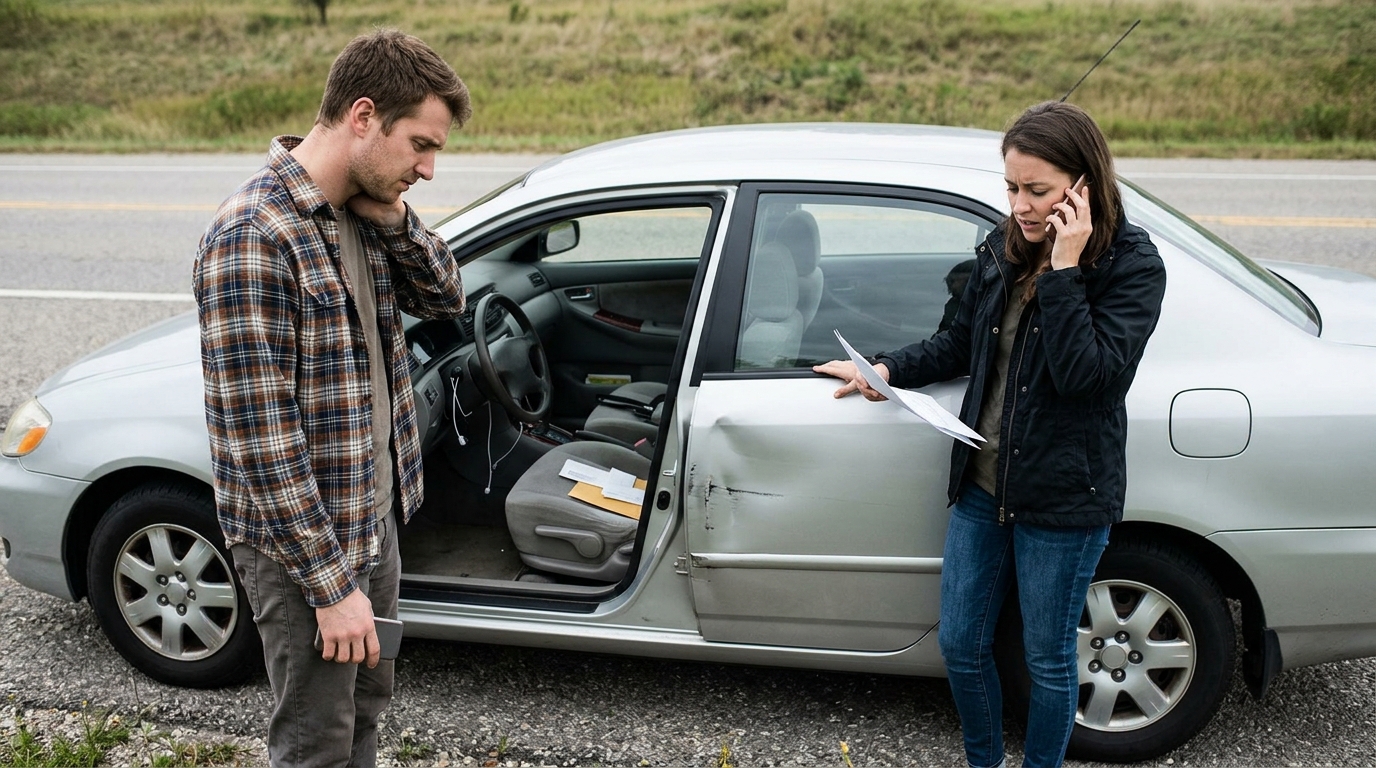
Uninsured motorist (UM) coverage reimburses you, a family member, or a designated driver when an uninsured or hit-and-run driver causes the crash; underinsured motorist (UIM) coverage applies when the at-fault driver has liability insurance but not enough of it to pay your total loss (Insurance Information Institute, undated). The money is measured by what you would have been legally entitled to collect from the at-fault driver, up to the limit you bought.
Whether you have to carry it, whether it covers your car as well as your body, and whether limits from several vehicles can be added together all depend on your state's statute and your insurer's filed policy form.
What Uninsured/Underinsured Motorist Coverage Actually Pays For
Two coverages sit under one label.
UM/UIM bodily injury (UMBI/UIMBI) has no actual cash value basis, because no property is being valued. The trigger in standard policy language is that you are "legally entitled to recover" damages from the owner or operator of the uninsured vehicle: the adjuster evaluates your claim the way a liability adjuster would evaluate it against the other driver, then pays up to your limit. UM applies when the at-fault driver has no liability insurance at all or is a hit-and-run driver; UIM applies when that driver has insurance but the limits are too low to cover your full damages (Insurance Research Council, 2023).
Uninsured motorist property damage (UMPD) is the actual cash value coverage. It pays the ACV of the damage to your vehicle, less any deductible the statute or filed form applies, capped at the UMPD limit.
A constructed illustration, not filed loss data: you are in Virginia, an at-fault (tort) state where the other driver's negligence decides who pays. Your uninsured motorist endorsement carries the Virginia statutory minimum of at least $20,000 for damage to the insured's property in any one accident (Code of Virginia, undated). A driver sideswipes you and leaves, and nobody identifies the car. The form excludes the first $200 of the loss where the owner or operator is unidentifiable (Code of Virginia, undated), so a loss at or above the limit pays $20,000 minus $200.
Limits from more than one vehicle are sometimes added together. In a three-car family with $20,000 uninsured motorist liability limits, in a state that does not prohibit stacking, $60,000 would be available for one accident with an uninsured driver (Insurance Information Institute, undated). States that bar stacking cap you at the single $20,000 limit for that crash.
In 2022, 14.0 percent of motorists — about one in seven — were uninsured, and 15.7 percent countrywide had insufficient coverage (Insurance Research Council, 2023).
What It Doesn't Cover
- Damage to your own vehicle where only bodily injury UM was bought. In Colorado, UM/UIM pays the insured's bodily injury losses and does not cover damage to the insured's vehicle (Colorado General Assembly, Office of Legislative Legal Services, undated); that damage runs through collision instead.
- Any liability you owe to the other driver. Colorado's legislative staff state it plainly: the coverage does not protect the other driver (Colorado General Assembly, undated). Your liability limits handle that.
- The first $200 of a hit-and-run loss in Virginia when the owner or operator of the uninsured vehicle cannot be identified (Code of Virginia, undated).
- Crashes where the at-fault driver's liability limits pay your damages in full. UIM is triggered only when that driver's insurance is insufficient to pay the total loss (Insurance Information Institute, undated).
- Mechanical breakdown, rust, wear, or component failure unrelated to a collision with an uninsured vehicle — a failed transmission or dead battery is not a UM loss.
- Racing, speed contests, and competitive driving events, excluded across standard auto coverage parts.
- Vehicles you or a household member own that are not listed on the policy, blocked by the owned-but-not-insured exclusion.
- Hit-and-run claims with no physical contact and no corroboration, where the statute or filed form requires contact with the phantom vehicle.
Typical Limits and Deductibles
Every premium effect below is an illustrative estimate, not a filed rate. Cost turns on your state, limits, deductible, age and driving record, vehicle year/make/model, credit-based insurance score where the state permits its use, ZIP code or rating territory, insurer, and the underwriting company inside that insurer you are placed in. A quote estimate is not the premium you will be charged once the policy binds.
| Limit or deductible option | What it means in a claim | Approximate premium effect |
|---|---|---|
| No UM/UIM, where the state lets you reject it in writing | Nothing is payable from your own policy when an uninsured or hit-and-run driver injures you; twelve states require insurers to offer UMPD but let drivers reject it in writing (NerdWallet, undated) | Removes the UM/UIM line entirely; illustrative |
| UM/UIM set equal to your bodily injury liability limits | Colorado insurers must provide UM/UIM equal to the policyholder's current bodily injury liability coverage unless it is waived in writing (Colorado General Assembly, undated) | Scales with the liability limit you chose; illustrative |
| Stacked limits across three vehicles at $20,000 each | $60,000 available for one accident with an uninsured driver, in a state that does not prohibit stacking (Insurance Information Institute, undated) | Stacked forms cost more than non-stacked where the election is allowed; illustrative |
| UMPD at $15,000, Maryland | Maryland requires $15,000 of UMPD, applying to uninsured and underinsured drivers plus hit-and-runs even if the driver is not identified (NerdWallet, undated) | Built into the Maryland minimum package; illustrative |
| UMPD/UIMPD at $20,000 combined, Virginia | Required if you buy insurance in Virginia; a $200 deductible applies when a hit-and-run driver cannot be identified (NerdWallet, undated; Code of Virginia, undated) | Included in the mandatory uninsured motorist endorsement; illustrative |
Is It Required, and By Whom
State law. UM and/or UIM coverage is required in 22 states and Washington, D.C.; everywhere else it is optional (Insurance.com, undated). A legislative survey listed the 22 UM jurisdictions as Connecticut, the District of Columbia, Illinois, Kansas, Maine, Maryland, Massachusetts, Minnesota, Missouri, Nebraska, New Hampshire, New Jersey, New York, North Carolina, North Dakota, Oregon, South Carolina, South Dakota, Vermont, Virginia, West Virginia and Wisconsin, and the 14 UIM states as Connecticut, Maine, Maryland, Massachusetts, Minnesota, Nebraska, New Jersey, North Carolina, North Dakota, Oregon, South Dakota, Vermont, Virginia and Wisconsin (Connecticut General Assembly, Office of Legislative Research, 2013). The Insurance Information Institute puts the UM mandate at about 20 jurisdictions and says only a handful of states require drivers to purchase underinsured motorist coverage (Insurance Information Institute, undated). Counts differ because statutes change; confirm the current rule with your own state's insurance department before dropping anything.
Property damage is mandated in fewer places. Maryland requires $15,000 of UMPD (NerdWallet, undated). Virginia does not require drivers to buy car insurance at all, but if they do, $20,000 of combined UMPD and UIMPD is required (NerdWallet, undated). Twelve other states require insurers to offer UMPD while letting drivers reject it in writing (NerdWallet, undated).
An offer is not a mandate. Colorado leaves UM/UIM optional for the driver, but every insurer must provide it at an amount equal to the policyholder's bodily injury liability limits unless the policyholder waives it in writing (Colorado General Assembly, undated). If you never signed a waiver, check your declarations page.
Lenders and lienholders. Auto loan and lease agreements require physical damage coverage — comprehensive and collision — because that protects the collateral. They do not normally require UM/UIM bodily injury, which pays you rather than the lender. Read which coverage a lender's letter actually names; force-placed insurance typically protects only the lender's interest in the car.
Questions
Does UM/UIM pay for a rental car while my car is repaired?
UM/UIM bodily injury does not — it pays damages for injury, not transportation costs. Where a state sells uninsured motorist property damage, some filed UMPD forms include loss of use and some do not, so read the endorsement wording rather than assuming. Rental reimbursement is a separate coverage bought by the day.
Am I covered as a passenger or a pedestrian?
Uninsured motorist coverage reimburses the policyholder, a member of the family, or a designated driver if one of them is hit by an uninsured or hit-and-run driver (Insurance Information Institute, undated). Standard forms define "insured" broadly enough to reach family members injured on foot or riding in someone else's car, but your form's own definition controls, and household members with their own policies can trigger priority-of-coverage disputes.
How is my UIM payment calculated against the at-fault driver's limits?
It depends on whether your state uses an offset or an add-on approach. In a difference-in-limits state, whatever the at-fault insurer pays is subtracted from your UIM limit and your policy pays the remainder. In an excess or add-on state, your full UIM limit sits on top of the liability payment. UIM is triggered only where the at-fault driver's insurance is insufficient to pay the total loss (Insurance Information Institute, undated), and each claim is adjudicated on its own facts.
Does UM/UIM cover damage to my car?
Only where the state or the form includes property damage. In Colorado, UM/UIM pays bodily injury losses and does not cover damage to the insured's vehicle (Colorado General Assembly, Office of Legislative Legal Services, undated). In Maryland, $15,000 of UMPD is required and applies to hit-and-runs even if the driver is never identified (NerdWallet, undated). Check your declarations page for a separate UMPD line.