By the Drivers Compass editors · Updated October 31, 2026
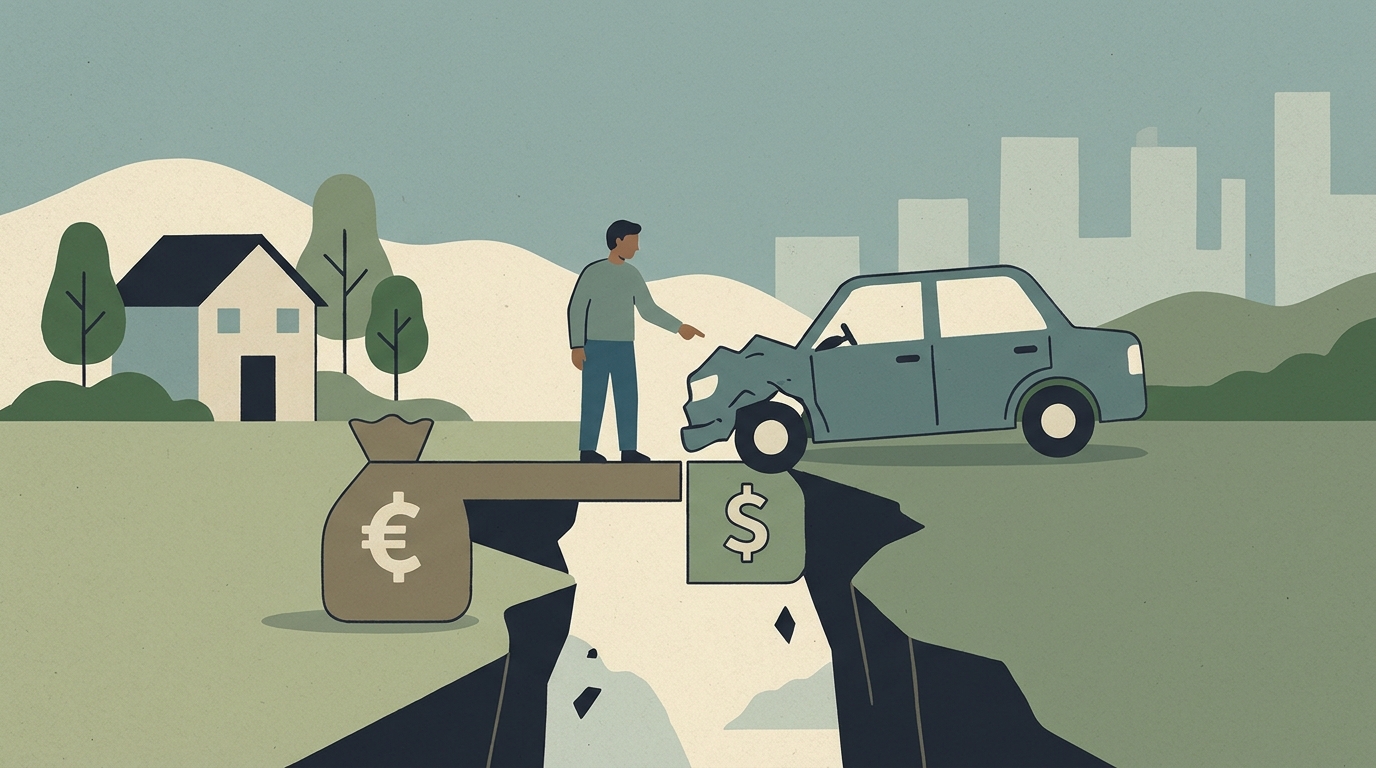
Gap insurance covers the difference between what you still owe on your vehicle or motorhome and what it's worth (Washington State Office of the Insurance Commissioner, undated). It exists because physical damage coverage settles a total loss at actual cash value, which accounts for depreciation (New York State Department of Financial Services, Office of General Counsel, 2008), not at your loan or lease balance.
No state financial responsibility law makes you buy it. A lender or lessor can require it by contract, and what a dealership sells under the name "gap insurance" is frequently a debt waiver agreement instead (Washington State Office of the Insurance Commissioner, undated).
What Gap Insurance Actually Pays For
Gap insurance covers the difference between what you owe on your vehicle or motorhome and what it is worth (Washington State Office of the Insurance Commissioner, undated). That difference exists because of the payout basis underneath it: most motor vehicle physical damage policies pay actual cash value (ACV) only, which takes depreciation into account (New York State Department of Financial Services, Office of General Counsel, 2008). If your insurer declares the vehicle a total loss, collision coverage pays that actual cash value and does not pay money you still owe on the loan (Washington State Office of the Insurance Commissioner, undated).
Here is the arithmetic, using the illustration published by the Washington State Office of the Insurance Commissioner (undated) for a vehicle in Washington. It is a regulator's constructed example, not filed loss data. Fault does not change the math, because the settlement comes from your own first-party collision coverage rather than another driver's liability coverage — your state's no-fault or at-fault rules govern injury claims, not the ACV figure on your car.
- Loan balance on a new vehicle: $30,000.
- Actual cash value at the time of the accident: $25,000.
- Without gap coverage: you receive $25,000 minus your deductible, and you still owe $5,000 on the loan.
- With gap coverage: you receive $25,000 plus $5,000, and you owe $0 on the loan.
Separately, lessors and creditors sell "gap waivers," under which the lessor or creditor agrees not to hold you liable for the remaining amount (New York State Department of Financial Services, Office of General Counsel, 2008). That is a contractual waiver of debt, not an insurance payout.
What It Doesn't Cover
- Interest the lender charges you. Finance charges accrued on the balance are excluded (Washington State Office of the Insurance Commissioner, undated).
- Late fees and missed loan payments. Neither is covered (Washington State Office of the Insurance Commissioner, undated). If you were behind when the car was totaled, the arrears stay with you.
- Extended warranties you added to the auto loan. Service contract amounts rolled into the financing are excluded (Washington State Office of the Insurance Commissioner, undated).
- Your collision or comprehensive deductible. In the Washington regulator's illustration, the $25,000 actual cash value is paid minus the deductible and gap pays only the $5,000 shortfall (Washington State Office of the Insurance Commissioner, undated). Some filed gap forms add deductible reimbursement up to a stated amount; whether yours does depends on that insurer's filed language.
- A loss that is not a total loss. Gap responds when the insurance company decides the vehicle or motorhome is totaled (Washington State Office of the Insurance Commissioner, undated). Repairable collision damage, hail dents fixed under comprehensive, and mechanical breakdown unrelated to a collision produce no ACV settlement for gap to sit on top of.
- A total loss with no underlying physical damage payout. If you carry liability only, or the collision or comprehensive claim is denied, there is no actual cash value settlement from which the gap amount is calculated.
Typical Limits and Deductibles
Gap does not have liability-style limits. What varies is the product you buy, whether it can be canceled, and the deductible on the underlying coverage that generates the ACV figure.
| Limit/deductible option | What it means in a claim | Approximate premium effect |
|---|---|---|
| Gap insurance added to your auto policy | Pays the difference between the actual cash value settlement and what you owe on the vehicle or motorhome (Washington State Office of the Insurance Commissioner, undated) | Usually raises the premium only slightly, and can be canceled if you pay the loan off (Washington State Office of the Insurance Commissioner, undated) |
| Dealer or lender "gap insurance" that is actually a debt waiver agreement | The creditor agrees not to hold you liable for the remaining amount owed after the physical damage payout (New York State Department of Financial Services, Office of General Counsel, 2008) | Often overpriced, and cannot be canceled or returned if the loan is paid off quickly (Washington State Office of the Insurance Commissioner, undated) |
| The collision/comprehensive deductible you choose | Subtracted from the ACV settlement before the gap amount is paid; gap covers the loan-balance shortfall, not the deductible | Illustrative example: a higher deductible lowers the physical damage premium and leaves more out of pocket at total loss |
| Payout cap or percentage limit stated in the filed form | Some gap forms cap the payment at a stated percentage of actual cash value or a dollar maximum, leaving any excess balance with you | Not separately rated; check the declarations page and the filed form |
Premium effects vary by state, insurer and underwriting company, vehicle year and model, loan term, and territory. Any quote for gap is an estimate until the policy is bound.
Is It Required, and By Whom
State law. No state financial responsibility law requires a driver to carry gap insurance. It is not part of any state's minimum liability requirement and not part of any state's no-fault medical benefits. Where state law addresses gap, it regulates how it is sold rather than requiring it. New York is the clearest example: N.Y. Pers. Prop. Law § 302A(1) provides that no retail installment contract may be conditioned upon the buyer obtaining motor vehicle debtor gap insurance (New York State Department of Financial Services, Office of General Counsel, 2005). Section 302A(2) provides that if the contract holds the buyer responsible for the gap amount, a gap waiver must be offered — but only if motor vehicle creditor gap insurance is available to the holder from a New York authorized insurer. Section 302A(3) relieves the holder of that duty if it has obtained declination notices or other evidence of unavailability from every insurer authorized to write gap insurance in the state during the current calendar year or the preceding odd-numbered calendar year (same source).
Lenders and lienholders. Outside restrictions like New York's, a lender or lessor can make gap protection a condition of the loan or lease as a matter of contract. That is a credit requirement, not a motor vehicle law requirement, and the consequence of dropping it is a loan default remedy, not a license suspension.
Your own insurer. In Washington, your insurance company may never mention gap insurance or offer it, but must sell it to you if you ask (Washington State Office of the Insurance Commissioner, undated). Availability and filing rules differ by state and insurer, so ask your carrier directly and compare the price against the dealership's quote.
Questions
Does gap insurance pay my collision deductible?
Not in the standard arrangement. In the Washington State Office of the Insurance Commissioner's illustration (undated), the insurer pays the $25,000 actual cash value minus your deductible and gap pays the $5,000 loan shortfall, so the deductible stays out of pocket. Some filed gap forms add deductible reimbursement up to a stated amount; that applies only if your insurer's filed language says so, so check the form attached to your policy.
Is the gap product the dealership sells the same thing?
Often not. Dealerships and lenders may sell what they call gap insurance that is actually a debt waiver agreement rather than actual insurance, and those agreements are often overpriced and cannot be canceled or returned if the loan is paid off quickly (Washington State Office of the Insurance Commissioner, undated). Gap insurance bought from your auto insurer usually raises the premium only slightly and can be canceled if you pay off the loan (same source).
Can I cancel gap coverage once the loan is paid off?
Gap insurance added to an auto policy can be canceled if the loan is paid off (Washington State Office of the Insurance Commissioner, undated). A dealer or lender debt waiver agreement generally cannot be canceled or returned if the loan is paid off quickly (same source). Read the cancellation and refund terms in the agreement before you sign it rather than after.
My car was totaled and I don't have gap. What are my options with the lender?
Ask the lender about a "collateral exchange," in which the insurance payment goes toward the loan on the totaled car and the remaining amount owed is added to the loan on the replacement vehicle (Washington State Office of the Insurance Commissioner, undated). That moves the balance rather than erasing it, and whether the lender agrees is its decision. If a creditor sold you a gap waiver, check whether it agrees not to hold you liable for the remaining amount (New York State Department of Financial Services, Office of General Counsel, 2008).