By the Drivers Compass editors · Updated October 31, 2026
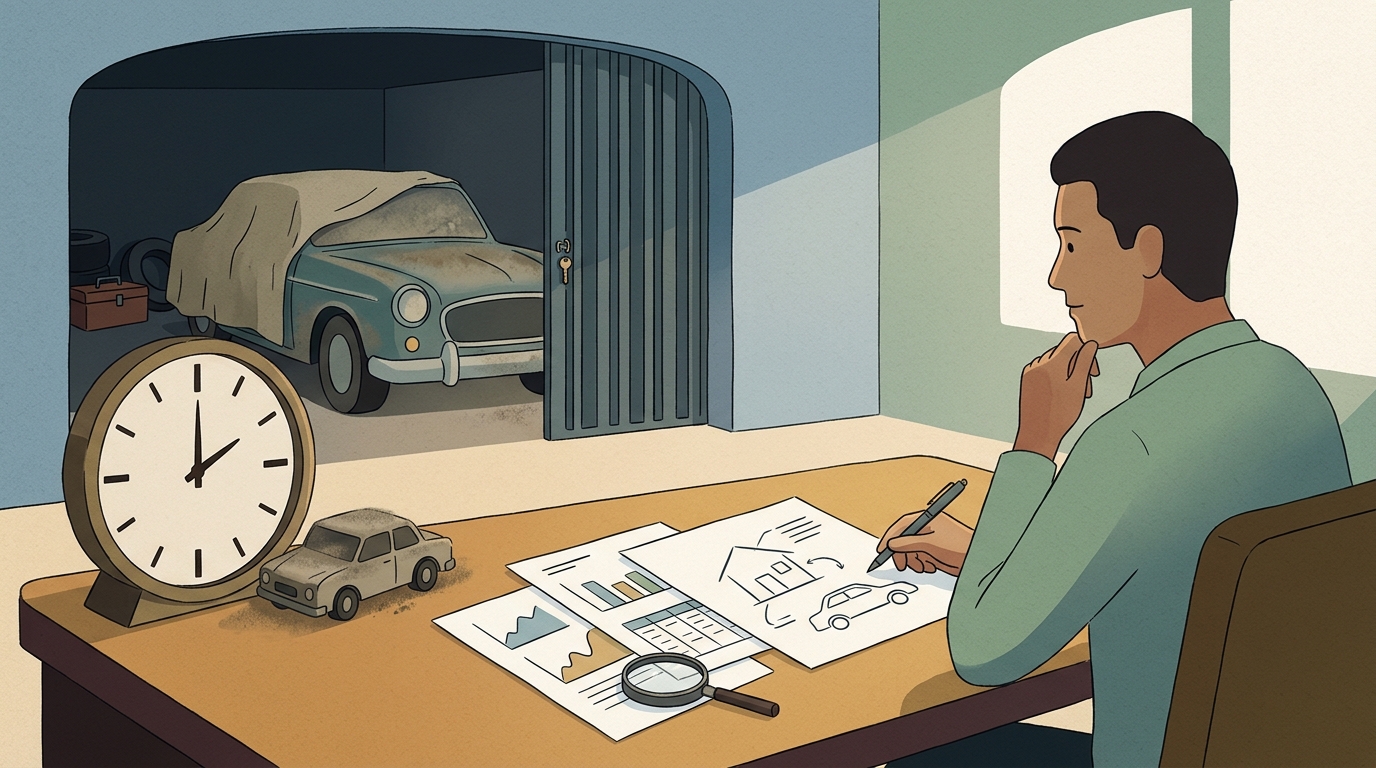
In most states the duty to insure a car attaches to its registration, not to whether you drive it. Park the car, keep the plates, cancel the policy, and the DMV can record an uninsured lapse — Florida, for example, requires continuous PIP and property damage liability on any currently registered vehicle even when it is inoperable, and the tag must be surrendered before the insurance is cancelled (Florida Department of Highway Safety and Motor Vehicles (FLHSMV), undated).
That leaves three paths: keep the policy as written, cut it back to comprehensive-only storage coverage, or surrender the plates and cancel. Which one is open to you depends on your state, any lienholder listed on your declarations page, and whether a court has you on an SR-22 filing.
What This Situation Means for Your Coverage
The trigger is the registration, not the odometer. North Carolina law (G.S. 20-309) requires continuous liability insurance on every vehicle with a valid North Carolina registration, written by a company licensed in that state; an out-of-state policy does not satisfy it (North Carolina Division of Motor Vehicles (NCDMV), undated). Florida applies the same logic to a car that cannot be driven at all: a currently registered vehicle must carry PIP and PDL whether or not it is operable, and the owner must surrender the tag before cancelling (Florida Department of Highway Safety and Motor Vehicles (FLHSMV), undated).
When coverage stops, the state usually finds out. New York treats any period in which a registered vehicle is uninsured as a lapse and can suspend both the registration and the driver license (New York State Department of Motor Vehicles, undated). If that registration suspension runs more than 90 days, you must surrender the registration and plates, and the license is suspended for the same number of days; reinstating it requires paying DMV a license suspension termination fee (New York State Department of Motor Vehicles, undated). In North Carolina, relicensing after a lapse revocation costs a civil penalty of $50, $100, or $150 depending on prior paid lapses within a three-year period, plus a restoration fee (North Carolina Division of Motor Vehicles (NCDMV), undated).
Some states build a storage path into the registration rules. Colorado requires a stored but operable vehicle to stay registered, yet allows a DR2303 Non-Use of Vehicle form to be filed directly with the county in place of insurance when the car is stored and not driven (Colorado Department of Revenue, Division of Motor Vehicles, undated). Under Colorado House Bill 22-1388, the owner of an inoperable vehicle undergoing maintenance, repair, restoration, rebuilding, or renovation pays an annual specific ownership tax and receives a decal as proof (Colorado Department of Revenue, Division of Motor Vehicles, undated).
Two obligations survive storage regardless of state. A lienholder named on your declarations page requires comprehensive and collision under your loan or lease contract, not under state law — read that insurance clause before you change anything. And if you hold an SR-22, a cancellation means the insurer notifies the state and the SR-22 clock restarts (Insurance Pro Agencies, undated).
Do You Need It? Quick Check
Check each against your paperwork, not your memory:
- Your registration card or DMV record shows the plate as active and not surrendered.
- Your state ties insurance to registration rather than offering a non-use filing — Florida and North Carolina require continuous coverage on a registered vehicle (Florida Department of Highway Safety and Motor Vehicles (FLHSMV), undated; North Carolina Division of Motor Vehicles (NCDMV), undated), while Colorado accepts a DR2303 Non-Use of Vehicle form filed with the county (Colorado Department of Revenue, Division of Motor Vehicles, undated).
- Your latest loan or lease statement shows a balance above zero, or a lienholder appears in the "Loss Payee" field of your declarations page.
- A court order, DMV letter, or your policy shows an active SR-22 filing.
- Your declarations page lists Comprehensive (Other Than Collision) with a deductible — if it does not, a stored-car theft or hail loss is not covered now either.
- The car will sit where theft, vandalism, or water damage is possible: a driveway, street, or shared garage (ValuePenguin, undated).
- Nobody will move the car on a public road during storage, street sweeping included — driving on comprehensive-only coverage is no different from driving uninsured (U.S. News & World Report, undated).
Your Next Steps
- Before you cancel anything, this week. Pull your declarations page and loan statement, then check your DMV's registration and non-use rules. If a lienholder is named, read the insurance clause — dropping collision on a financed car usually breaches it and lets the lender force-place coverage.
- Ask your insurer's service line whether it will write comprehensive-only. Not every carrier files it. Get the change confirmed in writing with an effective date, and keep the amended declarations page; reducing coverage instead of cancelling also preserves a continuous coverage history (Policygenius, undated; Yahoo Finance, undated).
- If you are dropping coverage entirely, surrender the plate first, cancel second. Delaware requires plates to go to the Division of Motor Vehicles before cancellation on an actively registered vehicle (Delaware Division of Motor Vehicles, undated), and Florida requires the tag be surrendered first (Florida Department of Highway Safety and Motor Vehicles (FLHSMV), undated). The Erie County Clerk's Office in New York publishes a plate-surrender procedure including drop-off, so motorists avoid a lapse, fine, or suspension (Erie County Clerk's Office (NY), undated). Keep the receipt.
- On an SR-22, call the insurer's SR-22 or filings department before changing the policy. A lapse means the state is notified and the clock restarts (Insurance Pro Agencies, undated); Illinois requires three continuous years, and a lapse restarts it in full while re-suspending the license (American Auto Insurance, undated).
- If a lapse notice arrives, answer inside the printed window — NCDMV's liability insurance termination notice allows 10 days now, 30 days effective October 1, 2026, before the plate can be revoked (North Carolina Division of Motor Vehicles (NCDMV), undated).
- Before you drive again, restore liability and confirm the effective date in writing, dated before the day you plan to move the car.
Coverage Options Compared
| Criterion | Keep the full policy | Comprehensive-only (storage insurance) | Cancel and surrender plates |
|---|---|---|---|
| Cost direction | Highest; you pay for liability and collision you cannot use | Lower, with liability and collision premium removed; described as an affordable option (U.S. News & World Report, undated) | No premium, but registration and plate costs return later |
| Legal standing while registered | Satisfies registration-based mandates such as Florida's PIP and PDL rule and North Carolina's G.S. 20-309 | Includes no liability coverage (U.S. News & World Report, undated), so it may not satisfy those mandates | Compliant only once the plate is actually surrendered (Delaware Division of Motor Vehicles, undated) |
| What it pays | Stored-car perils plus liability and collision if the car moves | Theft, vandalism, and water damage while stored (ValuePenguin, undated) | Nothing |
| Lienholder contract | Normally satisfies the loan's insurance clause | Satisfies it only if the contract does not require collision — check the agreement | Almost always a breach while a balance remains |
| Getting back on the road | Immediate | Add liability back before the car moves (U.S. News & World Report, undated) | Re-register and re-insure; in North Carolina after a lapse revocation, a $50, $100, or $150 civil penalty plus a restoration fee (North Carolina Division of Motor Vehicles (NCDMV), undated) |
Comprehensive-only keeps your coverage history unbroken (Yahoo Finance, undated). Where a state offers a non-use filing, that route can cost less than either insurance option — Colorado lets a DR2303 form filed with the county stand in for insurance on a stored vehicle (Colorado Department of Revenue, Division of Motor Vehicles, undated).
Questions
My car is in a locked garage and nobody has the keys. Can I just cancel?
Not while the registration is active, in states that tie the mandate to registration. Florida requires PIP and PDL on a currently registered vehicle even when it is inoperable, and requires the tag to be surrendered before cancellation (Florida Department of Highway Safety and Motor Vehicles (FLHSMV), undated). Delaware uses the same order: plates to the Division of Motor Vehicles first, or the registration and all owners' driver's licenses are suspended (Delaware Division of Motor Vehicles, undated). A locked garage is not an exemption; a surrendered plate or a state non-use filing is.
I need to move the stored car a block for street cleaning. Does comprehensive-only cover that?
No. Driving on car storage insurance is no different from driving uninsured, because comprehensive-only does not meet legal driving requirements and carries no liability coverage (U.S. News & World Report, undated). Add liability back with an effective date before you move the car.
I'm on an SR-22 and going overseas for a year. Can I pause it?
Treat pausing as restarting. If the policy lapses or is cancelled while an SR-22 is required, the insurer must notify the state and the clock starts over (Insurance Pro Agencies, undated). Illinois requires three continuous years, and any lapse restarts the full requirement while re-suspending the license (American Auto Insurance, undated). Raise it with the insurer's SR-22 department before you cancel.