By the Drivers Compass editors · Updated October 31, 2026
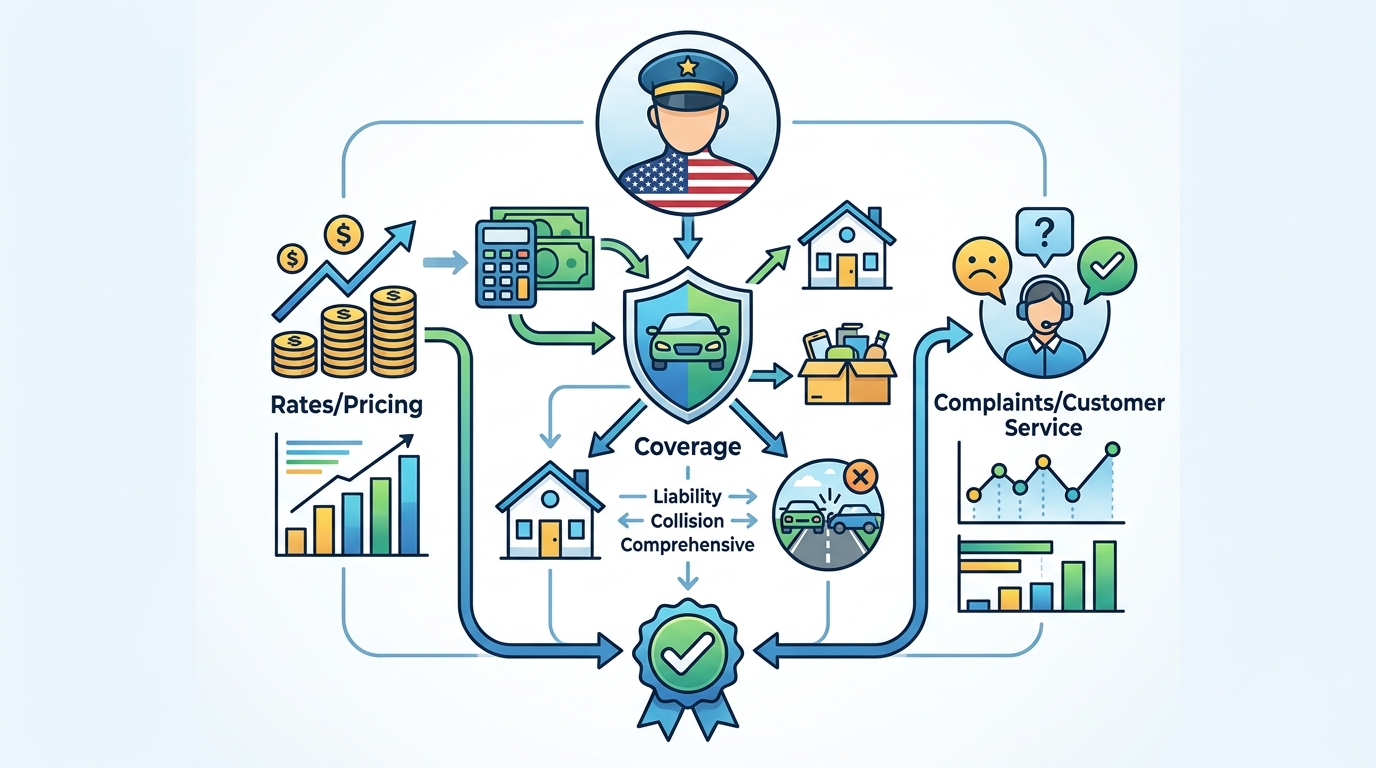
USAA sells auto insurance only to military members, veterans and certain family members, so it is not a company most drivers can simply switch to. For those who are eligible the picture splits in two: AM Best affirmed a Financial Strength Rating of A++ (Superior) and a Long-Term Issuer Credit Rating of 'aaa' (Exceptional) for United Services Automobile Association, its subsidiaries and USAA Capital Corporation (AM Best, 25 June 2026), while USAA scored lowest — tied with National General — in J.D. Power's 2026 U.S. Auto Claims Satisfaction Study (Insurance.com, 27 October 2026).
Its NAIC complaint index is 1.01, marginally above the 1.0 industry baseline (Insurify, 30 October 2026). What you personally pay depends on your state, limits, deductible, vehicle, record and territory, and on which USAA underwriting company writes the policy.
Rates by Driver Profile
USAA's published averages come from rate datasets, not from your file. Insurance.com publishes USAA average annual premiums for each profile below, with full-coverage figures drawn from Quadrant Information Services data; Insurify separately publishes a USAA average monthly full-coverage premium (Insurify, 30 October 2026). A composite is not a quote, and a quote is not the premium you are finally charged.
The benchmark matters as much as the number: Insurance.com sets USAA's full-coverage average against Nationwide's average rather than a single national figure, so any "X% below average" claim depends on which average is used.
| Driver profile | Coverage basis of USAA's published average | Published comparison |
|---|---|---|
| Clean record, full coverage | Comprehensive and collision plus liability | Benchmarked directly against Nationwide's average (Insurance.com) |
| Clean record, minimum limits | Each state's own statutory minimum | Separate USAA state-minimum average; compare only against other minimum-limit figures |
| Clean record, liability-only | 50/100/50 bodily injury and property damage | USAA average published at those specific limits (Insurance.com) |
| Teen driver | Full coverage, teen rated on the policy | Separate USAA teen average; teen surcharges are among the largest rating factors in every state |
| Senior driver | Full coverage | Separate USAA senior average; some states restrict age as a rating factor |
| One at-fault accident | At-fault property damage claim over $2,000 | USAA post-accident average published at that $2,000 damage threshold |
| Speeding violation | Full coverage, one speeding conviction | Separate USAA post-violation average |
| DUI on record | Full coverage, DUI conviction | Separate USAA post-DUI average; several states also require SR-22 or FR-44 filing |
Credit-based insurance score is a rating input for USAA in most states but is banned or restricted in California, Hawaii, Massachusetts and Michigan, so a poor-credit profile is not a rating category there at all. Whether your state is no-fault (personal injury protection pays your own medical costs first) or tort changes which coverages you are buying before any discount applies.
Coverage Options and Add-Ons
Endorsements are filed by form number, state by state. An add-on sold in Texas may not exist in New York, so check your declarations page and the filed form before assuming a scenario is covered.
- Rental reimbursement — a daily dollar limit multiplied by a maximum number of days per claim, both chosen at purchase and printed on the declarations page. The daily cap, not the total, controls what the rental counter can bill you.
- Roadside assistance — towing, jump-starts and lockout service, capped per disablement. Ask how USAA records usage in your state, since some insurers log it as claim activity.
- Car replacement assistance / total-loss add-ons — pays an uplift above actual cash value after a total loss, expressed as a percentage of ACV in the filed form. ACV is set by the adjuster's valuation, not by your loan balance.
- Glass and windshield coverage — subject to your comprehensive deductible unless your state mandates zero-deductible glass. Florida, Kentucky and South Carolina handle windshield claims differently from most states.
- Accident forgiveness — waives the first at-fault surcharge after a stated number of claim-free years. Not filed in every state, and it does not erase the accident from your motor vehicle record.
- SafePilot telematics — a mileage and driving-behaviour program in participating states only. Enrollment and performance credits are calculated separately, and a poor score can reduce the benefit at renewal in some states.
- Vehicle storage during deployment — drops collision and liability on an unused car. Dropping liability can trigger a registration or lapse problem under your state's financial responsibility law.
- Rideshare and gap-style loan coverage — treat both as open questions until you read the form. Personal auto policies exclude livery use by default.
Discounts Available
Two different things get called a discount. One is a named program you apply for; the other is the average rate effect a dataset observed across policyholders meeting a condition. The first four rows come from Insurance.com's analysis of Quadrant Information Services data — realised averages, not a guaranteed credit on your renewal.
| Discount | Qualifying condition | Figure published |
|---|---|---|
| Loyalty / length of membership | Continuous years insured with USAA | Average realised loyalty discount percentage for USAA policyholders (Insurance.com, Quadrant data) |
| Multi-policy | Auto plus a USAA homeowners or renters policy | Average realised multi-policy discount percentage (Insurance.com, Quadrant data) |
| Marital status | Rated married rather than single | Average realised marital-status rate difference (Insurance.com, Quadrant data); restricted as a rating factor in some states |
| Primary use of vehicle | Pleasure or low-mileage use rather than commuting | Average realised primary-use discount percentage (Insurance.com, Quadrant data) |
| Good student | Full-time student meeting the filed GPA standard | Credit applied per rated student driver; GPA threshold set in the state filing |
| Defensive driving course | Completion of an approved course | Several states, including New York, mandate a minimum credit by statute |
| Vehicle storage | Car stored and not driven, typically during deployment | Applies to the collision and liability portion only |
| SafePilot | Telematics enrollment in a participating state | Enrollment and performance credits set separately in the state filing |
Ask for the discount list specific to your state and underwriting company, then check it line by line against your declarations page. A discount you were quoted is not applied until it appears there.
Complaint Data and Claims Satisfaction
USAA's NAIC complaint index is 1.01 (Insurify, 30 October 2026). The index is scaled so 1.0 is the expected volume of confirmed complaints for a company of that size, meaning complaints arrive at roughly the rate USAA's market share predicts rather than well below it. That figure is reported as a single aggregate, not split into delay, denial or unsatisfactory settlement offer, so it cannot tell you which stage of the process generates grievances. Your own state insurance department publishes complaint counts by company and reason, which is the more useful breakdown.
The third-party studies pull in opposite directions. USAA tied for the top score in J.D. Power's 2026 U.S. Insurance Shopping Study but is not officially ranked because it does not meet the study's award criteria (Insurance.com, 27 October 2026) — that study measures quoting and purchase, not claims. In the 2026 U.S. Auto Claims Satisfaction Study, USAA scored lowest, tied with National General, and is likewise unranked on eligibility grounds (Insurance.com, 27 October 2026).
Insurify separately publishes an overall user rating, an Insurify Quality (IQ) Score and a claims-handling rating for USAA from customer reviews (Insurify, 30 October 2026); those are review-based and move on a different basis from the regulator-sourced index. On financial strength, AM Best affirmed the A++ (Superior) and 'aaa' ratings on 25 June 2026. A rating is an opinion on ability to pay claims, not a promise of solvency, and it does not carry over to other agencies' scales.
Claims Process Walkthrough
- Report the loss through the USAA mobile app, usaa.com or the claims phone line. The app lets you open the claim, upload photos and track status; the channel changes the paperwork path, not the policy terms.
- Get your claim number and assigned adjuster. No insurer-specific average time-to-first-contact or time-to-payout figure for USAA appears in the data cited here — what is published is its lowest-scoring result in J.D. Power's 2026 U.S. Auto Claims Satisfaction Study (Insurance.com, 27 October 2026). Ask for any verbal timeline in writing.
- Submit damage documentation — a photo estimate through the app, an inspection, or a shop estimate. Using a USAA-network repair facility usually means the insurer arranges the estimate and repair warranty directly; using your own shop is your right in most states but can add a reconciliation step.
- Settle the vehicle damage. Your collision or comprehensive deductible as shown on the declarations page comes out of the payment, and in an at-fault-state liability claim against another driver it may be recoverable later through subrogation.
- Handle the injury side under your state's rules. In a no-fault state, personal injury protection pays first and has its own filing deadline, often days from the accident; in a tort state, bodily injury is pursued against the at-fault driver. These deadlines are state law, not USAA policy.
- Escalate if it stalls. Request the claim file notes and the written basis for any denial or partial payment, then use your state insurance department's complaint process — those complaints feed the index of 1.01 (Insurify, 30 October 2026). Each claim is adjudicated on its own facts.
Who This Insurer Is Best and Worst For
- Eligible members who prioritise balance-sheet strength. AM Best's A++ (Superior) and 'aaa' ratings, affirmed 25 June 2026, sit at the top of that scale. If nobody in your household is eligible, none of the rest applies.
- Drivers who want a low-friction buying experience. USAA tied for the top score in J.D. Power's 2026 U.S. Insurance Shopping Study (Insurance.com, 27 October 2026), though unranked under the award criteria.
- Drivers whose top priority is the claims experience. The same research house placed USAA lowest, tied with National General, in the 2026 U.S. Auto Claims Satisfaction Study (Insurance.com, 27 October 2026).
- Members who bundle and stay put. Insurance.com's Quadrant-based analysis publishes realised loyalty and multi-policy discount percentages for USAA policyholders — both reward tenure and a second property policy.
- Anyone assuming the complaint record is exceptional. At 1.01 against the 1.0 baseline (Insurify, 30 October 2026), confirmed complaints arrive at about the expected rate for the company's size. Get a comparison quote at identical limits and deductible before renewing.
Questions
Who can actually buy USAA auto insurance?
Active-duty, Guard and Reserve members, veterans with a qualifying discharge, precommissioned officers, and certain spouses and children of members. Eligibility is verified before a policy is bound, so a USAA quote on a comparison site is contingent — and even after eligibility clears, the bound premium can differ once your motor vehicle record and garaging address are checked.
Does the A++ rating mean my claim will be paid?
No. The A++ (Superior) Financial Strength Rating and 'aaa' Long-Term Issuer Credit Rating affirmed on 25 June 2026 are opinions on USAA's ability to meet obligations, not on whether a loss falls within your policy language. Coverage is decided by the filed form and your state's law, and the rating is specific to AM Best's scale.
Why does USAA appear in J.D. Power studies but show as 'not ranked'?
Its scores are reported but excluded from the official ranking because USAA does not meet the award criteria, which generally require open availability to the broader market (Insurance.com, 27 October 2026). In 2026 those scores landed at opposite ends of two studies from the same research house in the same year.
Can I rely on USAA's published average rate when budgeting?
Treat it as a benchmark. Insurance.com publishes distinct USAA averages for full coverage, state-minimum and 50/100/50 liability-only, and the post-accident figure assumes one at-fault property damage claim over $2,000 — a different accident size changes the surcharge. Your premium also turns on territory, vehicle and, outside California, Hawaii, Massachusetts and Michigan, your credit-based insurance score.