By the Drivers Compass editors · Updated October 31, 2026
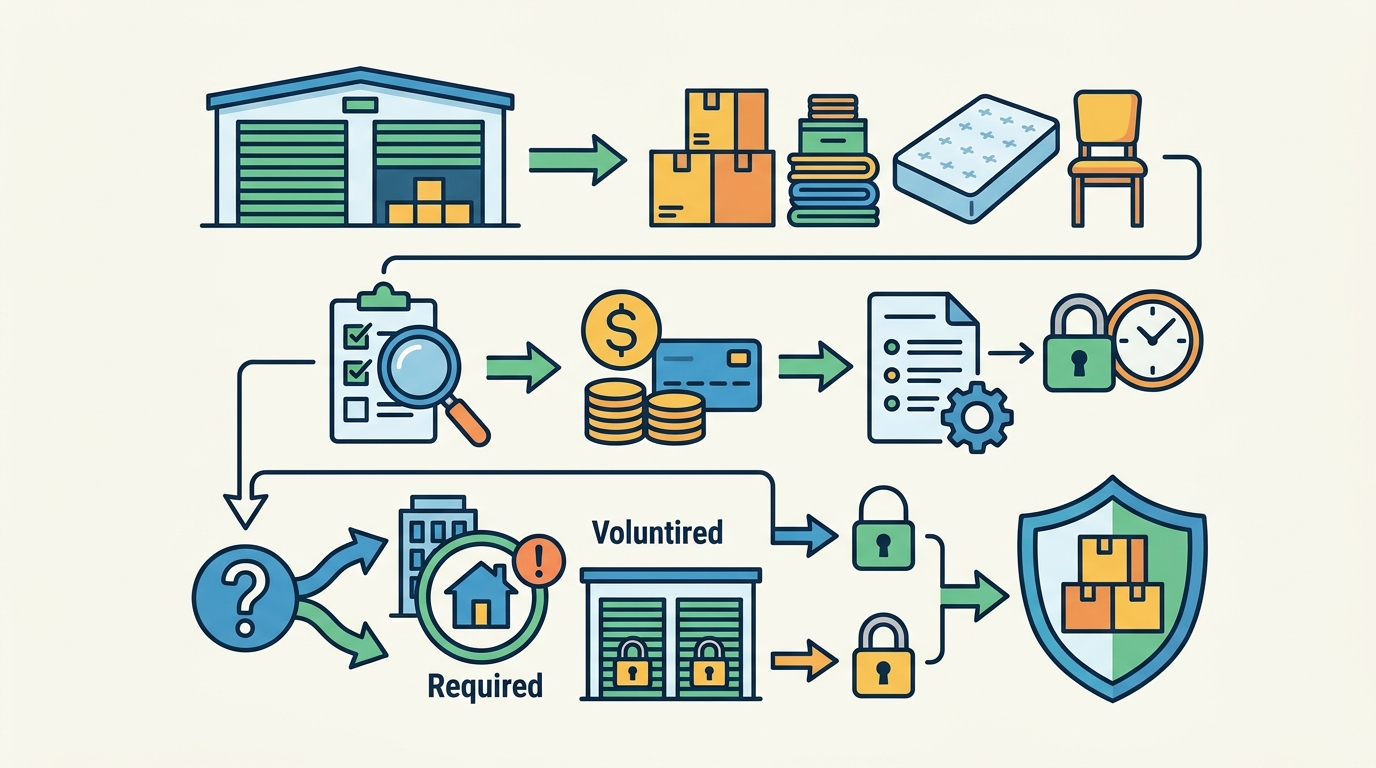
"Storage insurance" is almost never a separate product. In all but two states it is your existing auto policy stripped down to comprehensive coverage only, which pays for theft, fire, hail, falling objects and vandalism while the car sits still (Storage.com, undated). A comprehensive-only policy averages $238 a year nationally, according to Compare.com citing NAIC data, and comprehensive-only rates for several large companies in Illinois have run $27 to $51 a month depending on the deductible chosen (ValuePenguin, undated).
The catch is the part it removes. Comprehensive-only coverage does not satisfy the liability requirement that every state except New Hampshire places on a registered vehicle (StorageCafe, undated), so dropping to it usually has to be paired with a nonoperation or non-use filing at your state DMV.
What Storage Insurance Actually Covers
Storage insurance is the informal name for comprehensive coverage carried without liability or collision. On your declarations page it appears as a single line — "Comprehensive" or "Other Than Collision" — with a deductible beside it. Storage.com describes car storage or parked-car insurance as falling under the comprehensive umbrella in all states but two, so in most states you are not buying a new policy, you are endorsing an existing one down to one coverage.
What that line pays for, subject to the insurer's actual filed policy language, is physical damage to the covered auto from non-collision perils while it is parked: theft of the vehicle, fire, hail, flood, falling tree limbs, vandalism and animal damage. Payment goes to the named insured, and to any lienholder or loss payee listed on the declarations page, on an actual cash value basis. Policygenius defines actual cash value as the car's value at the time of loss after age and wear and tear, illustrating it with a $20,000 purchase price that depreciates to roughly $15,000 after a few years. MoneyGeek notes comprehensive deductibles usually run $100 to $2,500, and that claims are paid at actual cash value accounting for age, condition and mileage. Any individual claim is still adjudicated case by case against the policy wording and the facts of the loss.
What it does not cover is the larger half of a normal policy:
- Liability — bodily injury and property damage you cause to others. This is the coverage states mandate, and removing it is what makes the policy illegal to drive on.
- Collision — damage from hitting another vehicle or object, including a tow-truck or shunting incident inside a storage lot in many forms.
- Uninsured/underinsured motorist and medical payments or PIP, depending on which your state permits or requires.
- Mechanical breakdown, dead batteries, rust, rodent-chewed wiring that the insurer characterises as wear, and the gap between actual cash value and a loan balance.
U.S. News & World Report puts the practical point bluntly: driving with only comprehensive-only coverage is legally no different from driving uninsured, because it does not meet the legal driving requirements in any state. Comprehensive coverage itself is never mandated — no state requires it — but if the vehicle is leased or financed the lender will almost certainly require it (GEICO, undated). For scale on the underlying coverage, drivers spent an average of $160 a year on comprehensive coverage from 2015 to 2019 according to NAIC data cited by Policygenius.
Who Needs This Coverage
Check these against your registration, loan statement and policy declarations page rather than against a general sense of risk:
- The vehicle has been parked and undriven for 30 days or more and is not driven regularly — the condition U.S. News & World Report uses to describe comprehensive-only storage coverage.
- Your insurer's rule requires a minimum storage period before it will reduce coverage; some companies will only allow comprehensive-only after the car has been in storage 30 days (Policygenius, undated). Ask before you assume.
- You have filed, or intend to file, a California Planned Nonoperation under Vehicle Code §4604, which the California DMV charges $28 for — the registration is suspended for use, so liability is no longer required, but the car can still be stolen or hailed on.
- Your loan or lease statement lists a physical-damage requirement. GEICO notes a lender financing or leasing the vehicle will almost certainly require comprehensive, so dropping it entirely during storage can breach the contract and trigger force-placed coverage.
- You are deployed, working abroad, or hospitalised for an extended period and the car sits at a residence or in a rented unit with the keys out of your hands.
- A seasonal vehicle — convertible, project car, show car — is off the road for the winter but you are keeping it registered rather than filing for nonoperation.
- You are between buyers: the car is listed for sale, not being test-driven by you, and sitting in a driveway or a lot.
- You live in New Hampshire, where drivers are not required to carry auto insurance but the state requires proof of financial responsibility (Insurify, undated) — comprehensive-only does not provide that proof.
What It Costs
Each figure below is a published average or range for the scenario named, not a quote. What you are charged turns on the car's actual cash value (higher value, higher premium), the deductible you pick (a $2,500 deductible prices well below a $100 one), your garaging zip code and its theft and hail loss history, your record, your insurer and its underwriting company, and credit-based insurance score where your state permits its use. A quote estimate is not the bound premium.
| Scenario / variable | What drives the number | Published range | Source named |
|---|---|---|---|
| Illinois, comprehensive-only, several large companies | Deductible chosen | $27–$51 per month | ValuePenguin, undated |
| General parked-car comprehensive-only | Car's value and location | $5–$50 per month | The Zebra, undated |
| Comprehensive-only (parked car) average | Not broken out | $12–$30 per month | Storage.com, undated |
| Comprehensive-only policy, national average | Not broken out | $238 per year | Compare.com citing NAIC |
| Comprehensive coverage, 2015–2019 | Nationwide average spend | $160 per year | Policygenius citing NAIC |
| State-by-state comprehensive-only comparison | State of garaging | $98 (California), $144 (Alaska), $169 (Alabama), $200 (Arizona) per year | BuyAutoInsurance.com, undated |
| California Planned Nonoperation filing | Vehicle Code §4604 fee, all vehicles/OHV | $28 one-time | California DMV |
| SR-22 filing, if a violation forces one alongside storage | State filing fee | $15–$50, $25 common | Yahoo Finance, undated |
How to Get or File It
- Pull your current declarations page and find the "Comprehensive" or "Other Than Collision" line, the deductible beside it, and any lienholder or loss payee listed. That page, not a quote screen, tells you what you currently carry and who else has a claim on a payout.
- Read the physical-damage clause in your loan or lease agreement before you change anything. GEICO notes lenders financing or leasing a vehicle will almost certainly require comprehensive; keeping it is usually the contract requirement, dropping liability may not be.
- If your state offers a non-use or nonoperation filing, submit it before the registration period runs. In California that is the Planned Nonoperation filing under Vehicle Code §4604, $28 for all vehicles and OHV; the California DMV allows a PNO to be filed up to 90 days after the registration expiration date if the vehicle was not operated in any manner, but applicable late penalties are then due. Other states handle non-use differently — check your own DMV or DOI, do not assume California's process.
- Call your insurer and ask for the specific change in writing: remove bodily injury and property damage liability, collision, uninsured/underinsured motorist and medical payments or PIP, retain comprehensive only, effective on a stated date. Ask two questions outright — whether the company imposes a minimum storage period before allowing it, since some require 30 days (Policygenius, undated), and whether reducing coverage counts as a lapse in that company's underwriting for future rating.
- Set the deductible deliberately. MoneyGeek puts comprehensive deductibles at $100 to $2,500, and a claim pays actual cash value less that deductible — on a car Policygenius illustrates as worth roughly $15,000 after a few years, a $2,500 deductible is a sixth of the recovery.
- Get the revised declarations page and keep it with your nonoperation receipt. Do not cancel the policy outright: a gap in coverage can affect your rate on re-rating, and if a lapse or violation later puts you under a financial-responsibility filing, the filing fee runs $15 to $50 with $25 common (Yahoo Finance, undated) and the filing plus the policy generally must be maintained about three years (State Farm, undated) — in California, Infinity Auto Insurance lists a $25–$50 filing fee against minimum limits of 30/60/15 for three years.
- Before the car moves again, restore liability and collision with an effective date earlier than the first drive, and reinstate the registration if you filed for nonoperation. Driving on comprehensive-only is legally no different from driving uninsured in any state (U.S. News & World Report, undated).
Questions
Can I drive a car insured with storage coverage only?
No. U.S. News & World Report states that driving with comprehensive-only coverage is legally no different from driving uninsured, because it does not meet the legal driving requirements in any state. If you need to move the car even one block, put liability back on first with an effective date before the trip.
If the car never leaves the garage, why does the state still want liability?
Because the requirement attaches to the registration, not the mileage. StorageCafe notes every state except New Hampshire requires every registered car to carry at least minimum liability insurance even if it is not driven; New Hampshire instead requires proof of financial responsibility (Insurify, undated). The way out is usually a nonoperation filing — California charges $28 for a Planned Nonoperation under Vehicle Code §4604.
How long does the car have to be in storage before I can switch?
Comprehensive-only is described as covering vehicles in storage 30 days or more and not driven regularly (U.S. News & World Report, undated), and some insurers will only allow a reduction to comprehensive-only after the vehicle has been in storage for a minimum of 30 days (Policygenius, undated). Ask your own company for its stated minimum before you plan around a date.
What would a theft claim actually pay out?
If the claim is accepted, comprehensive pays actual cash value less the deductible. Policygenius defines actual cash value as the car's worth at the time of loss after age and wear — a $20,000 car depreciating to roughly $15,000 after a few years — and MoneyGeek puts comprehensive deductibles at $100 to $2,500. Every claim is adjudicated individually against the insurer's filed policy language.
Is it cheaper to just cancel the policy entirely?
Cheaper in the month, yes — comprehensive-only runs about $12 to $30 a month for a parked car (Storage.com, undated) versus nothing. But cancelling removes theft, fire and hail protection, can breach a lender's physical-damage requirement (GEICO, undated), and leaves a coverage gap that insurers weigh when re-rating. If a violation later triggers a financial-responsibility filing, expect a $15–$50 filing fee, commonly $25 (Yahoo Finance, undated), maintained roughly three years alongside the policy (State Farm, undated).