By the Drivers Compass editors · Updated October 31, 2026
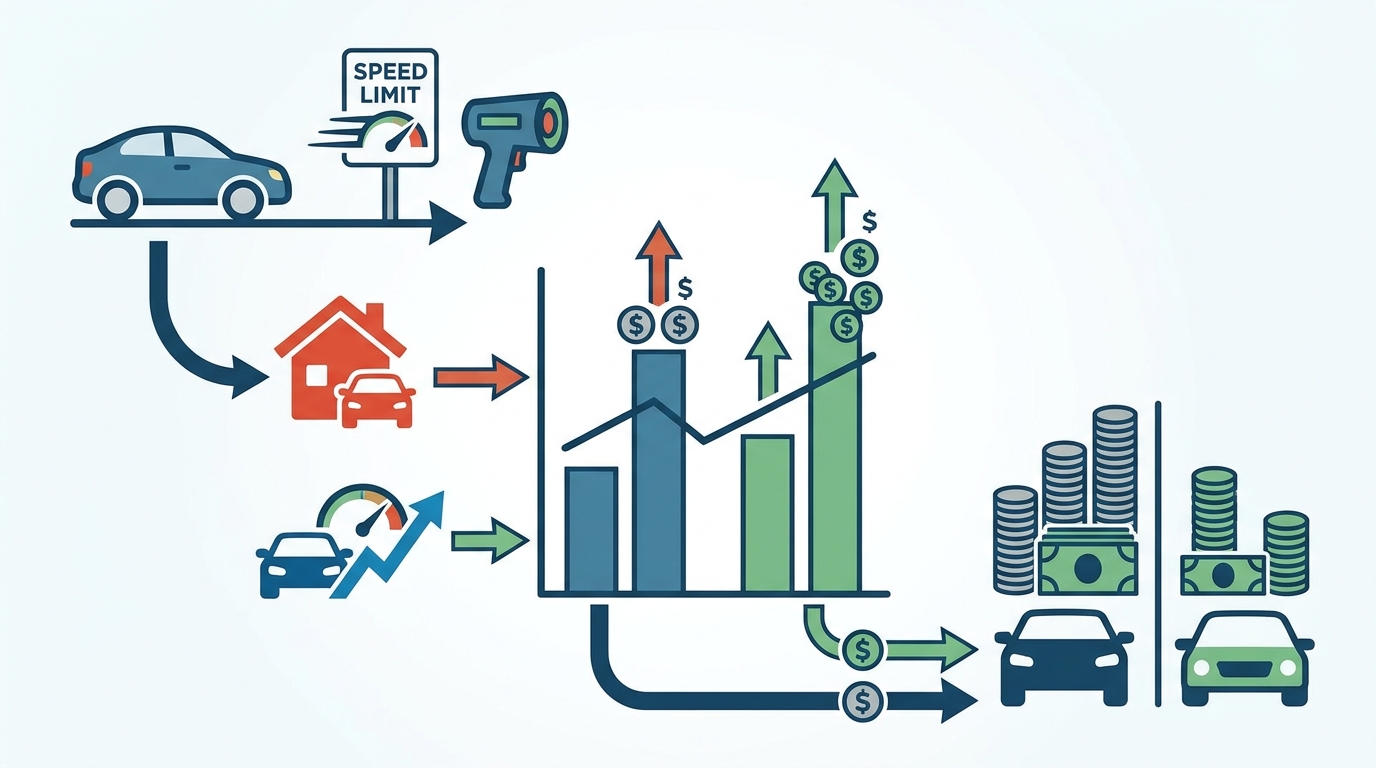
For a driver with a recent speeding ticket, State Farm averages $2,266 a year, or $189 a month, against a national average of $3,028 a year for the same profile (NerdWallet, 2026-10). There is no matching national speeding-ticket average published for Progressive in the same analysis, so the honest comparison is partial: Progressive's documented low-price positions here are minimum-limits coverage at $561 a year versus a $648 national average (NerdWallet, 2026-10), and specific states — Insurance.com names Progressive cheapest for drivers with a speeding ticket in New York, where those drivers average $2,269 a year.
That means neither company is "the cheaper one" for every ticketed driver. Rates are individually underwritten by state, zip code, coverage limits, vehicle and record, and the only number that settles it for you is a quote from both — bound, not estimated.
How These Rates Were Compared
Two driver profiles do the work in this comparison, and they are not the same profile. Read which one a number belongs to before you hold it up against your renewal notice.
Profile A — 35-year-old, full coverage, good credit, recent speeding ticket. NerdWallet's chart of State Farm rates against other large auto insurers is built on a 35-year-old driver with a clean driving history and good credit buying a full coverage policy (NerdWallet, 2026-10). The violation figures are the same build with a recent speeding ticket added to the record.
Profile B — minimum-limits liability coverage. The Progressive figure available here, $47 a month or $561 a year, is a minimum coverage average (NerdWallet, 2026-10). Minimum coverage means whatever your state's statutory liability limits happen to be, which differ state to state, and buying at that level leaves you personally exposed for damages above the limit.
Where the numbers come from: NerdWallet updates its average car insurance rates monthly by analyzing more than 500 million rates from across the country supplied by Quadrant Information Services (NerdWallet, 2026-10). These are analyzed quote-level averages, not filed rate changes approved by a state department of insurance, and not a premium any particular person paid. Treat them as modeled national aggregates.
The state-level comparisons — Insurance.com for New York, Insurify for Texas liability-only — are undated in the material available, so use them directionally rather than as current pricing.
One limit worth naming plainly: there is no published national full-coverage speeding-ticket average for Progressive in this data set. Anyone telling you Progressive beats State Farm nationally for ticketed drivers, or the reverse, is filling that gap with something other than a number.
Rate Comparison
| Insurer or benchmark | Driver profile | Average premium (source) |
|---|---|---|
| State Farm | 35-year-old, full coverage, recent speeding ticket | $2,266/year, $189/month (NerdWallet, 2026-10) |
| National average | Same profile, recent speeding ticket | $3,028/year, $252/month (NerdWallet, 2026-10) |
| State Farm | 35-year-old, full coverage, clean record, good credit | $1,985/year, $165/month (NerdWallet, 2026-10) |
| National average | Full coverage, clean record | $2,361/year, $197/month (NerdWallet, 2026-10) |
| Progressive | Minimum-limits coverage | $561/year, $47/month (NerdWallet, 2026-10) |
| National average | Minimum-limits coverage | $648/year, $54/month (NerdWallet, 2026-10) |
| New York drivers | Speeding ticket, statewide average | $2,269/year, with Progressive named cheapest for that group (Insurance.com, undated) |
| Convicted speeder, any insurer | Full coverage, post-conviction | $2,486/year, about a 25% increase after a speeding ticket (NerdWallet, 2024-05) |
| State Farm | 35-year-old, full coverage, at-fault crash | $2,565/year, $214/month vs $3,524 national (NerdWallet, 2026-10) |
| State Farm | 35-year-old, full coverage, DUI | $3,147/year, $262/month vs $4,437 national (NerdWallet, 2026-10) |
| State Farm | Full coverage, poor credit | $7,791/year vs $3,954 national (NerdWallet, 2026-10) |
Read the top two rows together: State Farm's $2,266 a year for a ticketed 35-year-old sits below the $3,028 national average for the same profile, and NerdWallet's analysis also places State Farm below other large auto insurers for drivers with a speeding ticket (NerdWallet, 2026-10).
Progressive's $561-a-year minimum-limits average sits under the $648 national minimum-coverage average (NerdWallet, 2026-10) — a different coverage tier entirely from the $2,266 full-coverage figure, so the two are not a head-to-head.
Two state-level readings cut the other way. In New York, Insurance.com names Progressive the cheapest option for drivers with a speeding ticket, against a $2,269 statewide average for that group. In Texas, Insurify names State Farm and Progressive together as the cheapest liability-only rates for drivers with speeding tickets, with no dollar figure attached to either in that comparison.
Where the Price Difference Comes From
- Different underwriting weight on credit. State Farm averages $7,791 a year for full coverage with poor credit against a $3,954 national average (NerdWallet, 2026-10) — among the most expensive of the largest insurers for that group — while averaging $1,985 a year for a clean-record driver with good credit (NerdWallet, 2026-10). An insurer that leans harder on credit-based insurance scoring can be the cheapest option for one applicant and the most expensive for the next with an identical ticket. California, Hawaii and Massachusetts don't allow insurers to use credit in setting car insurance rates at all (NerdWallet, 2026-10), which removes that lever in those three states.
- Different surcharge schedules for the same violation. A speeding ticket raises full-coverage cost about 25% on average, to $2,486 a year for a convicted speeder (NerdWallet, 2024-05), but each insurer files its own surcharge table by violation type and its own look-back window in each state. Two carriers can price the identical citation very differently, and a ticket reduced or dismissed in court may be surcharged differently again.
- Different territory rating within a state. New York ticketed drivers average $2,269 a year with Progressive named cheapest (Insurance.com, undated), while State Farm leads the national ticketed average at $2,266 versus $3,028 (NerdWallet, 2026-10). Zip-code-level loss experience, litigation costs and repair costs are rated separately by each insurer, which is why a national ranking flips inside particular states.
- Different coverage tiers being compared. Progressive's $561-a-year figure is minimum limits; State Farm's $1,985 is full coverage (NerdWallet, 2026-10). Collision and comprehensive, the deductible you pick and your liability limits move premium more than most ticket surcharges do.
- Different age curves. State Farm averages $4,378 a year for 20-year-olds against $4,722 nationally, but $1,765 for 60-year-olds against $2,029 nationally (NerdWallet, 2026-10) — a wider proportional gap at 60 than at 20. The same insurer is not equally competitive at every age band.
- Different distribution and discount structures. Agent-based and direct models carry different expense loads, and discount programs are filed separately in each state, so a multi-policy or telematics credit available to you in one state may not exist, or may be sized differently, in another.
- Service record is separate from price. State Farm's NAIC complaint index is cited as below 1.0, meaning fewer complaints than average (ChooseFI, undated). That says nothing about whether your quote will be lower.
Which Driver Profile Fits Which Insurer
The 35-year-old with one recent speeding ticket buying full coverage. This is the profile State Farm's published numbers favor: $2,266 a year, or $189 a month, against a $3,028 national average for the same profile, and below other large auto insurers for ticketed drivers in the same analysis (NerdWallet, 2026-10). If your ticket is a single speeding conviction, your credit is good, and you want collision and comprehensive, State Farm belongs in your quote set.
The driver buying minimum-limits liability because cash is tight. Progressive's $561-a-year minimum-coverage average, below the $648 national minimum-coverage average (NerdWallet, 2026-10), is the figure that points its way. In Texas specifically, Insurify names State Farm and Progressive as the cheapest liability-only rates for drivers with speeding tickets, so quote both there. Understand what you are buying: minimum limits satisfy your state's statutory requirement and nothing more, and anything above the limit on an at-fault loss comes out of your own assets.
The New York driver with a ticket. Insurance.com names Progressive cheapest for this group against a $2,269 statewide average, which sits alongside State Farm's $2,266 national ticketed figure (NerdWallet, 2026-10) — the national leader and the state leader are effectively the same price, which is exactly the situation where you have to quote both rather than trust a ranking.
The ticketed driver whose credit is also poor, outside California, Hawaii and Massachusetts. State Farm's $7,791 average for poor credit versus a $3,954 national average (NerdWallet, 2026-10) swamps its advantage on the $2,266-versus-$3,028 ticketed comparison (NerdWallet, 2026-10). Here the credit factor, not the citation, is the main driver, and you should widen your shopping list well past these two names.
The 20-year-old with a ticket. State Farm averages $4,378 a year at age 20 versus $4,722 nationally (NerdWallet, 2026-10) — still under the national figure, but a narrower margin than the $2,266-vs-$3,028 gap at the ticketed 35-year-old profile.
One practical note: among ChooseFI community members comparing State Farm and Progressive quotes for clean-record drivers, State Farm came in cheaper or within $50 a year in 71% of the comparisons discussed (ChooseFI, undated). That is a clean-record sample, not a ticketed one, and it is community-reported rather than filed data. Get quotes from both carriers plus at least two others, re-run them at each renewal, and compare at identical limits and deductibles — a quote is an estimate and may not match the premium you are finally charged once the underwriting company pulls your motor vehicle record.
Questions
Does this comparison still hold if I add a teen or young driver to the policy?
No — the $2,266-a-year State Farm figure is a 35-year-old with full coverage and one recent speeding ticket (NerdWallet, 2026-10), and adding a young driver rebuilds the rating entirely. State Farm averages $4,378 a year for 20-year-olds against a $4,722 national average, compared with $1,964 at age 40 against $2,289 nationally (NerdWallet, 2026-10) — a smaller proportional advantage at the younger age. Re-quote both insurers with the young driver listed and the actual vehicle assignment before assuming either ranking survives.
Does bundling with home insurance change which one is cheaper?
It can, and none of these figures account for it. The $2,266 State Farm ticketed average and the $561 Progressive minimum-coverage average (NerdWallet, 2026-10) are auto-only averages. Multi-policy discounts are filed separately by each insurer in each state, so the size of the credit — and whether the home policy itself prices competitively where you live — has to be checked on an actual bundled quote, not inferred from the auto number.
What if I have an at-fault accident or a DUI as well as the speeding ticket?
The gap changes size. State Farm averages $2,565 a year for a 35-year-old with full coverage and an at-fault crash against a $3,524 national average, and $3,147 a year with a DUI against a $4,437 national average (NerdWallet, 2026-10). Multiple violations on one record are rated together, and several insurers move those applicants into a different underwriting company with its own filed rates, so a two-violation record is not simply the sum of the single-violation surcharges. How long each insurer looks back at a citation is set by its own state filing, and that window can differ from how long the conviction stays on your motor vehicle record — ask the carrier for both.
I live in California, Hawaii or Massachusetts — does the credit point apply to me?
Not in the same way. Those three states don't allow insurers to use credit when determining car insurance rates (NerdWallet, 2026-10), so the $7,791-a-year poor-credit average versus a $3,954 national average reported for State Farm (NerdWallet, 2026-10) reflects states where credit scoring is permitted. In those three states the comparison turns more heavily on territory rating, vehicle, record and coverage limits, and you still need quotes from both carriers at identical limits.