By the Drivers Compass editors · Updated October 31, 2026
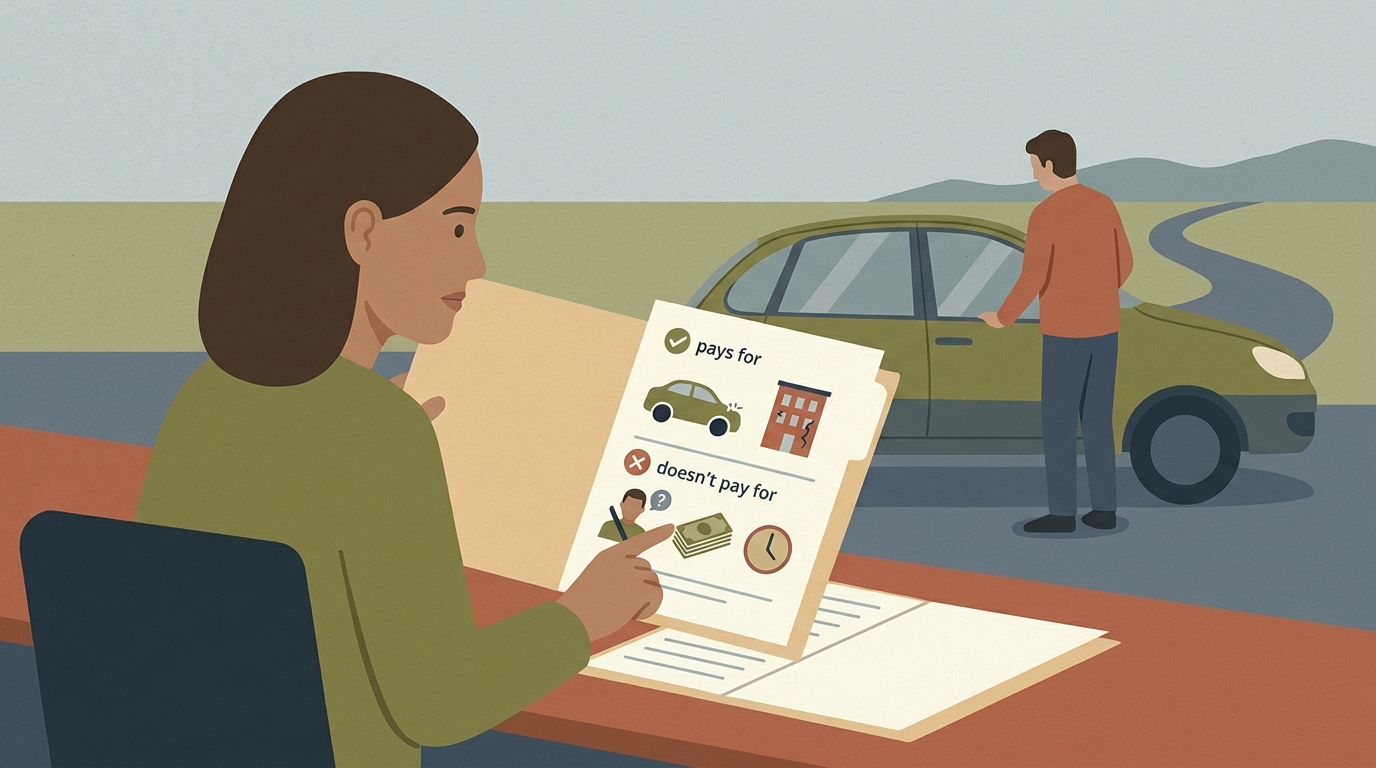
An SR-22 is a form an auto insurance company files with the state to provide evidence of insurance; it is not a type of insurance policy (Insurance.com). Every dollar paid on a claim comes from the liability coverage underneath the filing — bodily injury and property damage limits, paid to other people, with no deductible and nothing for your own car.
What the filing adds is an obligation: the state is told when coverage starts and, more importantly, when it stops. The required period, the fee, and whether your state uses an SR-22, an SR-22A or an FR-44 vary by state and by the violation behind it.
What SR-22 Insurance Actually Pays For
There is no product called "SR-22 insurance." An SR-22 is a form an auto insurance company files with the state to provide evidence of insurance; it is not a type of insurance policy (Insurance.com). In Texas it is a Financial Responsibility Insurance Certificate, required under Texas Transportation Code Chapter 601 to verify that a driver is maintaining motor vehicle liability insurance (Texas Department of Public Safety, 2020-09-16).
What pays is the liability coverage the certificate vouches for. Bodily injury liability pays the injured person's damages up to a per-person limit, capped again by a per-accident limit. Property damage liability settles the other party's vehicle on an actual cash value (ACV) basis — repair cost, or ACV less salvage if it is a total loss — up to the property damage limit. No deductible applies, and it pays third parties, never you.
What follows is a constructed illustration, not filed loss data. Texas is an at-fault (tort) state, so fault decides who pays. You rear-end another car while carrying the statutory minimum of $30,000 for bodily injury or death of one person, $60,000 for two or more persons and $25,000 property damage in one crash (Texas Department of Public Safety, 2020-09-16). Illustrative example: her injuries total $42,000 and her car's actual cash value is $19,400.
- Property damage: $19,400 paid on an ACV basis, inside the $25,000 cap (Texas Department of Public Safety, 2020-09-16).
- Bodily injury: $30,000 paid, the per-person cap (Texas Department of Public Safety, 2020-09-16). The remaining $12,000 is not covered, and she can pursue you personally for it.
- Your own bumper and your own hospital bill: nothing from this policy.
Claims are adjudicated case by case against your insurer's filed language, and the SR-22 changes none of those numbers. It only tells the state the policy exists.
What It Doesn't Cover
The filing certifies liability coverage. These sit outside it:
- Damage to your own vehicle in a crash you caused. That is collision coverage, with its own deductible, and no SR-22 certifies it.
- Your own injuries. Paid by medical payments or personal injury protection — mandatory in no-fault states, optional or rejectable in writing in at-fault states such as Texas.
- Theft, hail, flood, fire, vandalism and animal strikes. These fall under comprehensive (other-than-collision) coverage, with its own deductible, which no state financial responsibility law requires.
- Racing or competitive driving. Loss arising from a prearranged or organised race or speed contest is a standard exclusion in filed personal auto liability forms.
- Intentional damage you deliberately cause to a person or to property.
- Vehicles not listed on the policy, including a vehicle furnished for your regular use that was never scheduled or rated.
- Delivery, courier and rideshare driving. Many filed personal auto forms exclude liability while you carry passengers or goods for a fee unless an endorsement is attached. Read your insurer's filed language before assuming either way.
- Property in your care, custody or control, such as the rented garage you back into.
- State and administrative charges. The reinstatement fee Texas requires with a valid SR-22 to restore a suspended licence (Texas Department of Public Safety, 2020-09-16) and the per-term filing fee paid at each renewal (InsuredBetter) are costs to you, not claim payments.
Typical Limits and Deductibles
| Limit, deductible or fee | What it means in a claim | Approximate premium effect |
|---|---|---|
| Texas statutory minimum liability | Pays up to $30,000 for bodily injury or death of one person, $60,000 for two or more persons and $25,000 property damage in one crash, with no deductible and nothing for your own vehicle (Texas Department of Public Safety, 2020-09-16) | The cheapest liability that satisfies the filing. Texas drivers with an SR-22 are classified high risk and pay around 36 percent more for the same coverage (AutoInsurance.com) |
| Liability limits above the state minimum | Raises the per-person, per-accident and property damage caps; in the illustration above, the injury claim would have fallen inside the per-person limit instead of being cut off at it | Illustrative example: each additional dollar of liability limit generally costs less than the first, but the effect varies by state, territory, vehicle and carrier |
| Collision deductible, higher versus lower | Optional, and certified by no SR-22. Pays repair cost above the deductible, capped at the vehicle's actual cash value | Illustrative example: a higher deductible lowers collision premium and raises your out-of-pocket by the difference on every collision claim |
| SR-22 filing fee, per term | An administrative charge for making the filing, not a claim payment | The fee ranges per term and is paid at each renewal, separate from any premium increase (InsuredBetter). California drivers may pay a filing fee for each policy term their insurer files an SR-22 with the DMV (Compare.com) |
| Surcharge after one DUI plus an SR-22 | Changes nothing about what the policy pays; only the price | Average annual premiums with an SR-22 and one DUI: Travelers from $1,962 to $2,933, a 49% increase, and GEICO from $2,159 to $5,321, a 146% increase (Insurance.com). The increase varies widely by carrier (InsuredBetter) |
| SR-22A (Georgia, Texas, Missouri) | A certificate of financial responsibility generally required after repeated violations of SR-22 requirements, such as letting the filing lapse (LifeSafer) | Requires six months of insurance coverage paid in advance, unlike a standard SR-22 (AutoInsurance.com) |
No figure above is your rate. Pricing is individually underwritten by state, zip code, limits, deductible, vehicle, record, age and — where permitted — credit-based insurance score, and it differs between underwriting companies inside the same insurer group.
Is It Required, and By Whom
The requirement is always a state requirement, triggered by a conviction, a judgment or a lapse in mandatory coverage — never by your lender.
State law. In Texas, the Financial Responsibility Insurance Certificate is required under Texas Transportation Code Chapter 601 to verify that a driver is maintaining motor vehicle liability insurance, and it must be maintained for two years beginning from the date of the conviction requiring it, or two years from the date a judgment was rendered (Texas Department of Public Safety, 2020-09-16). To reinstate a Texas licence after an SR-22 suspension, you must submit a valid SR-22 and pay the required reinstatement fee (Texas Department of Public Safety, 2020-09-16).
The rules differ elsewhere. Some states do not require an SR-22 at all, and Florida and Virginia require an FR-44 instead (U.S. News & World Report). Florida generally requires SR-22 or equivalent FR-44 filings for three years following a DUI conviction, with the exact length depending on offense severity and prior violations (Muscal Law). California drivers typically maintain SR-22 coverage for three years, and if the policy cancels or lapses while it is required, the requirement period restarts (Compare.com). Illinois requires the filing for a set period after certain serious driving violations (Insurify). Check your own state's licensing agency for the period that applies to your case.
Lenders and lienholders. A finance company or lessor does not require an SR-22 and cannot file one. What the loan or lease contract requires is physical damage coverage — collision and comprehensive, usually with a maximum deductible and the lienholder named as loss payee. The two are unrelated: meeting your lender's requirement does not satisfy the state, and the state's liability filing does not satisfy your lender.
One consequence sits with the insurer rather than the state: a required SR-22 filing can increase premiums or, in some cases, result in the insurer canceling or not renewing the policy (Yahoo Finance).
Questions
Does the liability behind an SR-22 cover a rental car?
Liability for injury or damage you cause to others often extends to a rental under a personal auto policy's filed language, but damage to the rental car itself is physical damage — collision and comprehensive, or the rental company's loss damage waiver. Since an SR-22 only certifies liability, it adds nothing here. Ask your insurer to show you the filed extension-of-coverage wording before you decline the counter waiver.
Can I show my insurance card instead of filing an SR-22?
Not in Texas. An insurance card or policy will not be accepted by the Texas Department of Public Safety in place of a required SR-22 (Texas Department of Public Safety, 2020-09-16). The filing has to come from the insurer to the state; the proof in your glovebox serves a different statute.
What happens if my policy lapses while the SR-22 is active?
Your insurer notifies the state that the filing has ended, which generally puts your licence back at risk. In California, if the policy cancels or lapses while an SR-22 is required, the requirement period restarts (Compare.com). Repeated lapses in Georgia, Texas and Missouri can move you onto an SR-22A (LifeSafer), which requires six months of coverage paid in advance (AutoInsurance.com).
How much more will I pay with an SR-22?
It depends on the carrier, not on the form. One comparison of average annual premiums with an SR-22 and one DUI showed Travelers moving from $1,962 to $2,933, a 49% increase, and GEICO from $2,159 to $5,321, a 146% increase (Insurance.com), while Texas drivers with an SR-22 pay around 36 percent more for the same coverage (AutoInsurance.com). The increase varies widely by carrier (InsuredBetter), so quoting several is worth the time. A quote is an estimate and will not necessarily match the premium you are finally charged.
Is the filing fee the same as my premium increase?
No. The SR-22 filing fee is a separate administrative charge that ranges per term and is paid at each renewal, independent of any premium increase (InsuredBetter). California drivers may pay a filing fee for each policy term their insurer files the SR-22 with the DMV (Compare.com). Texas reinstatement after a suspension carries its own required fee as well (Texas Department of Public Safety, 2020-09-16).
Do I still need collision coverage if the state only asks for liability?
The state's financial responsibility requirement is satisfied by liability alone — in Texas, $30,000 per person, $60,000 per crash and $25,000 property damage (Texas Department of Public Safety, 2020-09-16). If the car is financed or leased, your lender's contract separately requires collision and comprehensive with the lienholder as loss payee. Dropping them to offset the cost of an SR-22 period can put you in default on the loan, which is a contract question rather than an insurance one.