By the Drivers Compass editors · Updated October 31, 2026
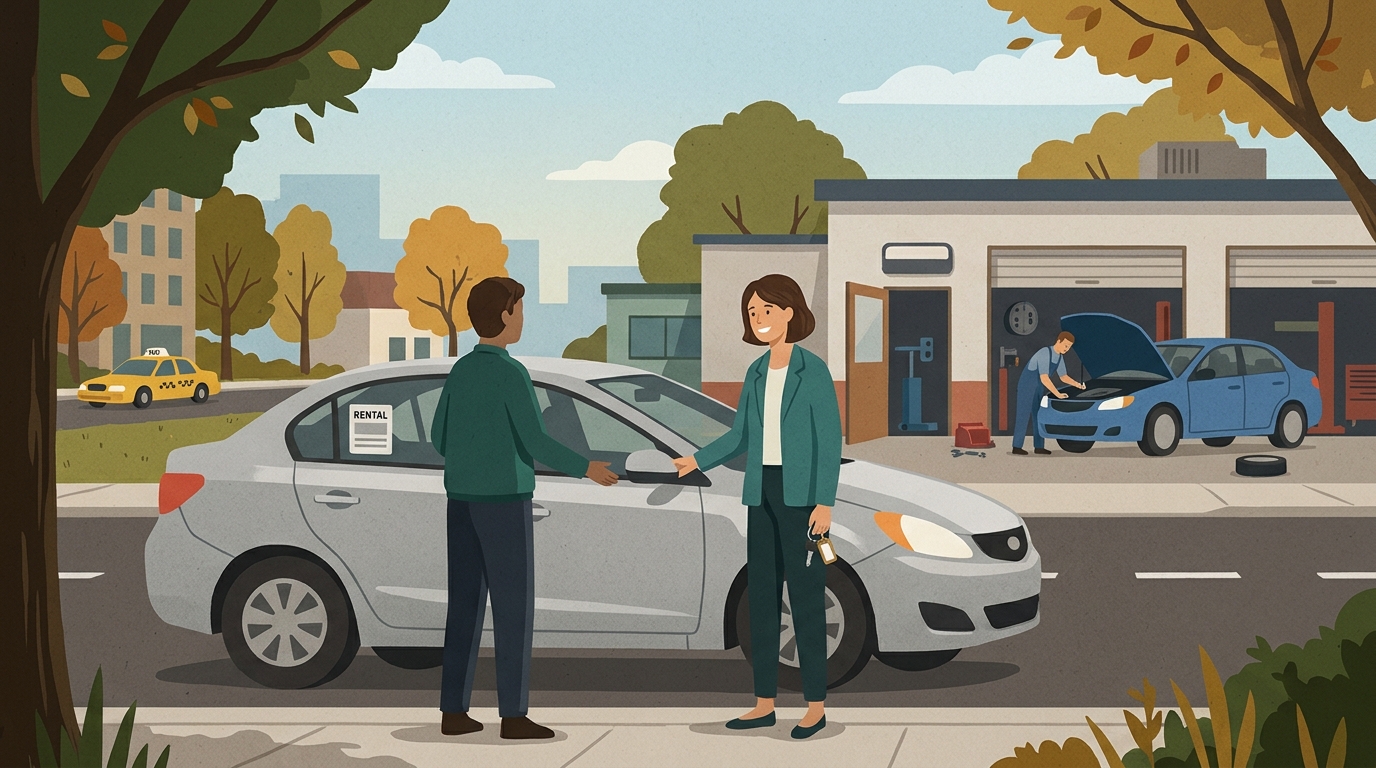
Rental reimbursement is an optional endorsement that reimburses what you actually spend on substitute transportation while your car is out of service from a loss covered by your comprehensive or collision coverage, up to a stated daily limit and a per-claim maximum. It does not pay the car's value and it carries no deductible of its own — it pays transportation expense, dollar for dollar, until a cap stops it.
No state financial responsibility law requires it, and lenders require comprehensive and collision rather than rental coverage. Whether it earns its premium depends on your daily limit, your shop's backlog, and whether you could absorb two or three weeks of rental cost yourself.
What Rental Reimbursement Coverage Actually Pays For
In the ISO personal auto policy this sits in Part D as Transportation Expenses; most carriers file the endorsement as "Rental Reimbursement." The payout basis is actual expense incurred up to a stated daily limit — not actual cash value, not stated amount, not agreed value. You rent, or the insurer direct-bills a rental partner, and the insurer pays the rental charge day by day up to the per-day figure on your declarations page, stopping at the per-claim maximum or when repairs are finished, whichever comes first.
Two conditions gate payment. The underlying loss has to be payable under comprehensive or collision on that specific vehicle. And the vehicle has to be out of use — most forms start the clock when the car goes into the shop or, for theft, after a waiting period written into the endorsement. Read the waiting-period wording on your own form.
Illustrative example — constructed, not filed loss data
Ohio is an at-fault (tort) state; assume you are at fault and claim on your own policy. Collision deductible $1,000, rental reimbursement $40 per day with a $1,200 per-claim maximum, repairs of $6,800, 14 days in the shop, rental rate $52 per day. All figures illustrative. - Collision pays $6,800 less the $1,000 deductible: $5,800 to the shop. - Rental reimbursement pays $40 x 14 = $560. The $1,200 cap is never reached because the daily limit binds first. - You pay the $1,000 deductible plus the $12-per-day rate gap: $168.
In that same illustrative structure, a repair lasting 35 days would hit the $1,200 maximum at day 30, and the last five days would be yours.
What It Doesn't Cover
- Mechanical breakdown unrelated to a collision or comprehensive loss. A failed transmission, dead alternator, blown head gasket or timing-belt job produces no rental payment, even with the car undrivable in a shop.
- Routine maintenance, manufacturer recall work and warranty repairs. Scheduled service, brake jobs and tire replacement are not covered losses, so no transportation expense is payable.
- Days beyond the per-day or per-claim cap. When the rental rate exceeds your daily limit, you pay the difference every day; when the per-claim maximum is reached, payment stops regardless of how long the shop keeps the car.
- Losses excluded by the underlying comprehensive or collision coverage — racing or competitive driving, intentional damage by an insured, wear and tear, freezing, mechanical or electrical failure, and carrying persons or property for a fee where that use is excluded. No covered loss, no rental payment.
- Rental-counter add-ons. Collision damage waiver, loss damage waiver, supplemental liability, prepaid fuel, mileage overage, additional-driver fees, GPS and child seats are generally not reimbursable transportation expense.
- Vehicles not scheduled on the policy, and scheduled vehicles without comprehensive and collision. The endorsement is written per vehicle and follows the damaged insured car.
- Convenience rentals. A van for a move or a car on a trip is not expense arising from a covered loss.
- Downtime after a total loss offer. Most forms end rental payment a fixed number of days after the insurer makes its settlement offer, not when you buy a replacement.
Typical Limits and Deductibles
Rental reimbursement has no deductible of its own. The deductible in play is the one on your comprehensive or collision coverage, and it comes out of the repair payment, not the rental. Every figure in the table is an illustrative estimate, not drawn from any state DOI rate filing; the filed charge varies by insurer, underwriting company, territory, vehicle and driver record.
| Limit / deductible option | What it means in a claim | Approximate premium effect |
|---|---|---|
| No endorsement | Nothing is paid toward a rental; the whole daily rate is yours | Baseline (illustrative) |
| $30/day, $900 per claim (illustrative tier) | Pays up to $30 per day for up to 30 days; you pay any excess daily rate | Roughly $10–$20 per vehicle per six-month term (illustrative estimate) |
| $40/day, $1,200 per claim (illustrative tier) | Pays up to $40 per day for up to 30 days; usually a compact or mid-size class | Roughly $15–$30 per vehicle per six-month term (illustrative estimate) |
| $50/day, $1,500 per claim (illustrative tier) | Pays up to $50 per day; typically a standard sedan or small SUV | Roughly $25–$45 per vehicle per six-month term (illustrative estimate) |
| $75–$100/day (illustrative tier) | Higher daily rate for a truck, large SUV or minivan substitute | Roughly $40–$80 per vehicle per six-month term (illustrative estimate) |
Some insurers file the endorsement as a single per-claim amount with no daily sublimit. Check whether your declarations page shows one number or two, because the daily sublimit is usually what runs out first.
Is It Required, and By Whom
No state requires rental reimbursement. State financial responsibility laws mandate liability coverage — bodily injury and property damage limits — and, in no-fault states, personal injury protection. None of them reach substitute-transportation expense, and no statute in any state conditions registration or licensing on carrying this endorsement.
Lenders and lessors do not require it either. A loan or lease contract typically requires comprehensive and collision at or below a stated maximum deductible, with the lienholder named as loss payee, and often gap coverage on a lease. Those requirements protect the collateral. A rental car for you protects nothing the lender has an interest in. If a finance office says rental reimbursement is required to close the deal, ask to be shown the clause in the retail installment or lease agreement.
The only real gatekeeping comes from insurer underwriting rather than law: most carriers attach rental reimbursement only to a vehicle that already carries both comprehensive and collision, because those are the coverages that trigger it.
Fault changes your options, not the requirement. In an at-fault (tort) state, if another driver is liable, you can claim loss of use against their property damage liability coverage — a different legal theory, subject to their limit and to fault being accepted. In a no-fault state, no-fault benefits apply to injuries, not vehicle damage, so a rental after damage to your own car still comes from your physical damage coverages and this endorsement. Either way, payment on any specific claim is decided by the adjuster on the facts of that loss.
Questions
Does it pay if the other driver caused the crash?
Yes, if you file on your own collision coverage: the endorsement pays up to its daily limit while repairs run, and your insurer pursues the other carrier in subrogation. In an at-fault (tort) state you can instead claim loss of use against the at-fault driver's property damage liability coverage, which has no daily sublimit but requires their insurer to accept liability and must fit inside their limit. Which route resolves faster depends on how fault is settled, and neither path guarantees payment.
Does it cover the rental company's damage waiver?
Generally no. The endorsement reimburses transportation expense — the base rental charge and, under some filings, mandatory taxes and fees — not the optional collision damage waiver or loss damage waiver sold at the counter. Whether your own collision and comprehensive extend to a rental car is a separate question answered by the non-owned auto language in your policy, and that extension applies your own deductible.
What happens if my car is declared a total loss?
Rental payment continues while the claim is adjusted, but most forms end it a specified number of days after the insurer makes its total loss settlement offer, not when you find a replacement car. The number of days is written into your endorsement, so check it before you schedule the rental return. The per-claim maximum still applies on top of that time limit.
Does it cover me if I was driving for a rideshare or delivery app?
Only if the underlying physical damage loss is covered. Standard personal auto policies exclude damage occurring while the vehicle carries persons or property for a fee unless a rideshare or business-use endorsement is attached. If the collision claim is denied under that exclusion, the rental endorsement pays nothing, because a covered comprehensive or collision loss is what triggers it.
Can I take cash instead of renting a car?
Some insurers reimburse other substitute transportation — rideshare trips, taxis, transit fares — up to the same daily limit against receipts, because the policy term is transportation expenses rather than "rental." Others pay only against a rental agreement. Ask the adjuster what documentation will be accepted before you spend, since the basis is actual expense incurred, not a flat daily cash payment.