By the Drivers Compass editors · Updated October 31, 2026
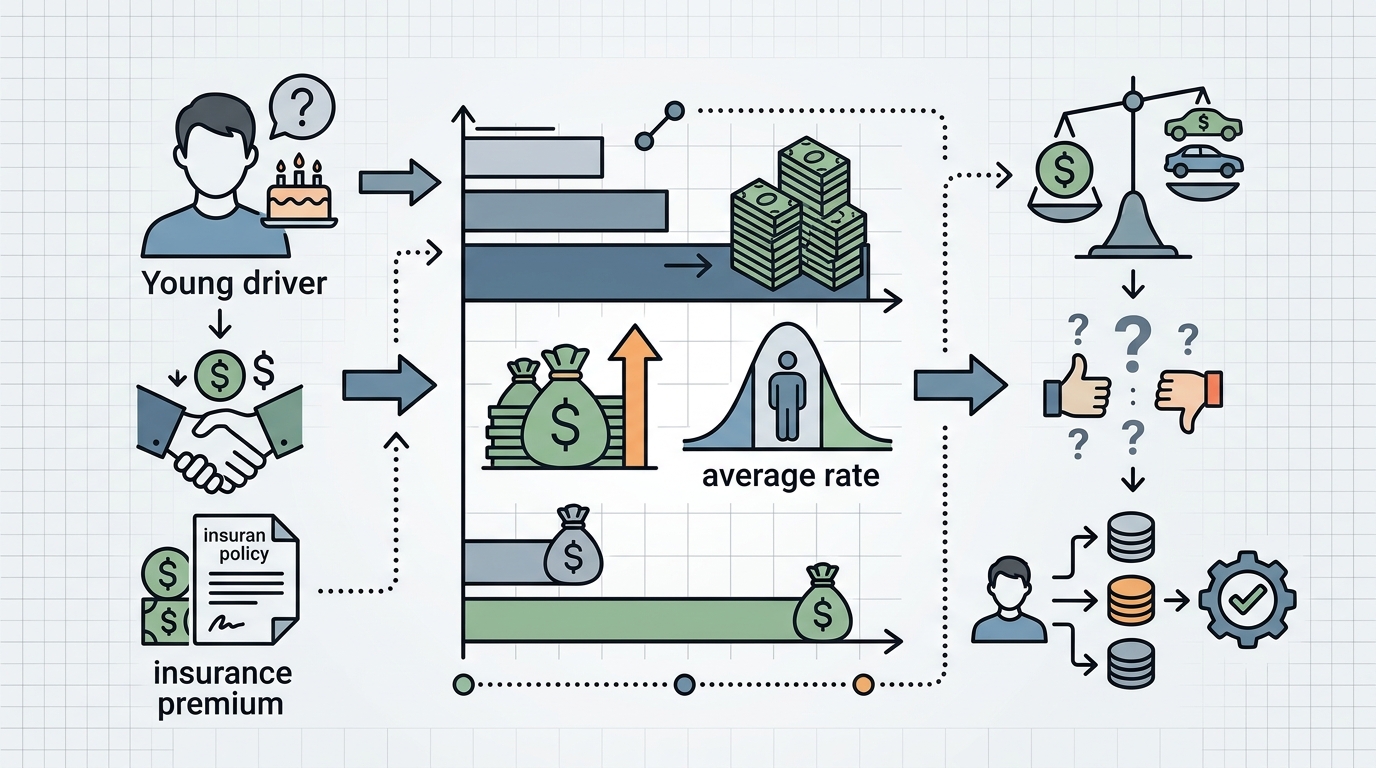
Whether $250 a month is normal for a 25-year-old depends almost entirely on what it buys. For full coverage — liability plus comprehensive and collision — in a higher-cost state, it sits inside the plausible range. For state-minimum liability only in a low-cost territory, it would sit above what a clean-record 25-year-old is typically quoted, because minimum coverage prices below full coverage at every company shown in ValuePenguin's comparison of 25-year-old rates (ValuePenguin, October 2026).
There is no single national "normal" to measure against, because the same driver can be quoted very different numbers in two zip codes a county apart. What you can do is compare your number against the right benchmark: same state, same coverage limits, same deductibles, same vehicle, same drivers listed.
What's Behind This Number
A premium is not a price list item. It is the output of your insurer's filed rating plan applied to your specific facts, so two "25-year-old" quotes can be built from completely different inputs.
The inputs that move the number most:
- Coverage tier. State-minimum liability only, versus full coverage (liability plus comprehensive and collision). These are not the same product and should never be compared head to head.
- Limits and deductibles. A minimum-limits liability policy and a higher-limit policy with physical damage attached are different purchases, even from the same company on the same day.
- Garaging zip code. Territory rating reflects local claim frequency, theft, repair labour rates and litigation patterns.
- State rules. Whether your state is no-fault (you carry personal injury protection and recover first-party medical from your own insurer) or at-fault/tort changes what you must buy and what it costs. Some states also restrict or ban the use of credit-based insurance scores, and there are states where insurers cannot use gender to rate car insurance at all (ValuePenguin, October 2026).
- Carrier and underwriting company. A single brand often writes through multiple companies with different rate levels; the one you are placed in depends on underwriting.
For benchmarks, two named sources are worth knowing. The National Association of Insurance Commissioners publishes an Auto Insurance Database reporting the national combined average premium per issued vehicle and the national average expense per insured vehicle per year for 2023, plus national total liability incurred losses for 2022 (NAIC, 2023). Those are industry-wide figures across all ages and coverage tiers — useful for direction of travel, not for judging a 25-year-old's quote.
For age-specific numbers, ValuePenguin publishes an average monthly cost of car insurance for a 25-year-old, broken out by coverage tier, company and state, priced on a stated set of coverage limits and a single test vehicle using insurer rate data (ValuePenguin, October 2026). Read that methodology line before you compare: if the test limits are higher than yours, the published figure is not your figure.
And a quote is not a bound premium. Verified driving history, prior-insurance records and vehicle inspection can all move the final number.
Average Rates by Category
Every row below comes from the same dataset — ValuePenguin's analysis of 25-year-old driver rates (ValuePenguin, October 2026), priced on its stated coverage limits and test vehicle. Pull the current dollar figures for your own state and coverage tier from that source before you draw a conclusion; what the table gives you is the direction each variable pushes the number.
| Comparison (driver age 25, same test vehicle) | Coverage tier | What the ValuePenguin October 2026 dataset shows |
|---|---|---|
| Cheapest vs most expensive of the four states compared | Full coverage | A rate gap between the lowest- and highest-cost of those states for the identical profile |
| Same four states | Minimum liability | Prices below the full-coverage figure in every state shown |
| Age 20 vs age 25 | Full coverage | The 20-year-old pays more than the 25-year-old |
| Age 25 vs older age bands | Full coverage | Cost by age continues to fall past 25, not stop there |
| Licensed since 16 vs first licensed at 25 | Full coverage | Getting licensed and insured for the first time at 25 costs more |
| Male vs female at 25 | Full coverage | A gender rate difference, except in the states where insurers cannot use gender |
| Cheapest company among non-military-restricted carriers | Full coverage | Published separately from military-restricted carriers |
| USAA | Full coverage | Published separately because eligibility is limited to military-affiliated drivers |
| Selected companies | Full coverage and minimum coverage | Both tiers published per company; the spread between carriers for the same profile is wide |
Two cautions. First, no company in that comparison is "cheapest" for you — ranking reorders by zip code, record, vehicle and the underwriting company you land in. Second, the national combined average premium per issued vehicle (NAIC, 2023) is an all-ages, all-tiers figure and is not a benchmark for a 25-year-old's full-coverage quote.
What Pushes You Above or Below Average
- Coverage tier. The single biggest lever. Full coverage adds comprehensive and collision on top of liability, and full coverage prices above minimum coverage for 25-year-olds at every company and state shown (ValuePenguin, October 2026). If your $250 buys minimum liability only, something else in your file is driving it.
- Garaging zip code. Territory is one of the largest factors after coverage tier. Moving across a city line can change the rate materially with no change to you or the car.
- At-fault accidents and moving violations. Causing accidents or getting tickets pushes rates up (ValuePenguin, October 2026). The surcharge size depends on the violation type and the insurer's filed plan — a minor speeding citation and a DUI are not in the same band. Ask your insurer for two separate answers: how many years the event stays on your motor vehicle record under state law, and how many years their filed rating plan counts it. Those periods often differ.
- Length of licensure. Getting licensed and insured for the first time at 25 costs more than being licensed since 16 (ValuePenguin, October 2026). Years of driving history, not just age, is a rated variable.
- Lapse in coverage. A gap in continuous insurance commonly moves you to a worse tier at new business and can cost you a prior-insurance discount, pushing the rate up rather than down.
- Credit-based insurance score, where state law permits it. Several states ban or restrict its use, so this factor may not apply to you at all.
- Gender, at age 25, except in the states where insurers cannot use gender to rate car insurance (ValuePenguin, October 2026).
- Vehicle make, model and year. Repair cost and parts availability feed directly into comprehensive and collision pricing. Average incurred loss per collision claim rose year over year (NAIC, 2023), and that pressure shows up in physical-damage rates.
- Annual mileage and commute use. Lower mileage bands usually rate lower, but the breakpoints are set in each insurer's filing — ask where they fall before you re-state your mileage.
- Market-wide pressure. Liability premiums grew faster than the number of insured vehicles between 2019 and 2023 (NAIC, 2023), so part of a renewal increase may have nothing to do with you.
How to Lower Your Rate Without Cutting Coverage
- Raise your comprehensive and collision deductible from $500 to $1,000. Premium falls; your out-of-pocket on each covered physical-damage claim rises by $500. Only do this if you can absorb $1,000 on short notice. Your liability limits are untouched.
- Bundle auto with renters or homeowners at the same carrier. Multi-policy discounts are filed by company and differ between them. Trade-off: your two policies then share a renewal relationship, so a claim on one can affect how both are reviewed.
- Ask for a usage-based program by name — Progressive Snapshot, State Farm Drive Safe & Save, Allstate Drivewise, Nationwide SmartRide or Root. Ask one specific question before enrolling: does the filed program allow the rate to go up based on recorded driving, or only down? The answer differs by company and by state.
- Ask whether paid-in-full, paperless and automatic-payment discounts apply. These change billing mechanics only, not coverage. Paid-in-full requires the full term up front.
- Verify your rated facts. Confirm the garaging address, annual mileage, commute distance and vehicle trim on the declarations page. A wrong mileage band or an old address can hold the rate above where it belongs.
- Ask about a state-approved defensive driving course discount. Availability, the approved provider list and how long the discount runs are set by state and by insurer.
- Shop at every renewal — three to five quotes, every six or twelve months depending on your term — at identical inputs. Same bodily injury and property damage limits, same deductibles, same uninsured motorist limits, same effective date, same listed drivers. If one quote is at minimum limits and another at higher limits, you are not comparing prices.
- Do not let coverage lapse while switching. Set the new policy's effective date on or before the old policy's cancellation date, with no gap at all.
- Keep liability limits where they are. Cutting liability to state minimum is the one "saving" that transfers risk straight back to you; raising a deductible caps your exposure at a known dollar amount, dropping liability does not.
Questions
I want to switch carriers mid-term. Will I be penalised?
Check whether your policy cancels pro-rata (refund proportional to unused days) or short-rate (a cancellation penalty withheld) — your declarations page or your state's cancellation rule will say which applies. Two mechanics matter more than the refund: set the new policy's effective date so there is no gap at all, and cancel in writing with the old carrier rather than just stopping payment, because a non-pay cancellation can follow you as a lapse into your next rating tier.
I'm moving to another state. Does my policy move with me?
No. Your policy is written on your current state's forms and will need rewriting for the new state — new minimum limits, possibly personal injury protection if the new state is no-fault rather than at-fault/tort, and a new garaging zip code. The state effect alone can be large: across the four states compared for 25-year-old full-coverage rates, there is a rate gap between the cheapest and the most expensive of them for the identical driver (ValuePenguin, October 2026). Tell your insurer before you move and check the new state's registration deadline.
I only got my licence at 25. Why is my quote higher than my friend's?
Years licensed is rated separately from age. Getting licensed and insured for the first time at 25 costs more than being licensed since 16, on the same coverage and vehicle (ValuePenguin, October 2026). That gap narrows as you build continuous driving and insurance history, so re-shop at each renewal rather than assuming the rate is fixed.
Will my premium fall automatically once I'm past 25?
There is no single birthday cliff. Full-coverage cost by age keeps declining through the older bands, and 20-year-olds already pay more than 25-year-olds for the same coverage (ValuePenguin, October 2026). A renewal can also rise for reasons unrelated to you: liability premiums grew faster than insured vehicles from 2019 to 2023, and average incurred loss per collision claim rose year over year (NAIC, 2023). Ask your insurer for the specific reason given for any renewal increase.
Should I add my partner or a roommate to the policy?
Insurers generally require licensed household members to be listed or formally excluded by signed endorsement. Adding a driver with a clean record and their own car can sometimes help through a multi-car discount; adding one with an at-fault accident or a ticket will push the rate up, because causing accidents and getting tickets raise rates (ValuePenguin, October 2026). Ask for the premium both ways before you decide, and never leave a regular driver of your car off the policy.