By the Drivers Compass editors · Updated October 31, 2026
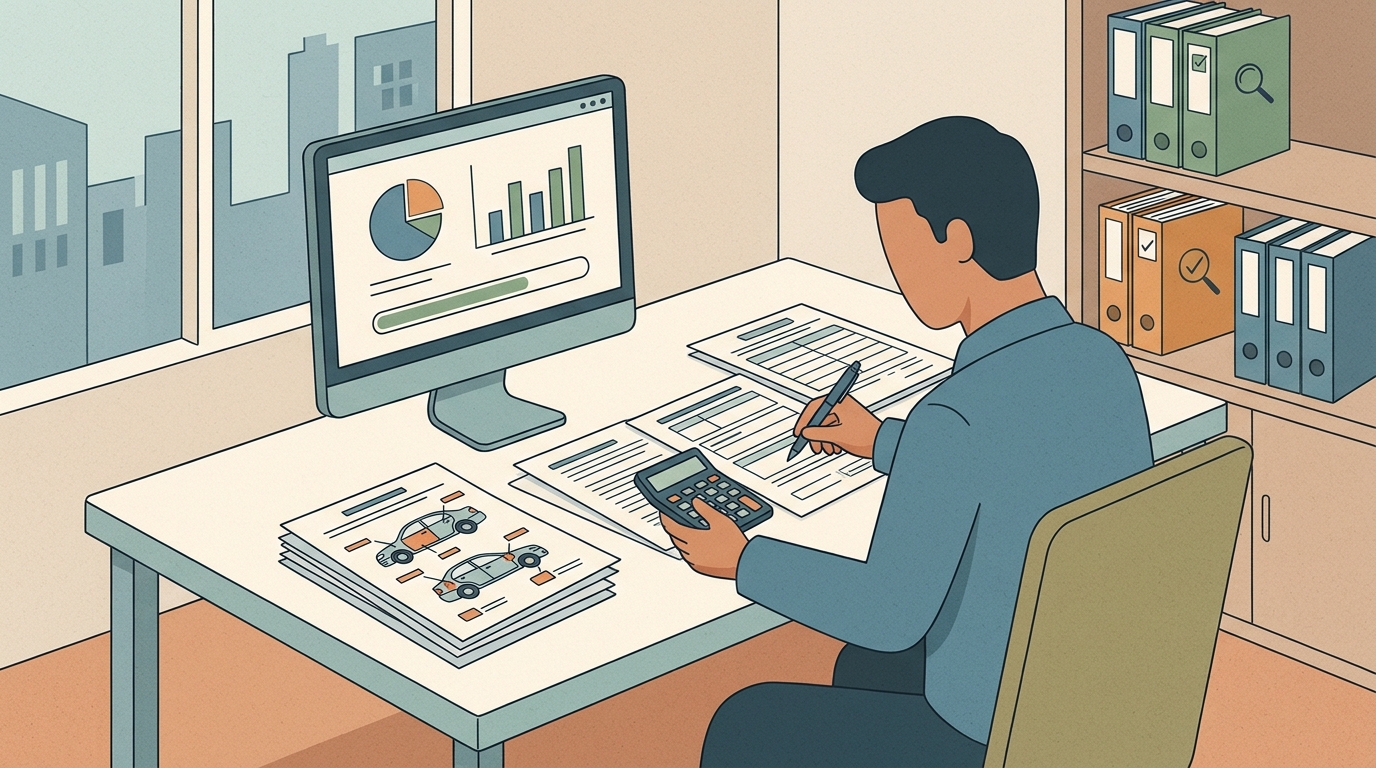
A diminished value (DV) claim seeks the difference between what your vehicle was worth before a crash and what it is worth after repairs, because a repaired accident shows up in the vehicle history that buyers and dealers check. In almost every state the claim is a third-party claim filed against the at-fault driver's insurer — all U.S. states and territories except Nebraska allow that route (Wikipedia, undated) — while a first-party claim against your own insurer is rejected in most states, with Georgia and North Carolina as the notable exceptions (Diminished Value of Georgia, 2025-03-19).
Whether you recover anything, and how much, depends on your state's case law, the policy's own language, your proof of pre-accident value, and the severity of the damage. Nothing below guarantees payment on any claim.
What Happens After You File
Your notice of claim creates a file. The insurer assigns a claim number and routes it to an adjuster — in a third-party DV claim, usually a property-damage liability adjuster at the at-fault carrier, not the appraiser who wrote the repair estimate. The carrier then sets a reserve: an internal dollar estimate of what the file may cost, which is often set low on DV because the adjuster has only the repair invoice at that point and no valuation evidence from you.
State unfair-claims-practices rules drive what happens next, and they are not uniform. Arizona requires an insurer to acknowledge receipt of a claim notice within a set period unless it pays within that same period (Cornell Law School Legal Information Institute, undated). New Jersey's regulation requires the insurer to commence an investigation within a set period of receiving notice of claim for claims other than auto physical damage, and sets outside payment periods for third-party property damage and third-party bodily injury claims absent clear justification (Cornell Law School Legal Information Institute, undated). Under the Texas Prompt Payment of Insurance Claims statute, the insurer must notify the claimant of acceptance or rejection within the statutory period after receiving all information it needs, or state that it cannot yet decide (Thompson Coe, 2022-03); a violation exposes the insurer to the insured's attorney fees plus statutory damages (Property Insurance Coverage Law Blog, undated).
Investigation on a DV file means verifying liability, confirming repairs were completed, and valuing the loss. Many carriers calculate their offer with the 17c formula — a 10% cap on pre-accident value, then a damage-severity modifier and a mileage modifier (Conduit Law, undated). That is the insurer's internal method, not a legal standard, and it is the number your own appraisal exists to rebut.
Step-by-Step Filing Process
- Driver, at the scene or within days: photograph the damage, the odometer and the VIN plate, and write down the police report number. Confirm which insurer is liable — the at-fault driver's carrier for a third-party claim, or your own carrier only if you are in Georgia or North Carolina, the states where a policyholder can pursue DV against their own insurer (Diminished Value of Georgia, 2025-03-19).
- Driver: open the claim with the at-fault driver's insurer and ask the claims department for a claim number and the assigned adjuster's name, direct line and email. This is the recommended first step for a DV claim (CarInsurance.com, undated).
- Body shop: complete repairs and issue a final itemized invoice showing every supplement, part number and whether parts were OEM, aftermarket or used.
- Driver: document pre-accident value and get a written trade-in value letter from a dealer on letterhead (CarInsurance.com, undated).
- Driver: order an independent appraisal prepared to USPAP standards, which serves as the proof of loss in a DV claim (Wikipedia, undated). Allow time for the appraiser to inspect the repaired vehicle.
- Driver: send a written demand package to the adjuster — appraisal, repair invoice, trade-in letter, vehicle history report — and ask for a written decision.
- Adjuster: investigates and responds, typically with a 17c-based figure (Conduit Law, undated). Compare it line by line to your appraisal.
- Driver: if the response is a denial or a figure you dispute, ask in writing for the specific policy clause or case law relied on, then escalate to a claims supervisor and, if needed, file a complaint through your state department of insurance complaint portal.
- Driver: satisfy every remaining claim condition the carrier identifies before closing (CarInsurance.com, undated), and get the release language in writing before signing.
- Driver: if unresolved, file suit before the statute of limitations runs from the date of loss (Diminished Value of Georgia, 2025-03-19) — two years in most states, three in North Carolina, five in Missouri (CarInsurance.com, undated).
Documents and Evidence to Gather
- Police report number, and a printed copy of the report itself.
- Photographs of the damage taken before repairs began.
- Photograph of the odometer reading, dated.
- The body shop's written estimate.
- The final itemized repair invoice, including every supplement sheet.
- A vehicle history report showing the accident entry under your VIN.
- A trade-in value letter from a franchise dealer, on letterhead and signed.
- An independent appraisal report prepared to USPAP standards (Wikipedia, undated).
- Your vehicle title or registration showing ownership.
- The lease agreement and residual-value page, if the vehicle is leased.
- Service and maintenance records establishing condition before the loss.
- The claim number and the adjuster's written correspondence, including any denial letter.
- Window-sticker or build sheet documenting trim and factory options.
Typical Claims Timeline
Timelines are set by each state's claim-handling rules, not by a national standard, and the controlling day counts are written into the statute or regulation text for your state. Look yours up before you accept a delay as normal.
| Milestone | Who acts | What sets the clock |
|---|---|---|
| Acknowledgment of claim notice | Insurer | Arizona requires acknowledgment within a set period unless payment is made within that period (Cornell Law School Legal Information Institute, undated) |
| Start of investigation | Adjuster | New Jersey requires investigation to commence within a set period of notice for claims other than auto physical damage (Cornell Law School Legal Information Institute, undated) |
| Appraisal inspection | Independent appraiser, after repairs are finished | Scheduled by you; no statute governs it |
| Accept-or-reject decision | Insurer | Texas requires notice of acceptance or rejection within the statutory period after all needed information is received, or a statement that it cannot yet decide (Thompson Coe, 2022-03) |
| Payment | Insurer | New Jersey sets maximum payment periods for third-party property damage and third-party bodily injury claims absent clear justification (Cornell Law School Legal Information Institute, undated) |
| Suit filed | You | Two years from date of loss in most states, three in North Carolina, five in Missouri (CarInsurance.com, undated) |
Texas adds a financial consequence: an insurer that breaches those deadlines owes attorney fees plus statutory damages (Property Insurance Coverage Law Blog, undated). Most states have no equivalent penalty, so the practical enforcement tool is a department of insurance complaint.
Common Mistakes That Delay Payout
- Filing against your own insurer outside Georgia or North Carolina. Most states reject first-party DV claims in ordinary accident cases through case law, insurer practice or policy wording (CarInsurance.com, undated), so the file is closed and the two-year clock keeps running.
- Signing the property-damage release before the DV claim is resolved. A full and final release clause typically ends any further recovery on the same loss, including DV.
- Accepting the adjuster's 17c number without a competing appraisal. The formula caps the result at 10% of pre-accident value before severity and mileage reductions (Conduit Law, undated) — $1,500 at most on a $15,000 car (CarInsurance.com, undated).
- Submitting a dealer's phone estimate instead of a written valuation. A USPAP-compliant appraisal is what functions as proof of loss (Wikipedia, undated); informal opinions are easily discounted by the adjuster.
- Arguing that a good repair erased the problem. Roughly 70% of used cars are sold to dealers who check accident history, per Richard Hixenbaugh of Collision Claim Associates (CarInsurance.com, undated), which is the basis of the loss you are claiming.
- Claiming on a leased vehicle without the lease paperwork. Leased-vehicle DV claims succeed at a different rate than owned-vehicle claims (Diminished Value of Georgia, 2025-03-19), and the lessor, not you, may hold the right to recover.
- Negotiating only by phone. With no written demand and no written denial, a department of insurance complaint has nothing to review.
- Waiting past the limitations period. The clock runs from the date of loss (Diminished Value of Georgia, 2025-03-19), not from the date repairs ended or the denial arrived.
Questions
How long do I have to file a diminished value claim?
Most states allow two years from the date of loss, with North Carolina at three years and Missouri at five (CarInsurance.com, undated). The clock runs from the date of the crash, not from the repair date or the denial letter (Diminished Value of Georgia, 2025-03-19). Check your own state's limitations period, because the figure differs state by state and expiring it ends the claim.
Can I file a diminished value claim against my own insurance company?
In most states, no. Georgia and North Carolina are the states where a policyholder can pursue diminished value against their own insurer (Diminished Value of Georgia, 2025-03-19); elsewhere, case law, insurer practice or policy wording generally blocks first-party DV claims in ordinary accident cases (CarInsurance.com, undated). Third-party claims against the at-fault driver's insurer are allowed in every U.S. state and territory except Nebraska (Wikipedia, undated).
What is the 17c diminished value formula?
It is the calculation many insurers use internally: a 10% cap on the vehicle's pre-accident value, then a damage-severity modifier and a mileage modifier (Conduit Law, undated). On a $15,000 market value, 10% gives a $1,500 ceiling before those multipliers reduce it further (CarInsurance.com, undated). It is the carrier's method, not a legal standard, which is why an independent appraisal matters.
What proof does an insurer accept for diminished value?
An independent appraisal prepared to USPAP standards serves as proof of loss in a diminished value claim (Wikipedia, undated). Pair it with documentation of pre-accident value and a written trade-in value letter from a dealer (CarInsurance.com, undated), plus the final repair invoice and a vehicle history report showing the accident under your VIN.
Which states are most favorable to diminished value claims?
States that generally allow DV claims against the at-fault driver's insurer include Georgia, North Carolina, Washington, Arizona and Florida, with Georgia described as especially favorable (CarInsurance.com, undated). Other states limit recovery through case law, insurer practice or policy wording (CarInsurance.com, undated). Nebraska is the only U.S. jurisdiction that does not allow third-party DV claims (Wikipedia, undated).