By the Drivers Compass editors · Updated October 31, 2026
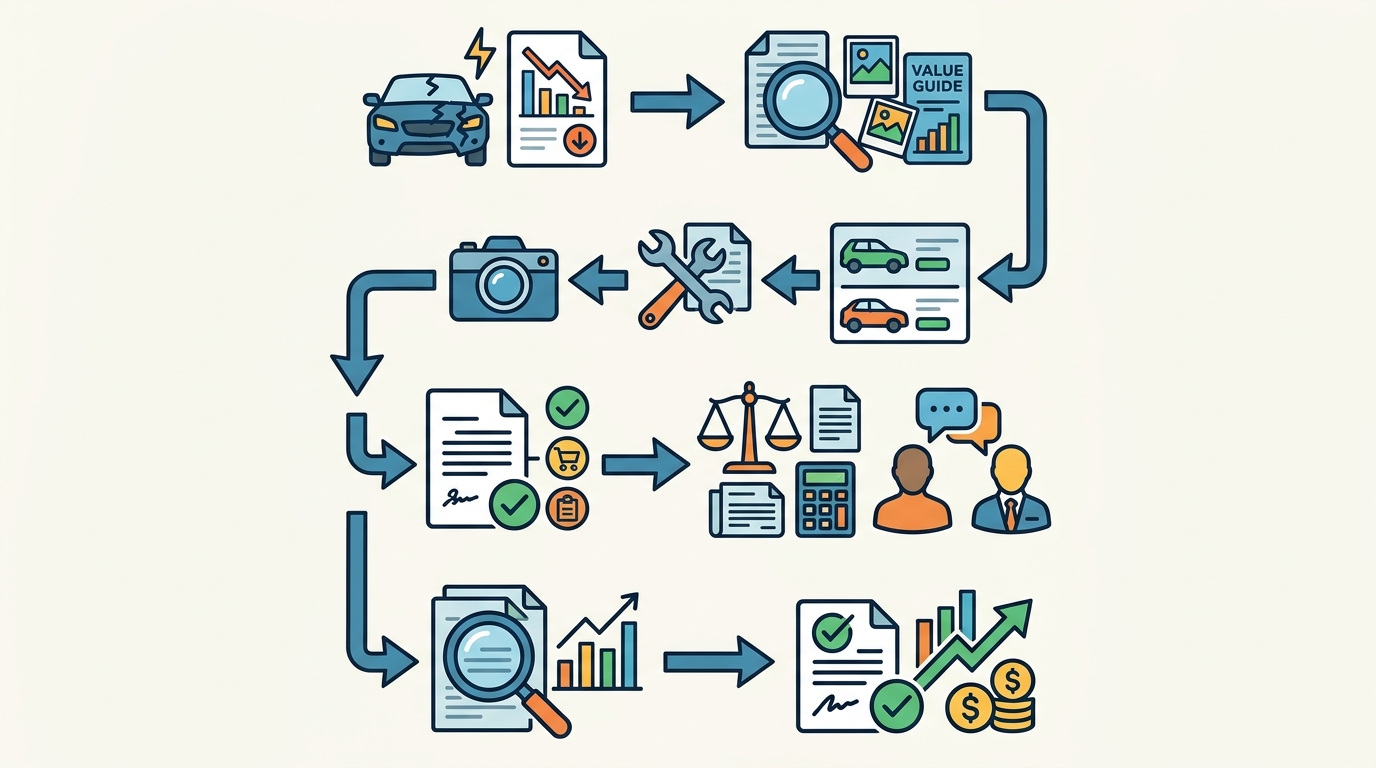
A total loss "denial" is usually not a refusal to pay — it is an offer built from a computerised valuation report you believe understates your car. You appeal by getting that report, checking every comparable vehicle and condition deduction against what your policy and your state require, and putting the errors in writing to the claims adjuster before the file closes.
Your routes then split. First-party claims on your own collision or comprehensive coverage usually have an appraisal clause in the Damage to Your Auto section; a claim against the at-fault driver's insurer does not (Autobody News, undated). A Department of Insurance complaint is a separate, external track that reviews conduct, not price.
Why Insurers Deny Claims Like This
Five clause types produce most total loss valuation disputes. Find each in your own policy before you write anything.
1. The actual cash value definition (definitions section, plus the Limit of Liability condition). Collision and comprehensive pay the lesser of ACV or repair cost — not what you paid, not what you owe, not dealer retail off the lot. The first question is whether the adjuster applied the ACV definition correctly, not whether ACV is the right measure.
2. The valuation method (statutory and regulatory conditions on settlement). Model regulation language long used as the benchmark requires a cash settlement based on the actual cost to purchase two or more comparable vehicles in the local market, or a value from a statistically valid database meeting listed criteria (NAIC, 1997-07). That database must give primary consideration to local market values and produce values for at least 85% of all makes and models for the last 15 model years (NAIC, 1997-07). Florida's statute permits comparables from the local market area within the preceding 90 days, a recognised industry database or guidebook, or two or more dealer quotations (Florida Legislature, Online Sunshine, undated). Industry commentary treats the model wording as reasonably inferring the retail dealer market as the valuation basis (IRMI, undated). Whether any of that binds your insurer depends on your state's adoption — check your Department of Insurance regulations, not the model.
3. Condition and prior-damage deductions (Limit of Liability condition; any prior damage exclusion). Deductions for tyres, paint, interior wear or unrepaired damage are judgement calls made from photographs, which is why they are the most frequently overstated line items.
4. Custom parts and equipment limits (an exclusion or sublimit inside Damage to Your Auto). Aftermarket wheels, lift kits and sound systems are often capped at a low sublimit or excluded unless endorsed.
5. Proof-of-loss and cooperation conditions (duties after a loss). Without mileage verification, service records, option documentation or a signed proof of loss, the insurer's clock may not have started. In California the insurer has 40 calendar days from receipt of proof of claim — not from the date you reported the loss — to accept or deny under 10 CCR § 2695.7(b) (Sky Law Group, 2026).
If your claim is against the at-fault driver's insurer, none of your policy's conditions govern it. That is a liability negotiation measured by your state's damages law.
Step-by-Step Appeal Process
Day counts run from the date printed on the denial or final offer letter. Steps 1–5 are the internal insurer appeal. Step 6 is the external regulator track; it runs in parallel and does not replace the internal one.
- Days 0–7 — request the full valuation report in writing. Email the named claims adjuster, copying the claims department, asking for the complete vendor report (CCC ONE, Mitchell or Audatex) with every comparable vehicle, source listing and condition adjustment (AutoACV, 2026). A summary sheet is not the report.
- Days 7–14 — audit each comparable. Check manufacturer, model year, body type, options and mileage against your vehicle, and confirm the listings came from your local market area. Florida's definition of a comparable motor vehicle is a concrete standard to test against (Florida Legislature, Online Sunshine, undated); your state may use its own or rely on the insurer's filed method.
- Days 14–21 — build replacement-cost evidence. Collect dated local dealer listings for genuinely comparable cars and, where your state recognises them, two or more written dealer quotations (Florida Legislature, Online Sunshine, undated). Add service records, tyre receipts and option documentation to rebut condition deductions.
- Days 21–30 — submit the written appeal and request supervisor review. Send a line-by-line rebuttal, not a narrative, and ask in the same letter for escalation to a claims supervisor or total loss review unit. In California, also demand in writing that the file be reopened within 35 calendar days of payment or final offer under 10 CCR § 2695.8(c) (Sky Law Group, 2026).
- Days 30–45 — invoke the appraisal clause if this is a first-party claim. It is an informal, contractually embedded dispute-resolution method for first-party physical-damage claims and is not available for third-party liability claims (Autobody News, undated). Either side may invoke it instead of going straight to litigation (Conduit Law, undated). Read your own clause for the day count and whether the insurer must agree.
- Days 45–60 — file a Department of Insurance complaint through your state's online complaint portal. The regulator reviews claims-handling conduct against your state's unfair claims settlement practices rules; it does not set your car's value. In California the insurer must answer a Department inquiry within 21 calendar days under 10 CCR § 2695.5(a) (Sky Law Group, 2026).
- Throughout — diary the suit-limitation condition. Your policy bars suit after a fixed period from the loss, and appraisal or a DOI complaint does not usually pause it. For a claim against the other driver's insurer, the controlling clock is your state's tort statute of limitations.
For third-party claims, skip step 5 and substitute a written demand letter to the liability adjuster setting out your valuation evidence and your state's measure of damages — in California, Civil Code § 3333 entitles a claimant to the amount which will compensate for all the detriment proximately caused (Sky Law Group, 2026).
Sample Appeal Letter
Send by email to the adjuster, copy the claims department, and keep the delivery confirmation.
First-party total loss valuation appeal
Written appeal of total loss valuation — Claim No. [claim number]
[Date]
[Insurer legal entity name], Claims Department Attn: [adjuster name], Claim No. [claim number] Policy No. [policy number] | Date of loss: [date] | Vehicle: [year, make, model, trim, VIN]
I am appealing the total loss offer of [offer amount] dated [date of offer letter]. The stated basis was [quote the denial or offer reason exactly as written]. I ask for a corrected valuation under [cite the policy section — e.g. Part [X], Damage to Your Auto, Limit of Liability condition] and, where applicable, [cite your state's total loss settlement statute or regulation].
The valuation report contains these errors:
1. Comparable [#] is a [trim/body type] with [mileage] miles and lacks [specific options on my vehicle]. Attached: the vendor report page and my window sticker/build sheet. 2. Comparables [#] and [#] are [distance] miles from my garaging zip code and are not local market vehicles. Attached: a printed listing page for each showing location and date. 3. A condition deduction of [amount] was applied for [item]. Attached: invoice from [vendor] dated [date] showing [work] completed at [mileage]. 4. [Option/equipment] was omitted. Attached: dealer installation invoice dated [date].
I also attach [number] dated local listings matching my vehicle's manufacturer, model year or newer, body type, options and mileage, priced from [low] to [high], and [number] written dealer quotations from [dealer names].
Please have a claims supervisor or your total loss review unit send a written, itemised response identifying which adjustments you accept and reject, with the reason for each. If the valuation is not resolved, I am invoking the appraisal clause in [cite the policy section] and will name my appraiser within [number] days of your reply.
[Name] | [Address] | [Phone] | [Email]
Enclosures: vendor valuation report; [number] dated comparable listings; [number] dealer quotations; service invoices dated [dates]; window sticker/build sheet; photographs dated [date].
Where to Escalate If the Appeal Fails
- State Department of Insurance complaint. Free, filed through the DOI's online complaint portal. In California the insurer must answer a Department inquiry within 21 calendar days under 10 CCR § 2695.5(a) (Sky Law Group, 2026); other states set their own windows. Suits any claim size because it costs nothing, but the regulator reviews handling conduct, not the dollar value. Under the NAIC Unfair Trade Practices Model Act, a first-tier penalty for a claims-settlement violation is not more than $1,000 per violation and $100,000 in aggregate unless committed flagrantly and in conscious disregard of the Act (NAIC, 2024); adoption varies by state.
- Appraisal clause (first-party only). One industry source estimated appraisal-clause arbitration typically runs $500 to $1,500 depending on repair complexity (Autobody News, undated); a quoted policy provision has each appraiser paid by the party selecting him, with appraisal and umpire expenses split equally (Stafford Claims Consulting, undated). Weeks to a few months. Best where the valuation gap comfortably exceeds your share of those costs. Not available against the at-fault driver's insurer (Autobody News, undated).
- Mediation. Cost and availability vary by state; some states run or require an auto claim mediation programme, often with the insurer bearing most of the fee. Usually faster than court. Suits mid-sized gaps where both sides want a number rather than a ruling. Check your DOI consumer services page for whether a programme exists.
- Consumer arbitration. For American Arbitration Association consumer cases, the fee schedule limits consumers' costs to a capped administrative filing fee, with waivers for those who qualify (AAA, undated). Months. Only relevant if your policy or a related agreement sends disputes there.
- Small claims court. A modest county filing fee, usually no lawyer, weeks to months to a hearing. Limits are local: the individual limit in San Francisco Superior Court is $12,500, with a different, lower limit for corporations, partnerships and governmental entities (Superior Court of California, County of San Francisco, undated); in Massachusetts an award may exceed the standard $7,000 cap where the case is based on property damage sustained in an automobile accident (Mass.gov, undated). Suits gaps under your county's cap.
- Attorney. Hourly, flat fee or contingency depending on claim type and state; months to years. Worth pricing when the gap is large or the handling looks like a violation. Whether a policyholder can sue an insurer directly for unfair claims settlement practices, and what damages are available, varies by state statute (NAIC, 2023). An attorney is also the route for third-party damages theories such as California's Civil Code § 3333 measure (Sky Law Group, 2026).
Questions
What actually happens if I miss the appeal deadline?
The administrative route closes and you are left with contract or court remedies. In California, missing the 35 calendar days from payment or final offer to demand reopening under 10 CCR § 2695.8(c) (Sky Law Group, 2026) lets the insurer treat the file as closed. Most states have no equivalent clock, so the operative limit becomes your policy's suit-limitation condition or your state's statute of limitations — after which no forum will hear it.
Does cashing the settlement cheque end my appeal?
It depends on what you sign, not the cheque alone. A payment accompanied by a full release, or marked as settlement in full, is different from an undisputed partial payment. Before depositing anything, read the release language and ask the adjuster in writing to confirm the payment is partial and the file remains open. The effect of accepting payment varies by state law.
Can I use the appraisal clause against the other driver's insurer?
No. The appraisal clause sits in your own policy's Damage to Your Auto section and applies to first-party physical-damage claims; it is not available for third-party liability claims (Autobody News, undated). Against the at-fault driver's insurer your tools are a written demand letter with valuation evidence, a Department of Insurance complaint about handling conduct, and then court under your state's damages law.
Will the Department of Insurance tell the insurer to pay more?
Generally not. A DOI complaint tests whether the insurer followed your state's claims-handling rules, including any total loss valuation method the state has adopted. Regulators can require a response, require corrective action and impose penalties — the NAIC model sets a first-tier penalty of not more than $1,000 per violation and $100,000 in aggregate absent flagrant conduct (NAIC, 2024) — but they do not adjudicate your car's value.