By the Drivers Compass editors · Updated October 31, 2026
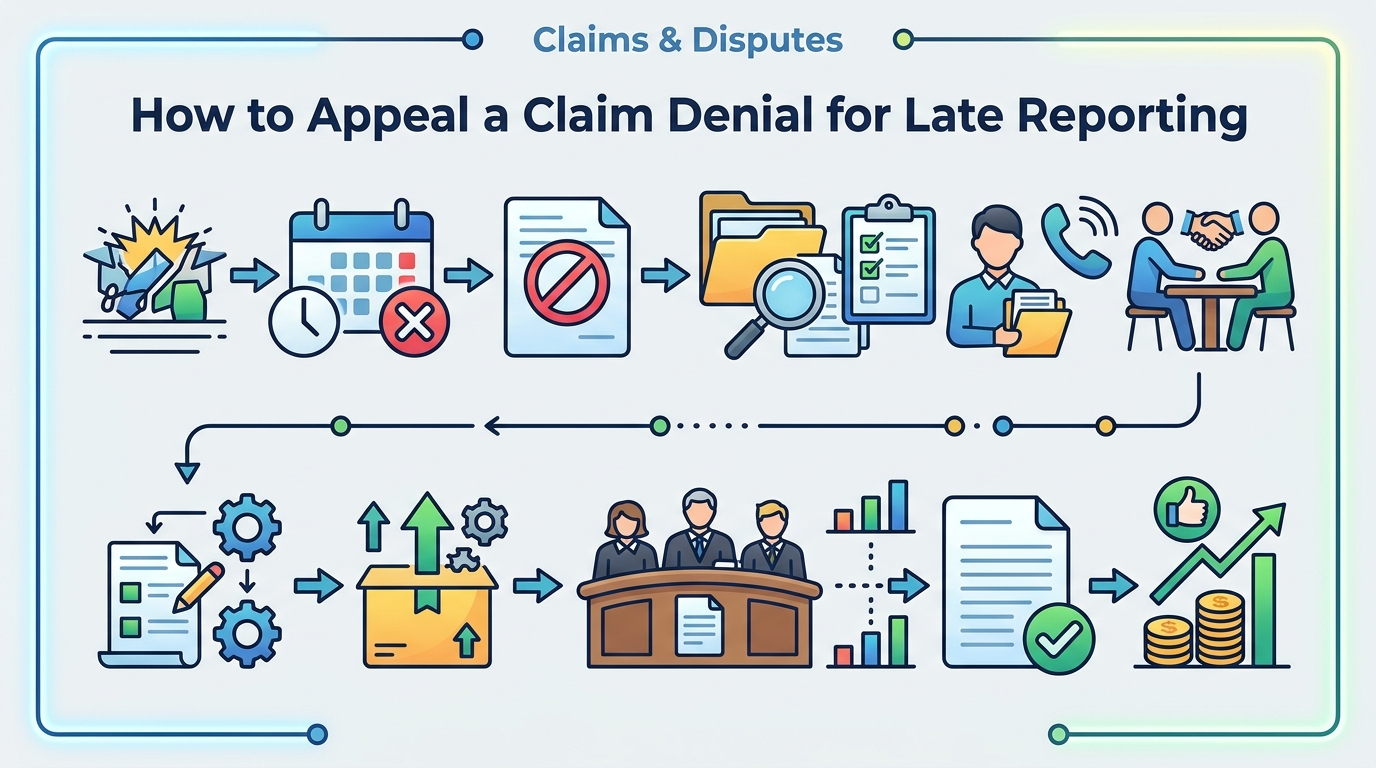
A late-reporting denial is one of the more appealable denials, because in a majority of jurisdictions the "notice-prejudice rule" bars an insurer from denying on late notice unless it shows the delay actually prejudiced it — statutory in some states, judge-made in others (Carlton Fields, 2015). Whether the rule helps you depends on your policy form: most courts refuse to apply it where reporting is built into the coverage grant rather than into a separate condition (Carlton Fields, 2015).
So your appeal makes two arguments: that notice was given as soon as was reasonably possible, and that nothing the insurer needed was lost.
Why Insurers Deny Claims Like This
Put your policy and the denial letter side by side. The letter should name the provision relied on; if it does not, email the claims adjuster and ask in writing which provision, which coverage part and which facts it rests on. You cannot appeal a reason that has not been stated.
1. The "Duties After an Accident or Loss" condition (a condition). Standard personal auto policies require you to notify the insurer "promptly" or "as soon as practicable" and to cooperate with the investigation. Because this sits among the conditions rather than in the insuring agreement, it is the clause the notice-prejudice rule was built for (Carlton Fields, 2015). Wisconsin codifies the point at Wis. Stat. §§ 631.81(1) and 632.26(2): late notice does not bar coverage unless timely notice was "reasonably possible" and the insurer was prejudiced (Carlton Fields, 2015).
2. Reporting written into the coverage grant (insuring agreement or definition). An occurrence policy responds to occurrences during the policy period whenever the claim is made; a claims-made-and-reported policy requires the claim to be both made and reported within a specified time (Carlton Fields, 2015). Most courts decline to apply the notice-prejudice rule to that second form, treating the reporting deadline as defining the scope of coverage, so late reporting bars coverage without any showing of prejudice (Carlton Fields, 2015). Colorado took that view in Craft v. Philadelphia Indemnity Insurance Co., 343 P.3d 951 (Colo. 2015), holding that excusing late notice under a date-certain requirement would rewrite a fundamental policy term (Carlton Fields, 2015).
3. A time-limited coverage part, such as medical payments (a coverage definition). Watch for language requiring expenses to be incurred and reported within a set period. In Brenegan v. Fireman's Fund Ins. Co. (Cal. App. 2015), a California court treated a one-year incurred-and-reported medical-expense clause as analogous to a claims-made clause, and so exempt from the notice-prejudice rule, because reporting was an element of coverage (Carlton Fields, 2015).
4. Asserted prejudice to the investigation (the insurer's burden where the rule applies). The adjuster points to what the delay cost: the car was repaired or sold before inspection, a witness is gone, a default judgment was taken. Each is answerable with dated evidence, and each is the insurer's to prove in notice-prejudice jurisdictions (Carlton Fields, 2015).
5. Late notice added after a denial on other grounds. Not automatically a waiver. In Re/Max Mega Group v. Maxum Indemnity Co., the insurer had not waived the reporting requirement by omitting late notice from its initial coverage disclaimer, because it did not know of the underlying demand letters then and had expressly reserved its rights (Wiley Rein LLP, 2012-03-22).
If you are a third-party claimant pursuing the at-fault driver's insurer, these notice duties are not yours to breach — they bind that insurer's policyholder. Your route is the tort claim against the driver, not an appeal under a policy you are not a party to.
Step-by-Step Appeal Process
Day 0 is the date printed on the denial letter. The day counts below are working targets; the only deadlines that bind you are those in the denial letter, your policy and your state's statutes.
- Day 0 — get the denial in writing. If it came by phone, email the adjuster and request a written denial identifying the policy provision, coverage part and facts relied on.
- Days 1–7 — request the claim file and the policy as issued. Write to the adjuster and the claims supervisor for the certified policy with all endorsements, the activity log, any recorded-statement transcript, and anything showing when the insurer first learned of the loss. Then check whether your notice duty sits in a condition or inside a coverage grant requiring reporting within a stated period (Carlton Fields, 2015).
- Days 5–20 — build two timelines. Yours: when the loss happened, when you learned of it, what prevented earlier notice. Theirs: what was still available to inspect and investigate when you called. In Re/Max, notice roughly two to three months after a 30-day reporting deadline expired defeated coverage (Wiley Rein LLP, 2012-03-22), so length of delay is what you are putting in context.
- Days 20–45 — file the internal appeal. Send a dated reconsideration request to the claims department's appeal or quality-review unit, copying the supervisor, with exhibits attached. For auto claims there is no universal statutory right of internal appeal as there is in health coverage; honour the date the insurer's letter gives.
- Days 45–60 — file a Department of Insurance complaint if the appeal is refused or unanswered. Use your state DOI's consumer complaint portal and attach the denial, your appeal and any response. In most states the DOI requires a written answer and reviews handling under the state's unfair claims practices statute; it generally does not adjudicate contract disputes or order payment.
- Before the suit-limitation date — preserve the legal claim. Find the "Legal Action Against Us" condition and your state's limitations period. In most states neither an internal appeal nor a pending DOI complaint stops that clock.
The tracks diverge at step 4. Against your own insurer you are appealing a contract decision, with possible remedies under your state's bad-faith or unfair claims practices law where that state recognises them. Against another driver's insurer you are negotiating a liability claim, governed by the tort limitations period where the crash happened.
Sample Appeal Letter
Send it to the claims appeal unit and the adjuster's supervisor by a method that produces a delivery record. Replace every bracket.
Written appeal of late-notice denial — first-party claim
Re: Claim No. [claim number] / Policy No. [policy number] / Date of loss [date] / Insured [name]
I am appealing the denial dated [date of denial letter], which states that coverage is barred because notice was not given as required by [quote the exact policy section cited, e.g. Part E, "Duties After an Accident or Loss," paragraph A.1].
1. The provision cited is a condition, not part of the coverage grant. It requires notice "[quote the operative words]" and does not make reporting within a fixed period an element of coverage. In a majority of jurisdictions the notice-prejudice rule bars denial for late notice unless the insurer demonstrates prejudice (Carlton Fields, 2015), and the letter identifies none.
2. Notice was given as soon as was reasonably possible. [State when you learned of the loss or of the claim against you and what prevented earlier notice.] Attached are Exhibit A, [e.g. the emergency department discharge summary dated (date)]; Exhibit B, [e.g. tow invoice No. (number) showing the vehicle's storage dates]; and Exhibit C, [e.g. the (carrier) outgoing-call log showing my first call to the claims line on (date)].
3. The delay did not impair the investigation. [e.g. The vehicle was unrepaired and available until (date), per the repair order at Exhibit D; police report No. (number) was filed on (date); the time-stamped photographs at Exhibit E are dated (date).] If the company maintains it was prejudiced, please identify in writing the specific evidence lost and the date it became unavailable.
4. Reservation. [If applicable: the denial dated (date) relied solely on (other ground) and did not mention late notice, although the company knew (what it knew and when).]
Please confirm receipt, state the date a decision will issue, and provide the complete claim file and the certified policy with all endorsements. If the denial is maintained, please state every provision relied on so I can address it in a complaint to the [state] Department of Insurance.
[Signature, printed name, address, phone, email, date]
Where to Escalate If the Appeal Fails
- State Department of Insurance complaint. No filing fee in any state; filed through the DOI consumer complaint portal. Expect a written insurer response and a regulatory review over weeks to months, varying by state and caseload. Suits claims of any size, including ones too small to litigate, and creates a documented record — but in most states the DOI reviews handling under the unfair claims practices law rather than ordering payment.
- Mediation. Some states run a free or low-cost DOI-administered mediation programme for certain auto or property claims; otherwise you use a private mediator, charging an hourly or per-session fee split between the parties. Usually one session, scheduled within weeks. Best for mid-range claims where both sides face litigation risk.
- Arbitration. Available where your policy's conditions provide for it (commonly uninsured/underinsured motorist disputes) or where both sides agree. You pay a share of the arbitrator's fee plus your own representation; timelines run months rather than years. Whether your state makes UM/UIM arbitration binding on coverage as well as damages varies.
- Small claims court. Filing fees are set by each state's published court fee schedule and are modest; no lawyer needed, hearings usually within weeks to a few months. Capped at your state's statutory small claims limit, which differs widely, so this fits lower-value first-party claims only.
- Insurance coverage attorney. Consultations are often free; many take first-party coverage and bad-faith matters on contingency with costs advanced, while hourly work is realistic only on larger claims. Litigation runs many months to years. Worth the call where the disputed amount exceeds the small claims limit, where the policy is a claims-made-and-reported form so the prejudice argument is unavailable (Carlton Fields, 2015), or where your suit-limitation date is near. Whether a bad-faith cause of action and extra-contractual damages exist depends on your state.
Questions
What happens if I miss the appeal deadline in the denial letter?
An insurer's internal appeal window is a company procedure, not a statutory right for most auto claims, so the file usually stays closed unless you bring new evidence. The deadline that is final is the suit-limitation date in your policy's "Legal Action Against Us" condition or your state's limitations period: the insurer can raise it as a complete bar and courts dismiss on it without reaching the merits.
Does it matter whether my policy is occurrence or claims-made?
It is the decisive question. An occurrence policy responds to occurrences during the policy period whenever the claim is made; a claims-made-and-reported policy also requires reporting within a specified time (Carlton Fields, 2015). Most courts decline to apply the notice-prejudice rule to claims-made-and-reported forms, treating the reporting deadline as defining coverage, so late reporting bars coverage without any showing of prejudice (Carlton Fields, 2015).
How late is too late?
There is no universal number. In Re/Max Mega Group v. Maxum Indemnity Co., notice roughly two to three months after a 30-day reporting deadline expired meant no coverage (Wiley Rein LLP, 2012-03-22). Under a condition-style clause in a notice-prejudice state the test is different: whether timely notice was reasonably possible and whether the insurer was prejudiced, which is how Wisconsin's statute frames it (Carlton Fields, 2015).
The insurer denied for another reason first, then added late notice. Can it do that?
Sometimes. In Re/Max, the court held the insurer had not waived the reporting requirement by leaving late notice out of its initial coverage disclaimer, because it did not then know of the underlying demand letters and had expressly reserved its rights (Wiley Rein LLP, 2012-03-22). Ask the claims department in writing what it knew and when, and whether it reserved rights. Waiver and estoppel doctrines vary by state.