By the Drivers Compass editors · Updated October 31, 2026
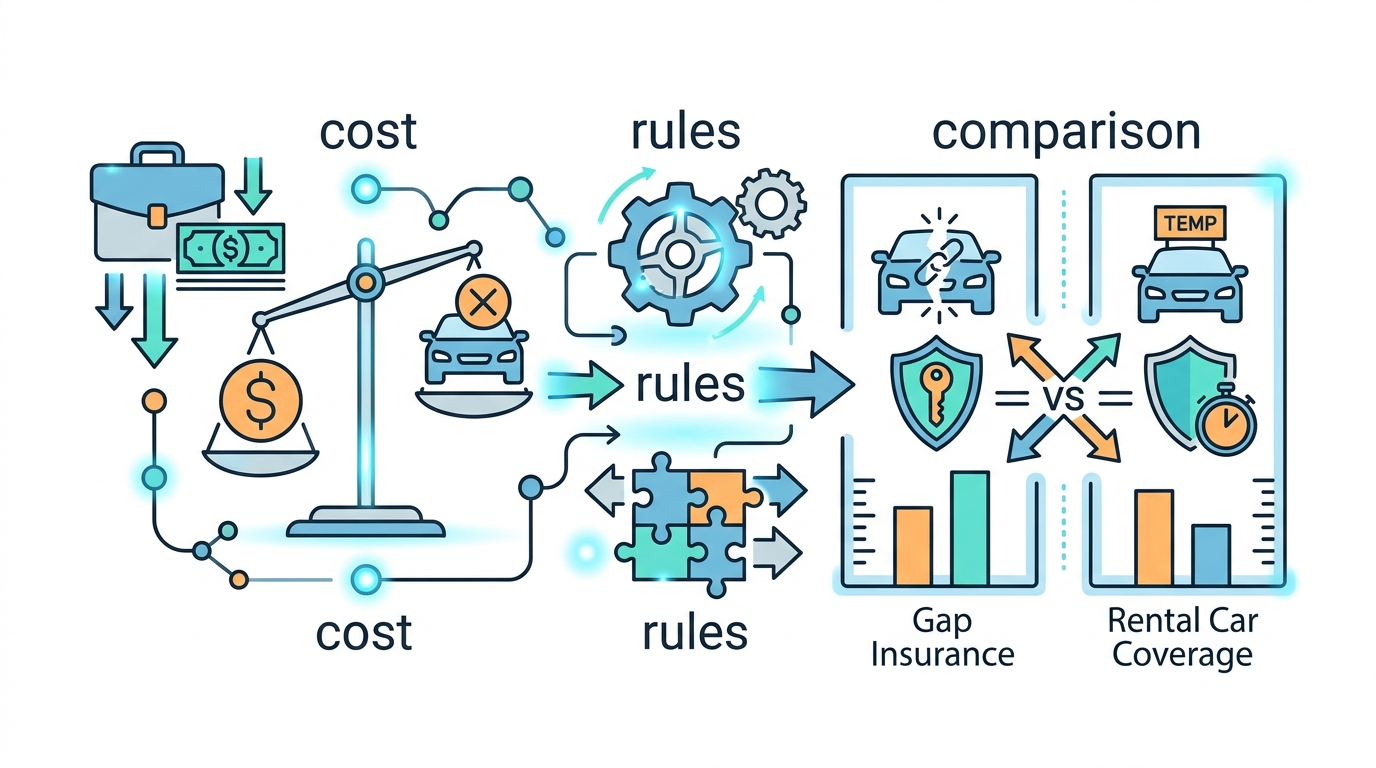
Gap insurance and rental reimbursement solve different problems, and no state's minimum liability law requires either. Gap covers the difference between what you still owe a lender and what your insurer says the car was worth when it was totaled; rental reimbursement pays for a loaner while a covered repair runs. Gap is the one a lease or finance contract can force you to carry, and it typically runs about $144 a year through an insurer (ValuePenguin, undated), against $2 to $15 a month for rental reimbursement (WalletHub, 2026).
Which you need comes down to two documents you can check tonight: your loan or lease statement, and whether your household has a second car.
Cost and Rules by State
No state's financial responsibility law requires either coverage. State minimums cover bodily injury and property damage liability, plus personal injury protection in no-fault states. A gap requirement comes from your lease or finance contract instead. What does change at state lines is how gap is regulated — as filed insurance, or as a debt cancellation waiver sold by the creditor. New York is the clearest published example below.
| Where you buy it | Who requires it | Typical cost (named source) | Duration or filing rule |
|---|---|---|---|
| Gap added to an auto policy | No state mandate; a lease or loan contract can require it | $50 to $250 per year, $144 typical (ValuePenguin, undated) | Rides on comprehensive and collision; ends if you drop those or the policy lapses |
| Gap billed monthly with premium | Same | $4 to $7 per month, Progressive averaging about $4 (MoneyGeek, undated) | Recharged each installment; usually removable once the loan is paid |
| Low end of insurer pricing | Same | Nationwide and Travelers averaged about $50 a year in one analysis, roughly 80% below Farmers and Erie (ValuePenguin, undated) | Individually underwritten by vehicle, loan-to-value and territory — this ordering will not hold for every driver |
| Gap if you insure with Geico | Same | Not sold at any price (ValuePenguin, undated) | Requires a lender waiver or a different carrier |
| Gap waiver through a bank or dealer | The creditor or lessor, as a loan condition | One-time fee of around $300, or rolled into the monthly payment (ValuePenguin, undated) | Runs for the loan term, not the policy term |
| Gap issued in New York | Lease or loan contract | Within the $20 to $400 per year national spread (Insurance.com, 2026) | Insurance Law §3427 covers gap issued for delivery in New York on a risk located or resident in the state; in the first 60 days, cancellation takes effect 20 days after written notice to the first named insured, or 15 days for certain enumerated bases (NY Legislature text via Justia, 2025) |
| Rental reimbursement, any state | Never mandated | $2 to $15 per month (WalletHub, 2026); $2 to $5 in another estimate (CarCoverGuide, 2026) | Generally no deductible (WalletHub, 2026); per-day and per-claim caps are printed on your declarations page |
Your declarations page gives the rental limits; your loan statement gives the current payoff. Those two decide this question, not an average.
Gap Insurance vs Rental Car Coverage
| Criterion | Gap insurance | Rental reimbursement |
|---|---|---|
| Who it protects | Your lender first — it retires loan balance above the settlement figure | You, directly; it pays a rental bill during a covered repair |
| Typical cost | $50 to $250 a year through an insurer, $144 typical, or about $300 one-time through a bank (ValuePenguin, undated) | $2 to $15 a month (WalletHub, 2026); $2 to $5 (CarCoverGuide, 2026) |
| When it is required | Commonly required by lease contracts and some finance contracts — the clause is in your paperwork, not in state law | Not required by any state or lienholder |
| What triggers payout | A total loss or theft declared by the insurer, which can take up to 30 days, sometimes longer (ValuePenguin, undated) | A covered comprehensive or collision claim that puts the car out of service; generally no deductible (WalletHub, 2026) |
| What ends it | Loan balance dropping below actual cash value, or payoff | The per-day or per-claim cap, or the repair finishing |
When gap is the wrong buy. If your loan statement shows a payoff below what the car would sell for — large down payment, short term, slow-depreciating model — you are paying around $144 a year (ValuePenguin, undated) to insure a shortfall that does not exist. Cash buyers are in that position from day one.
When rental reimbursement is the wrong buy. With a second car in the household, the arithmetic is thin: Allstate estimates one claim per customer every 10 years, roughly 120 monthly premiums apart (WalletHub citing Allstate, 2026), a driver paying $20 a month would need a $2,400 limit to break even over that decade (WalletHub, 2026), and a 7 to 10 day economy rental may cost under $300 (WalletHub, 2026). At the $2 to $5 a month end, offsetting $30 to $50 a day after a covered accident (CarCoverGuide, 2026), it looks much better.
Neither substitutes for the other. Rental reimbursement will not retire a loan balance; gap will not put you in a car during repairs.
Why the Differences Exist
The distance between a $50-a-year insurer endorsement and a roughly $300 one-time bank fee (ValuePenguin, undated) is mostly a difference in product. An endorsement is filed insurance, priced annually against your vehicle, loan-to-value and territory, and it stops charging you when you drop it. A dealer or bank product is usually a debt cancellation waiver: the creditor forgives the shortfall, prices it once for the whole loan term, and often finances the fee, so you pay interest on it.
That split is why the rules change at state lines. New York Insurance Law §3427 defines a covered policy as gap insurance issued or issued for delivery in New York on a risk located or resident in the state, and in the first 60 days no cancellation takes effect until 20 days after written notice to the first named insured, with 15 days for certain enumerated bases (NY Legislature text via Justia, 2025). On the waiver side, the New York Department of Financial Services holds that a creditor or lessor must waive the full gap liability less actual cash value, or it is conducting an insurance business requiring a license (NYDFS, undated). Other states draw that line elsewhere, some routing waivers through banking or dealer regulators. Check your own insurance department rather than assuming the New York rule travels.
Rental reimbursement is priced on frequency and severity instead of a contract requirement. One claim per customer every 10 years (WalletHub citing Allstate, 2026) at $30 to $50 a day (CarCoverGuide, 2026) produces a $2 to $15 monthly charge (WalletHub, 2026) with no deductible (WalletHub, 2026), because a deductible would erase a small claim.
Timing is the last structural difference. Gap cannot pay until the physical damage claim settles, and the insurer can take up to 30 days to declare a total loss, sometimes longer (ValuePenguin, undated), while loan payments keep coming due. How any individual claim is adjudicated depends on your filed policy language and your lease clause.
Questions
Does my gap coverage follow me if I move to another state?
The insurer endorsement does not travel unchanged — you are rewritten onto a policy filed in the new state, at that state's rates and rules. Protections tied to where the policy was issued stay behind: §3427 attaches to gap insurance issued for delivery in New York on a risk located or resident in the state (NY Legislature text via Justia, 2025), so its 20-day cancellation notice in the first 60 days does not follow you. A bank or dealer gap waiver is part of the loan contract and follows the loan, not your address.
If I total the car, does rental reimbursement keep paying until I buy a replacement?
No. It is tied to repair time, and most policies cut it off a set number of days after the total-loss offer — the number is on your declarations page. The insurer can take up to 30 days to declare a total loss, sometimes longer (ValuePenguin, undated), and the per-claim cap can run out inside that window. Gap, not rental reimbursement, is the coverage aimed at a total loss.
My insurer doesn't sell gap. What are my options?
Geico is the only major insurer that doesn't offer gap coverage at all (ValuePenguin, undated). If your lease requires it, buy a waiver through the lender or dealer — generally about $300 one-time, or rolled into the payment (ValuePenguin, undated) — or move the policy to a carrier that files the endorsement at $50 to $250 a year (ValuePenguin, undated). Compare full-term costs, and check whether the lender is financing the fee.
Why is gap quoted at $35 one place and $400 another?
The published ranges cover different products and drivers: $35 to $208 a year (CarInsurance.com, undated) and $50 to $250 a year (ValuePenguin, undated) for insurer endorsements, against a wider $20 to $400 spread across states, companies and personal situations (Insurance.com, 2026). Price rises with a longer term, higher loan-to-value, faster depreciation and a costlier comprehensive and collision premium underneath. One analysis put Nationwide and Travelers near $50 a year, roughly 80% below Farmers and Erie (ValuePenguin, undated), but that ordering shifts by vehicle and zip code.