By the Drivers Compass editors · Updated October 31, 2026
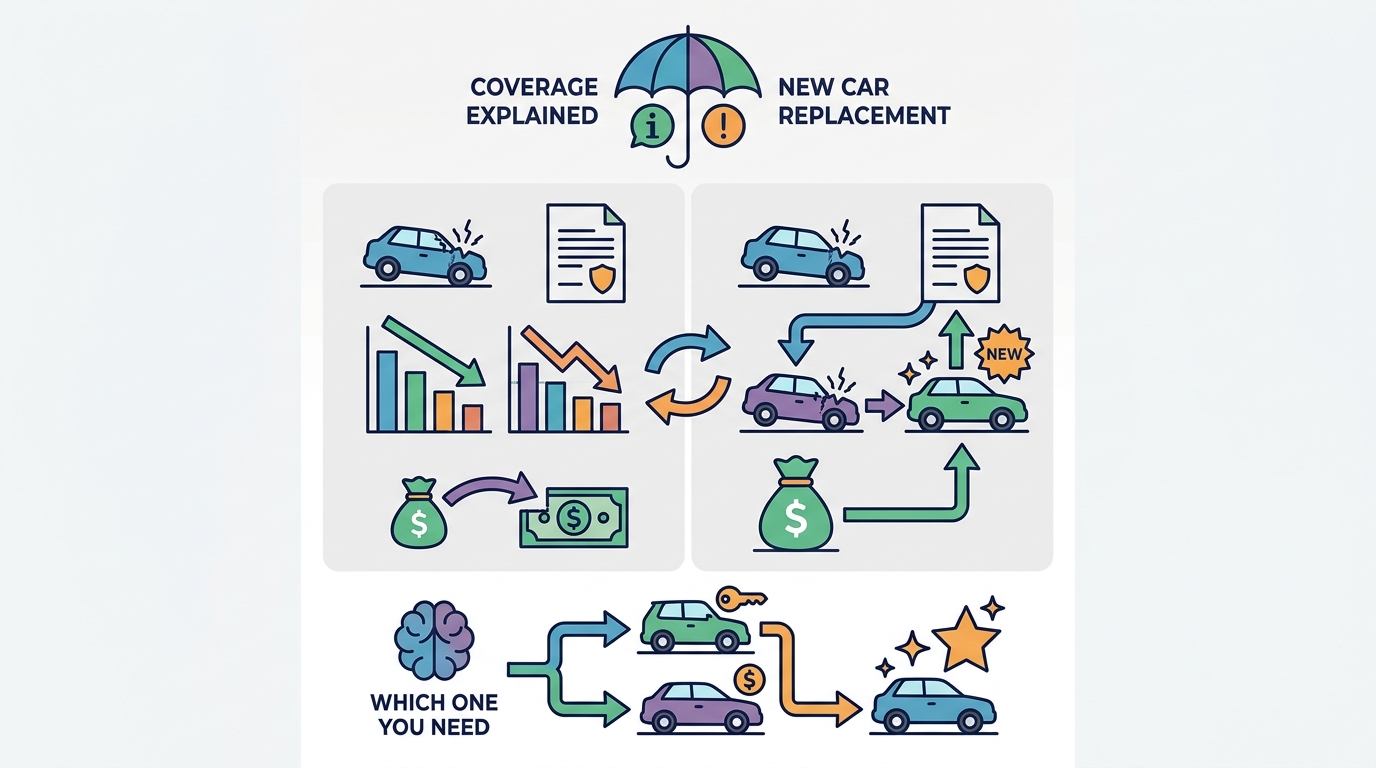
Gap insurance and new car replacement both sit on top of a total-loss settlement, but they solve different problems. Gap insurance pays the difference between your car's actual cash value at the time of loss and the amount owing on the loan or lease (New York State Department of Financial Services, 2008-03-27). New car replacement does not pay off your loan: the lender receives the full settlement amount, and you remain responsible for any loan balance above the covered replacement amount (Insurance.com, undated).
Neither pays first. Your collision or comprehensive coverage must be applied to the total loss claim before either add-on does anything (Insurance.com, undated).
Side-by-Side Comparison
| Axis | Gap insurance | New car replacement |
|---|---|---|
| What triggers payment | Total loss of the vehicle caused by theft or physical damage, and only where the loan or lease balance exceeds actual cash value (New York State Department of Financial Services, 2008-03-27) | Total loss of a vehicle still inside the insurer's age and mileage window; Travelers' version excludes losses caused by theft, fire, larceny or flood (The Zebra, undated) |
| Payout basis | The gap amount: actual cash value at the time of loss subtracted from the amount owing on the lease or loan at that time, paid against the outstanding balance (New York State Department of Financial Services, 2008-03-27) | Replacement of the vehicle without depreciation; American Family caps replacement cost at 110% of the totaled vehicle's original MSRP (The Zebra, undated). The lender receives the settlement and you owe any balance above it (Insurance.com, undated) |
| Deductible | None of its own. The deductible you chose on collision or comprehensive is taken out of the underlying total-loss settlement first (Insurance.com, undated); whether your gap form reimburses it depends on that filed form | None of its own. Same mechanism — your chosen collision or comprehensive deductible applies to the underlying claim and the replacement coverage sits above it (Insurance.com, undated) |
| Does at-fault status matter | No. The trigger is a total loss from theft or physical damage, whoever caused it. If an at-fault driver's property damage liability pays actual cash value instead, the shortfall against your loan is still a gap | No. Eligibility turns on vehicle age and mileage, not fault — but it is an endorsement on your own policy, so it applies only when you claim under your collision or comprehensive |
| Eligibility | Tied to the loan or lease, not the car's age; relevant whenever the balance sits above actual cash value | Typically requires carrying both comprehensive and collision, with mileage limits (The Zebra, undated). Allstate: two or fewer model years. Farmers: insured with Farmers at purchase, under two years, 24,000 miles or fewer. The Hartford: within 15 months or 15,000 miles. MetLife: under one year or fewer than 15,000 miles. Liberty Mutual: fewer than 15,000 miles and less than one model year. Nationwide: fewer than three years. Travelers: within five years (The Zebra, undated) |
| Availability | Sold by State Farm, Progressive, Esurance and USAA (The Zebra, undated). In New York, only a licensed agent or broker may offer gap insurance on an insurer's behalf (New York State Department of Financial Services, 2008-03-27) | Not offered by State Farm, Progressive, Esurance or USAA (The Zebra, undated) |
| Cost signal | Varies by insurer, state, vehicle and loan; sold as a policy add-on or as a dealer-financed product | Most companies estimate an average rate hike of 5%, which may vary by insurance company and vehicle (The Zebra, undated) |
Two products get confused with gap insurance. A gap waiver is not bought from an insurer — the creditor or lessor waives your obligation for the difference between the gap amount and actual cash value, and it applies only on a total loss caused by theft or physical damage (New York State Department of Financial Services, 2008-03-27). Loan/lease payoff is thinner: according to Progressive, it often pays about 25% of the vehicle's actual cash value (Insurance.com, undated), capping the benefit however large the shortfall.
No-fault rules change neither coverage. Where a state runs a no-fault system, it governs injury benefits, not vehicle damage; total losses run through your own collision and comprehensive or the at-fault driver's property damage liability, depending on that state's rules.
Which One Pays in Common Scenarios
These rows are constructed illustrations, not filed loss statistics. Each assumes you carry collision, comprehensive, gap, and a new car replacement option the vehicle still qualifies for.
| Scenario | Which coverage pays, and why |
|---|---|
| New car totaled months into a long-term loan, at-fault collision, at-fault (tort) state | Collision pays actual cash value minus your deductible (Insurance.com, undated). New car replacement lifts that to the cost of a new vehicle without depreciation. Gap pays only if the balance still exceeds what the insurer pays (Insurance.com, undated) |
| Car stolen from a driveway, never recovered | Comprehensive pays actual cash value minus the deductible. Gap applies to the shortfall, because theft is an express gap trigger (New York State Department of Financial Services, 2008-03-27). New car replacement depends on the form — Travelers' version does not apply to theft or larceny losses (The Zebra, undated) |
| Deer strike at highway speed, car totaled | Comprehensive pays, not collision, because animal strikes are an other-than-collision loss. New car replacement applies if the car is inside the age and mileage window; gap applies only if a balance remains |
| Rear-ended at a stoplight by an insured driver in an at-fault state | Claim against the other driver's property damage liability, which pays actual cash value, or under your own collision and pursue the deductible through subrogation. Either path pays depreciated value, so gap covers the remaining balance. New car replacement applies only on the claim filed under your own policy (The Zebra, undated) |
| Flood water reaches the dashboard | Comprehensive pays actual cash value minus the deductible; gap covers the loan shortfall. Travelers' replacement coverage excludes flood-caused losses (The Zebra, undated), so the exclusion list in your own form decides it |
| Older, higher-mileage car totaled with a balance above value | Collision or comprehensive pays actual cash value minus the deductible and gap covers the shortfall. New car replacement pays nothing: Allstate requires two or fewer model years, Farmers under two years and 24,000 miles, Nationwide fewer than three years (The Zebra, undated) |
| Paid-off car totaled in a parking-lot hit-and-run | Comprehensive pays actual cash value minus the deductible. Gap pays nothing — no amount is owing, so no gap amount exists (New York State Department of Financial Services, 2008-03-27) |
Do You Need Both, One, or Neither
Work through these against your loan statement and declarations page.
- Balance higher than what the car would sell for today, from a small down payment, a long term, or negative equity rolled in: keep gap until the balance drops below actual cash value, then drop it.
- You lease: lease contracts commonly require gap protection or build in a gap waiver. That comes from the lessor, not state law — compulsory insurance statutes set minimum liability limits only.
- Car paid off, or bought with cash: drop gap. There is nothing owing for it to pay against (New York State Department of Financial Services, 2008-03-27).
- Vehicle past your insurer's window — over two model years with Allstate, over 15 months or 15,000 miles with The Hartford, over a year or 15,000 miles with MetLife (The Zebra, undated): drop new car replacement, its trigger can no longer be met. Confirm the cutoff in your endorsement first.
- High annual mileage: a mileage-capped option expires well before the age limit. The average rate hike of 5% most companies estimate for this coverage (The Zebra, undated) then buys only the first months of ownership.
- You bought used: new car replacement is generally unavailable — American Family's version applies only to brand new vehicles (The Zebra, undated). Gap remains available and relevant.
- You dropped collision and comprehensive: neither add-on can function. New car replacement typically requires both (The Zebra, undated), and gap engages only after a total-loss claim settles.
- Insured with State Farm, Progressive, Esurance or USAA: replacement coverage is not on the menu; gap is (The Zebra, undated).
- You carry new car replacement and still owe more than the replacement payout: keep gap as well (Insurance.com, undated).
- A dealer offered a product at signing: ask in writing whether it is gap insurance from a licensed insurer or a gap waiver from the creditor (New York State Department of Financial Services, 2008-03-27).
Questions
If I carry both, which one pays first?
Collision or comprehensive is applied to the total loss claim first and pays actual cash value minus your deductible (Insurance.com, undated). New car replacement then raises the vehicle payout to the cost of a new car without depreciation. Gap comes last and covers what still remains owing on the loan or lease (New York State Department of Financial Services, 2008-03-27).
Does new car replacement make gap insurance unnecessary?
Not reliably. It does not pay off your loan — the lender receives the full settlement and you remain responsible for any balance above the covered replacement amount (Insurance.com, undated). Because it raises the vehicle payout without guaranteeing the full loan balance is paid, you may still need gap alongside it (Insurance.com, undated).
Can I collect twice — once from gap and once from new car replacement?
No. Gap pays the difference between actual cash value and the amount owing at the time of loss (New York State Department of Financial Services, 2008-03-27), so anything the replacement coverage pays toward the vehicle reduces the remaining balance and therefore the gap amount. If the settlement clears the loan, gap has nothing left to pay.
Is the dealer's gap product the same as gap insurance on my auto policy?
Often not. A gap waiver is an agreement where the creditor or lessor waives your obligation for the difference between the gap amount and actual cash value, and it applies only on a total loss caused by theft or physical damage (New York State Department of Financial Services, 2008-03-27). Gap insurance is issued by an insurer, and in New York only a licensed agent or broker may offer it on an insurer's behalf (New York State Department of Financial Services, 2008-03-27). A loan/lease payoff endorsement is narrower still — Progressive reports it often pays about 25% of actual cash value (Insurance.com, undated).