By the Drivers Compass editors · Updated October 31, 2026
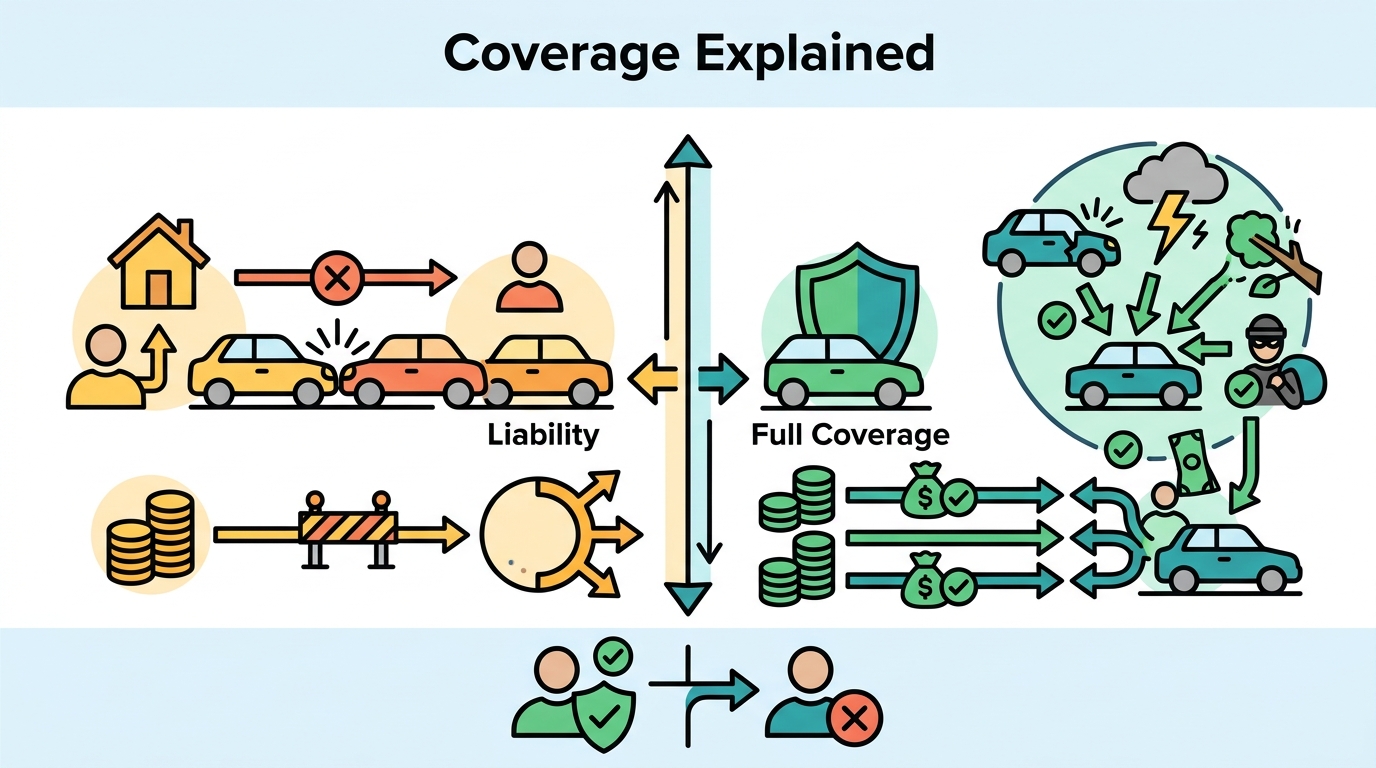
"Full coverage" is not an official policy type. It is shorthand for buying three things together: liability, collision and comprehensive coverage (State Farm, undated). Liability pays other people for injuries and property damage you cause (National Association of Insurance Commissioners (NAIC), undated); collision and comprehensive pay for your own vehicle after a deductible you pick, and neither is required by law (NAIC, undated).
So the real choice is whether to add own-car coverage on top of the liability your state already makes you carry. That turns on what your car is worth, whether a lender or lessor holds a contract over it, and what your state requires.
Side-by-Side Comparison
Both sides are scored on the same five axes. "Full coverage" here means the usual bundle of liability, collision and comprehensive (State Farm, undated), so the right-hand column covers only the collision and comprehensive parts — the liability part is identical to the left-hand column.
| Axis | Liability only (bodily injury + property damage) | Collision + comprehensive (the added parts of "full coverage") |
|---|---|---|
| What triggers payment | A third party's claim against you for injury or property damage from a crash you caused (NAIC, undated). | Collision: your car hitting another vehicle or an object such as a tree, curb or guardrail, or overturning (NAIC and State Farm, undated). Comprehensive: fire, severe weather, vandalism, flood, theft, falling objects such as a branch or power line, animal strikes, and broken glass (NAIC, NCMIC and Liberty Mutual, undated). |
| Payout basis | Pays the injured party, never you, up to your per-person bodily injury limit, per-accident bodily injury limit and property damage limit. Anything above those limits is yours to pay. | Pays repair cost, or the vehicle's value if it is a total loss, reduced by depreciation under most filed settlement language. Nothing is paid to other people. |
| Typical deductible | None. Liability pays from the first dollar of a covered third-party loss up to your limits. | One you select applies to each claim. Insurer's illustrative example: $2,000 of repairs with a $500 deductible means you pay $500 and the insurer pays $1,500 (State Farm, undated). The amounts you can choose are set by each insurer's filed options in your state. |
| Does at-fault status matter | Yes — it is the trigger. In a no-fault state your own insurer pays your injury losses regardless of who is at fault (NAIC, undated), which changes how injury claims route. | No. Collision applies whether or not you were at fault (State Farm, undated); comprehensive causes mostly involve no at-fault driver at all. |
| Required by whom | State law in every state except New Hampshire, though some states accept other proof of financial responsibility (MoneyGeek, undated). Which of bodily injury and property damage is mandated, and the minimum limits, are set state by state (State Farm, undated). | No state law requires either (NAIC, undated). Both are typically required by a lender or lessor on a financed or leased car (State Farm, undated) — a contract term, not a statute. |
Minimum liability limits sit far apart: Alabama requires 25/50/25 and Arizona 25/50/15 (Risk Education citing an Insurance Information Institute table archive, August 2024), California's are listed at 15/30/5 (same source), Florida requires $10,000 of personal injury protection and $10,000 of property damage liability with no bodily injury coverage mandated, and Alaska, Maine, Michigan, North Carolina and Virginia require $50,000 per person in bodily injury coverage (MoneyGeek, undated). About 80% of insured drivers buy comprehensive and 76% buy collision (Liberty Mutual, citing the Insurance Information Institute, undated).
Which One Pays in Common Scenarios
Every row is a constructed illustration, not filed loss data, and assumes liability, collision and comprehensive are all in force. Rows assume a tort state unless stated. Claims are adjudicated case by case.
| Scenario | Which coverage pays | Why |
|---|---|---|
| You rear-end another car at a stoplight | Your liability pays their car and their injuries; your collision pays your car minus your deductible | Liability is triggered by your legal responsibility for their loss (NAIC, undated) and pays nothing toward your own vehicle (Forbes Advisor, undated); collision applies regardless of fault (State Farm, undated) |
| Another driver rear-ends you, tort state | Their property damage liability once fault is established, or your collision minus your deductible if you file with your own insurer | Liability follows fault; collision does not require fault (State Farm, undated), so you can route it either way |
| Another driver rear-ends you in Florida, which mandates $10,000 of personal injury protection (MoneyGeek, undated) | Your own personal injury protection for injury losses; vehicle damage still routes through liability or your collision | Under a no-fault system the insurer pays its own policyholder for injury losses regardless of fault (NAIC, undated) |
| You hit a deer | Comprehensive, minus your comprehensive deductible | Animal strikes sit on the non-crash side of the line (Liberty Mutual, undated); no other person's property was damaged, so liability pays nothing |
| Your car is stolen from the driveway | Comprehensive, up to the vehicle's value and reduced by depreciation | Theft is a named comprehensive cause (NAIC, undated); liability and collision have no theft trigger |
| Hail dents the roof and a branch cracks the windshield | Comprehensive, glass included | Severe weather and falling objects are comprehensive causes, and comprehensive covers broken glass (NAIC, undated; NCMIC, undated) |
| You roll the car on ice with no other vehicle involved | Collision, minus your deductible | Overturning is written into collision, not comprehensive (State Farm, undated; NCMIC, undated) |
| Your financed car is totaled for less than the loan balance | Collision or comprehensive pays the vehicle's value; the shortfall is paid by nobody unless you bought coverage for that gap separately | The gap between a loan balance and a totaled car's value is not part of the bundle (State Farm, undated) |
Do You Need Both, One, or Neither
- You finance or lease. Keep both collision and comprehensive — lenders and lessors typically require them by contract (State Farm, undated; NAIC, undated), and dropping them can trigger force-placed coverage.
- You owe more than the car is worth. Keep both and add coverage for the gap between the loan balance and a totaled vehicle's value, which the bundle does not include (State Farm, undated).
- You own the car outright and it is worth roughly a year of collision and comprehensive premium plus your deductible. Drop collision or raise the deductible: the most either coverage will ever pay is the car's depreciated value minus that deductible.
- You own the car outright but could not replace it out of pocket. Keep both. Comprehensive is the only one of the three that answers theft, fire, flood and hail (NAIC, undated).
- Your state's minimums are low — California's are listed at 15/30/5 (Risk Education citing an Insurance Information Institute table archive, August 2024) and Florida mandates no bodily injury coverage (MoneyGeek, undated). Price higher liability limits before you price collision and comprehensive; injury claims above your limit come out of your assets.
- You want medical payments for yourself and passengers, a rental during repairs, or protection against uninsured drivers. Add each by name — none come with liability, collision and comprehensive (State Farm, undated).
- You rent cars often and already carry collision and comprehensive. The rental counter's collision/loss damage waiver is typically unnecessary, since those coverages extend to accident, fire, theft, wind, hail and deer damage (NAIC, undated). Confirm the extension in your insurer's filed policy language first.
Questions
Another driver hit me. Do I claim on their liability or my collision?
In a tort state, the at-fault driver's property damage liability pays your repairs once fault and amount are settled, with no deductible from you. If you claim on your own collision instead, you pay your deductible up front and your insurer pursues the other carrier, refunding your deductible to the extent it recovers; you cannot collect twice for the same damage. In a no-fault state your own insurer pays your injury losses regardless of fault (NAIC, undated), while vehicle damage still routes through liability or collision.
Can collision and comprehensive both pay for the same damage?
No. A single loss is classified by cause and settled under one coverage, so one deductible applies. A branch falling on a parked car is comprehensive; driving into the same tree is collision (NCMIC, undated). If your two deductibles differ, that classification decides which you pay, so ask the adjuster which coverage the claim was opened under.
Does carrying liability, collision and comprehensive mean I'm covered for everything?
No. Even with all three, a policy may exclude medical payments for you and your passengers, rental car costs, damage caused by uninsured or underinsured drivers, and the gap between a loan balance and a totaled vehicle's value, unless each is added separately (State Farm, undated). Those are separate coverages with their own limits and filed language — read your declarations page rather than assuming the bundle includes them.
If I drop collision and comprehensive, am I still legal to drive?
In every state except New Hampshire you must carry liability insurance or another accepted form of financial responsibility (MoneyGeek, undated), and no state law requires collision or comprehensive (NAIC, undated), so dropping them keeps you legal. It does not keep you compliant with a loan or lease, which typically requires both by contract (State Farm, undated), and it leaves theft, fire, hail and your own crash damage unpaid.