By the Drivers Compass editors · Updated October 31, 2026
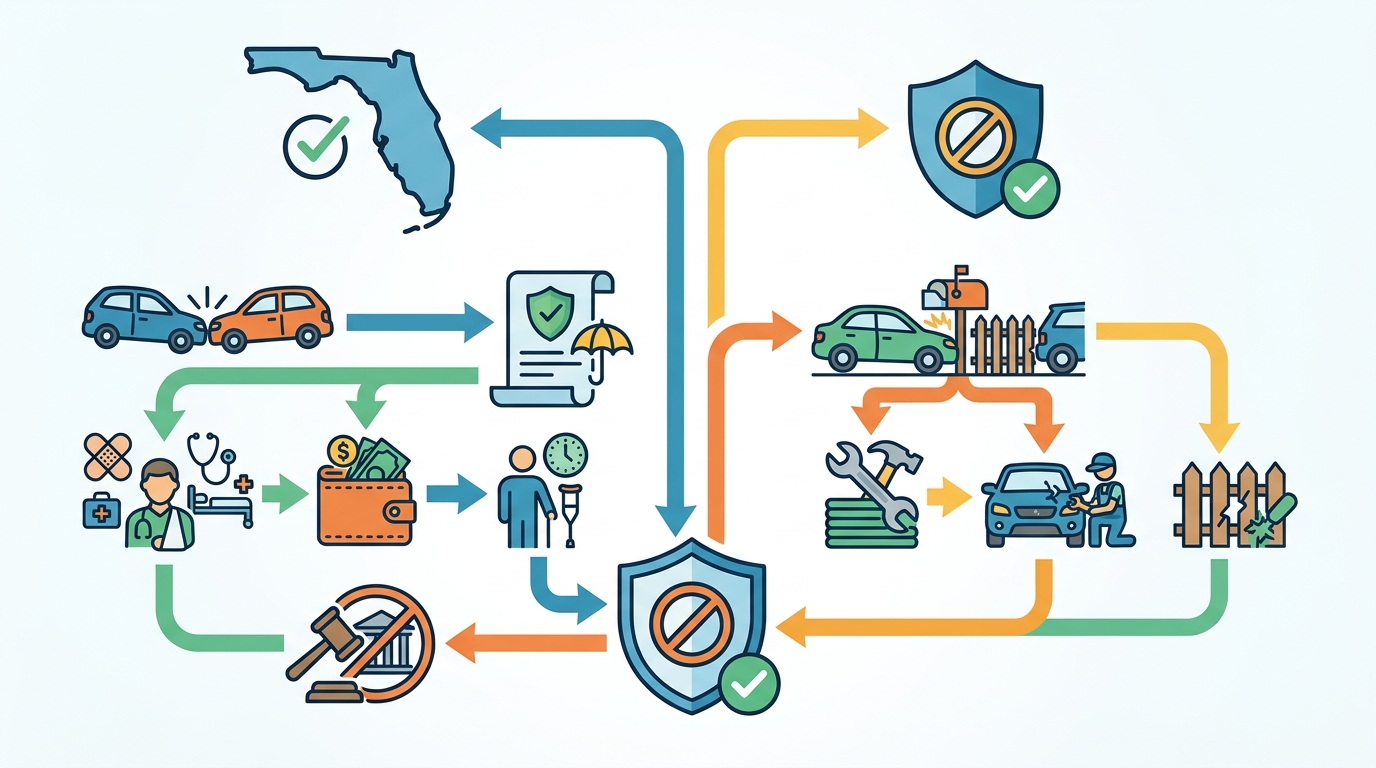
Florida requires two coverages before you can register a vehicle with at least four wheels: $10,000 of Personal Injury Protection and $10,000 of Property Damage Liability, under Florida Statute § 627.733 (Florida Department of Highway Safety and Motor Vehicles, undated). It does not require bodily injury liability — Florida is one of only two states that does not (U.S. News & World Report, undated) — so the minimum policy pays nothing toward injuries you cause other people.
The 10/20/10 split you see quoted for Florida comes from the Financial Responsibility Law, Section 324.021, and applies only to drivers who must show proof of financial responsibility after an at-fault crash or certain violations (ilabacalaw.com, undated). Knowing which rule you are under changes what you have to buy.
Florida Minimum Coverage Limits
Two separate rules operate here: one governs registering the vehicle, the other governs drivers already caught by the Financial Responsibility Law.
| Coverage Type | Minimum Limit | Required or Optional | Statute Citation |
|---|---|---|---|
| Personal Injury Protection (PIP) | $10,000, paying 80% of necessary medical expenses and 60% of lost wages regardless of fault | Required to register a vehicle with at least four wheels | Fla. Stat. § 627.733; benefits under § 627.736 (Florida Department of Highway Safety and Motor Vehicles, undated; ilabacalaw.com, undated) |
| Property Damage Liability (PDL) | $10,000 | Required to register a vehicle with at least four wheels | Fla. Stat. § 627.733 (Florida Department of Highway Safety and Motor Vehicles, undated) |
| Bodily Injury Liability (BI) | None at registration; 10/20 once triggered | Not required for ordinary registration; can become mandatory after an at-fault crash involving injury or death | Fla. Stat. § 324.021 and § 324.023 (ilabacalaw.com, undated) |
| Taxi registration | $125,000 per person / $250,000 per occurrence BI, plus $50,000 PDL | Required for vehicles registered as taxis | Florida DHSMV insurance requirements (Florida Department of Highway Safety and Motor Vehicles, undated) |
| DUI high limits (FR-44) | 100/300/50 for the statutory period | Required only of qualifying DUI drivers | Florida FR-44 filing requirement (quotesautoinsurance.org, undated) |
| Uninsured/Underinsured Motorist | Insurer must offer; you pick a limit or reject it in writing | Optional — the offer is mandatory, the coverage is not | Fla. Stat. § 627.727 (ilabacalaw.com, undated; Ged Lawyers, LLP, undated) |
| Collision and Comprehensive | No limit set by statute | Optional under state law | Not required by Florida statute |
What you pay for that 10/10 minimum depends on your zip code and territory, vehicle year and model, driving record, age, deductible, the insurer and the specific underwriting company it places you in, and — where permitted — a credit-based insurance score. A quote is not the bound premium.
Coverages Beyond the Minimum
None of the following is required by Florida law. Several are required by whoever financed or leased the car — a contract term, not a statute, and the distinction readers miss most often.
- Collision. Pays for your own car in a crash. Not required by statute, but a lienholder almost always requires it in the loan or lease so its collateral gets repaired. Dropping it mid-loan can trigger force-placed coverage added to your bill.
- Comprehensive. Theft, fire, flood, hail, animal strikes. Also not required by statute, also routinely required by finance and lease contracts. Whether a named-storm deductible applies comes from the insurer's filed language.
- Bodily injury liability. Not required to register a car in Florida (U.S. News & World Report, undated), but it is what responds to the other party's injury claim. A lessor may require liability limits above the statutory floor.
- Uninsured/underinsured motorist. Must be offered under § 627.727, and declined in writing (ilabacalaw.com, undated); it is not mandatory (Ged Lawyers, LLP, undated). Florida ranks second nationally for the share of uninsured drivers, around 24% (Dolman Law Group, undated).
- Medical payments (MedPay). Optional, and often bought against the portion of medical bills PIP does not pay under § 627.736.
- Higher PDL limits. The floor is $10,000 (Florida Department of Highway Safety and Motor Vehicles, undated), less than the value of many vehicles on the road.
- Rental reimbursement, towing, gap. Optional under state law; gap is commonly addressed in lease contracts.
Whether any of these responds to a particular situation — rideshare driving, business use, diminished value — depends on that insurer's filed language and endorsements.
Penalties for Driving Uninsured or Underinsured
Florida enforces through the license and registration system rather than a roadside fine alone.
Fail to maintain required coverage and your driver license and registration may be suspended for up to three years, with no temporary or hardship license available for an insurance-related suspension, plus a reinstatement fee of up to $500 (Florida Department of Highway Safety and Motor Vehicles, undated).
The fee is tiered: $150, $200, or $500 where a driver fails to provide proof of insurance (autoinsurance.com, undated). Under Florida Statutes § 324.0221, the tier follows lapse history — a second lapse costs $100 more than the first and a third costs $350 more, stacking within a three-year rolling window (uninsuredlicensesuspended.com, undated).
Reinstatement also requires a filing. An SR-22 in Florida certifies bodily injury liability and property damage liability coverage to meet the reinstatement requirements of the Florida Financial Responsibility Law (Florida Department of Highway Safety and Motor Vehicles, undated), generally kept on file for three years (autoinsurance.com, undated), with an average insurer filing fee of $15 (autoinsurance.com, undated). The fee is small; the premium at the required limits is not.
For uninsured-driving suspensions Florida uses the higher FR-44 certificate instead of a standard SR-22 — Florida and Virginia are the only two states that do (uninsuredlicensesuspended.com, undated). Qualifying DUI drivers must carry 100/300/50 for the statutory period (quotesautoinsurance.org, undated).
Separately, under § 324.023, an at-fault driver in a crash causing bodily injury or death can have bodily injury liability coverage become mandatory going forward (ilabacalaw.com, undated). Check your own suspension notice and the DHSMV schedule for the amounts applied to your record.
Minimum vs. Recommended Coverage
| Coverage | Florida state minimum | Commonly recommended limits |
|---|---|---|
| Bodily injury liability | None required to register (U.S. News & World Report, undated) | $100,000 per person / $300,000 per accident (U.S. News & World Report, undated) |
| Property damage liability | $10,000 under Fla. Stat. § 627.733 | $100,000 per accident (U.S. News & World Report, undated) |
| PIP | $10,000, paying 80% of medical bills and 60% of lost wages under § 627.736 | Same $10,000, plus optional MedPay |
| UM/UIM | Not required; offer mandatory under § 627.727 | Matched to liability limits |
| Written as a split | 0/0/10 plus $10,000 PIP | 100/300/100 |
The gap shows up in an injury claim. Bodily injury settlements in Florida typically range from $15,000 to $30,000 on average, based on one Florida firm's own settlement data (hermanwells.com, undated). A driver holding only the registration minimum has no bodily injury liability at all, so that amount sits with the driver personally. Even the triggered 10/20/10 split under § 324.021 leaves $5,000 to $30,000 of that range above the $10,000 per-person limit.
With around 24% of Florida drivers uninsured (Dolman Law Group, undated), the coverage that responds when the at-fault driver has nothing is UM/UIM, which Florida does not require (Ged Lawyers, LLP, undated). None of this means a given claim will be paid or paid in full; claims are adjudicated case by case against the filed policy language.
Questions
Why does Florida require PIP but not bodily injury liability?
PIP is the no-fault piece: under § 627.736 it pays 80% of necessary and reasonable medical expenses and 60% of lost wages up to $10,000 regardless of who caused the crash (ilabacalaw.com, undated). The system routes your medical bills to your own insurer first. Bodily injury liability, which pays other people, is simply not part of the registration requirement — Florida is one of only two states that does not require it (U.S. News & World Report, undated).
What is the 10/20/10 I keep seeing for Florida?
Those are the minimum financial responsibility limits in Section 324.021 — $10,000 per person and $20,000 per accident for bodily injury, plus $10,000 property damage. They apply only to drivers required to show proof of financial responsibility after an at-fault crash or certain violations (ilabacalaw.com, undated). They are not what the tag office asks for at registration.
Does my policy have to cover a motorcycle or scooter?
The PIP and PDL registration requirement applies to vehicles with at least four wheels (Florida Department of Highway Safety and Motor Vehicles, undated). Two- and three-wheeled vehicles fall outside that requirement, which does not make riding uninsured consequence-free — the financial responsibility rules in § 324.021 and § 324.023 can still attach after a crash. Confirm with the DHSMV before you register.
Can I get a hardship license while an insurance suspension is active?
No. Florida does not issue a temporary or hardship license for insurance-related suspensions, and the suspension can run up to three years (Florida Department of Highway Safety and Motor Vehicles, undated). Reinstatement means paying the fee — $150, $200, or $500 depending on lapse history (autoinsurance.com, undated) — and making the required filing.
What is the difference between an SR-22 and an FR-44 in Florida?
An SR-22 certifies bodily injury and property damage liability coverage to meet reinstatement requirements under the Florida Financial Responsibility Law (Florida Department of Highway Safety and Motor Vehicles, undated), typically on file for three years (autoinsurance.com, undated). An FR-44 requires higher limits — 100/300/50 for qualifying DUI drivers (quotesautoinsurance.org, undated). Florida and Virginia are the only two states using an FR-44 for uninsured-driving suspensions (uninsuredlicensesuspended.com, undated).
If my lender requires collision, is that a state requirement?
No. Collision and comprehensive are not required by Florida statute; they are contract terms in your loan or lease protecting the lender's collateral. Dropping them can satisfy state law while breaching your financing agreement, which may lead to force-placed coverage. Read the finance contract and the insurer's filed policy language before changing anything.