By the Drivers Compass editors · Updated October 31, 2026
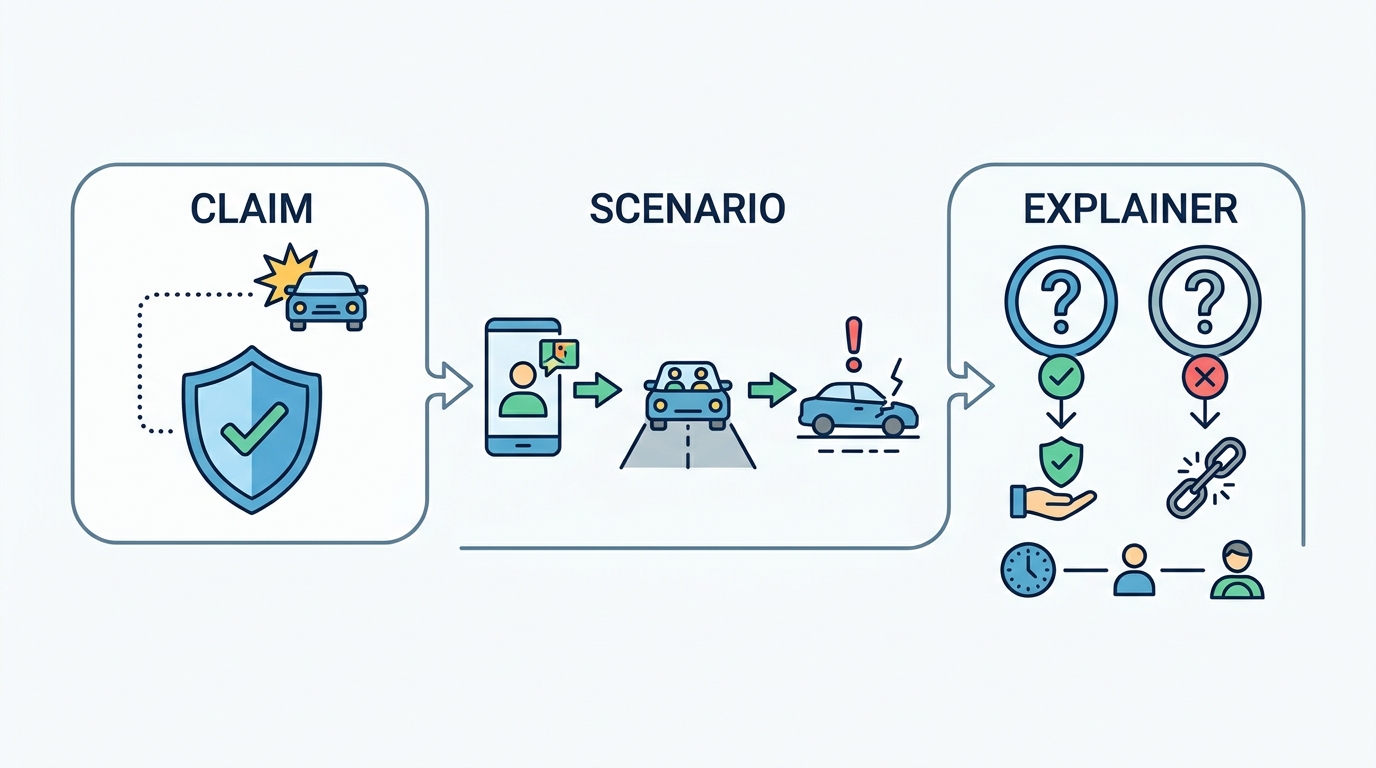
Usually no. A standard personal auto policy contains a public-or-livery conveyance exclusion: the ISO form PP 00 01 (01 05) bars liability arising from ownership or operation of a vehicle used as a public or livery conveyance, with an exception only for a share-the-expense car pool (Rough Notes, 2016). Carrying passengers for a fee through Uber or Lyft is not a car pool.
The NAIC notes a personal policy may not respond at all for ride-sharing-for-a-fee use — liability, PIP in no-fault states, comprehensive, collision and UM/UIM alike (NAIC, undated). What fills the gap depends on which of the three app periods you were in and whether you bought a transportation network company endorsement.
What Your Policy Actually Says
The clause that controls this is exclusion A.5. of the liability section — the public or livery conveyance exclusion. In the ISO PP 00 01 (01 05) form it bars coverage for liability arising out of ownership or operation of a vehicle used as a public or livery conveyance, and it does not apply to a share-the-expense car pool (Rough Notes, 2016). Many insurers added ISO endorsement PP 23 40 10 15, which replaces that exclusion so it also applies to any period a vehicle is used by an insured logged into a transportation network platform as a driver, whether or not a passenger is in the car, with parallel wording for medical payments and physical damage (Rough Notes, 2016).
Three endorsements run the other way. PP 23 45 10 15 restores liability, medical payments, UM/UIM and physical damage while you are logged in but have not accepted a request. PP 23 41 10 15 restores coverage but ends it the moment a passenger occupies the vehicle, when the TNC's own liability coverage takes over (Rough Notes, 2016). A true buyback of the broad livery exclusion is rare, though many carriers sell a TNC endorsement restoring coverage specifically during app use (totalcsr.com, undated); quoted premiums for it ran from a low flat annual charge up to a percentage surcharge depending on carrier (Rough Notes, 2016).
The NAIC splits the model into Period 1 (app on, waiting), Period 2 (request accepted, no passenger) and Period 3 (passenger aboard), and several state laws combine Periods 2 and 3 and require higher limits while a driver is actively engaged in a ride (NAIC, undated). Nearly all states and the District of Columbia have enacted TNC insurance legislation (NAIC, undated), so which period triggers which limit is a state-law question.
Payout basis: liability pays an injured third party up to the applicable per-person and per-accident bodily injury limit and the property damage limit, and nothing above it. Physical damage on your own car pays the lesser of repair cost or actual cash value minus the deductible on whichever policy responds, with depreciation on wear items. The TNC Model Bill requires no medical payments, PIP, comprehensive, collision or UM/UIM from the TNC (NAIC, undated).
How the Claim Process Works for This Scenario
- Before you close the app, screenshot or export the trip record showing your status and timestamps. Which period you were in decides which policy responds, and both adjusters will contest it.
- File a police report if your state requires one at the injury or property-damage threshold involved. In an at-fault/tort state the report drives the liability decision; in a no-fault state it supports the PIP question, which matters because personal-policy PIP may not apply to ride-sharing-for-a-fee use (NAIC, undated).
- Report inside the Uber or Lyft driver app the same day. Under the TNC Model Bill, TNC coverage is not contingent on a denial from your personal policy (NAIC, undated), so do not wait for your carrier to say no first.
- Report to your personal insurer and state plainly that the app was on and which period applied. Nondisclosure turns a coverage dispute into a rescission dispute, and the Model Bill gives personal auto insurers a statutory right of contribution against TNCs for erroneously paid claims (NAIC, undated).
- Pull your declarations page and look for PP 23 40, PP 23 41, PP 23 45 or a carrier-named TNC endorsement. In Period 1 with none of them, and with TNC physical damage available only when passengers are aboard (Rough Notes, 2016), repairs to your own car have no insurer behind them.
- If denied, get the denial in writing naming the exclusion and form number, match it against your trip log, and file a complaint with your state department of insurance if the period classification is wrong.
What Gets Paid and What You're Still On the Hook For
Allocation varies by state TNC statute, period, endorsement and the deductible on the responding policy. These are categories, not amounts.
| Paid by insurer | Paid by you |
|---|---|
| Third-party bodily injury and property damage during an active ride, at the primary liability limit Uber and Lyft provide once a request is underway (Rough Notes, 2016) | Any judgment or settlement above that per-accident limit, from personal assets |
| Third-party bodily injury and property damage in Period 1, at the reduced limits Uber and Lyft carry while logged in without an accepted request (Rough Notes, 2016) | The difference between those reduced Period 1 limits and the higher active-ride limits where the loss exceeds them |
| Repair cost or actual cash value of your vehicle with a passenger aboard, under the TNC's comprehensive and collision limits (Rough Notes, 2016) | That physical damage deductible, plus depreciation on wear parts and any betterment charge |
| Nothing toward your own vehicle in Period 1 under most enacted TNC legislation, absent an endorsement (NAIC, undated) | The full repair bill or the car's actual cash value in Period 1, plus any loan or lease balance above that value without gap coverage |
| UM/UIM bodily injury once the ride request is underway, at the limit Uber and Lyft carry (Rough Notes, 2016) | Injury costs from an uninsured driver in Period 1, for which the Model Bill requires no UM/UIM (NAIC, undated) |
| Medical payments or PIP only where your state statute or your own endorsement provides it, since the Model Bill requires neither (NAIC, undated) | Health plan deductible and coinsurance, and lost app earnings while out of service |
| Rental reimbursement only where your personal policy's rental coverage is not voided by the livery exclusion | The rental gap: the daily rate above any per-day cap and every day beyond the per-claim day limit |
Questions
I was logged in for food delivery, not passengers — does the same exclusion apply?
Not automatically. The ISO endorsement wording reaches a vehicle used by an insured logged into a transportation network platform as a driver (Rough Notes, 2016); whether a delivery-only platform meets that definition depends on your carrier's filed language. Ask in writing which form number is on your policy and whether delivery platforms fall inside it.
Do I have to tell my personal insurer I drive for Uber or Lyft?
Answer honestly when asked on an application or renewal — use classification is an underwriting fact. If your policy carries PP 23 40 10 15 with no buyback, coverage switches off every time the app opens (Rough Notes, 2016). Premiums observed for adding a TNC endorsement ranged from a low flat annual charge to a percentage surcharge by carrier (Rough Notes, 2016).
My claim was denied under the livery exclusion. What do I do next?
Get the denial in writing with the exclusion and form number cited, then compare the insurer's stated period against your app trip log timestamps. Period misclassification — particularly Period 2 versus Period 3, which several state laws combine and cover at higher limits (NAIC, undated) — is the common factual dispute. Submit the record to the adjuster and, if it contradicts the denial, complain to your state department of insurance; outcomes are decided case by case.
Does the TNC's coverage only kick in after my own insurer refuses?
No. Under the TNC Model Bill, TNC coverage is not contingent upon a denial of claim payment from the driver's personal auto policy (NAIC, undated), so report through the app without waiting. The Model Bill also grants personal auto insurers a statutory right of contribution against TNCs for erroneously paid claims, so one carrier paying does not settle allocation between them.