By the Drivers Compass editors · Updated October 31, 2026
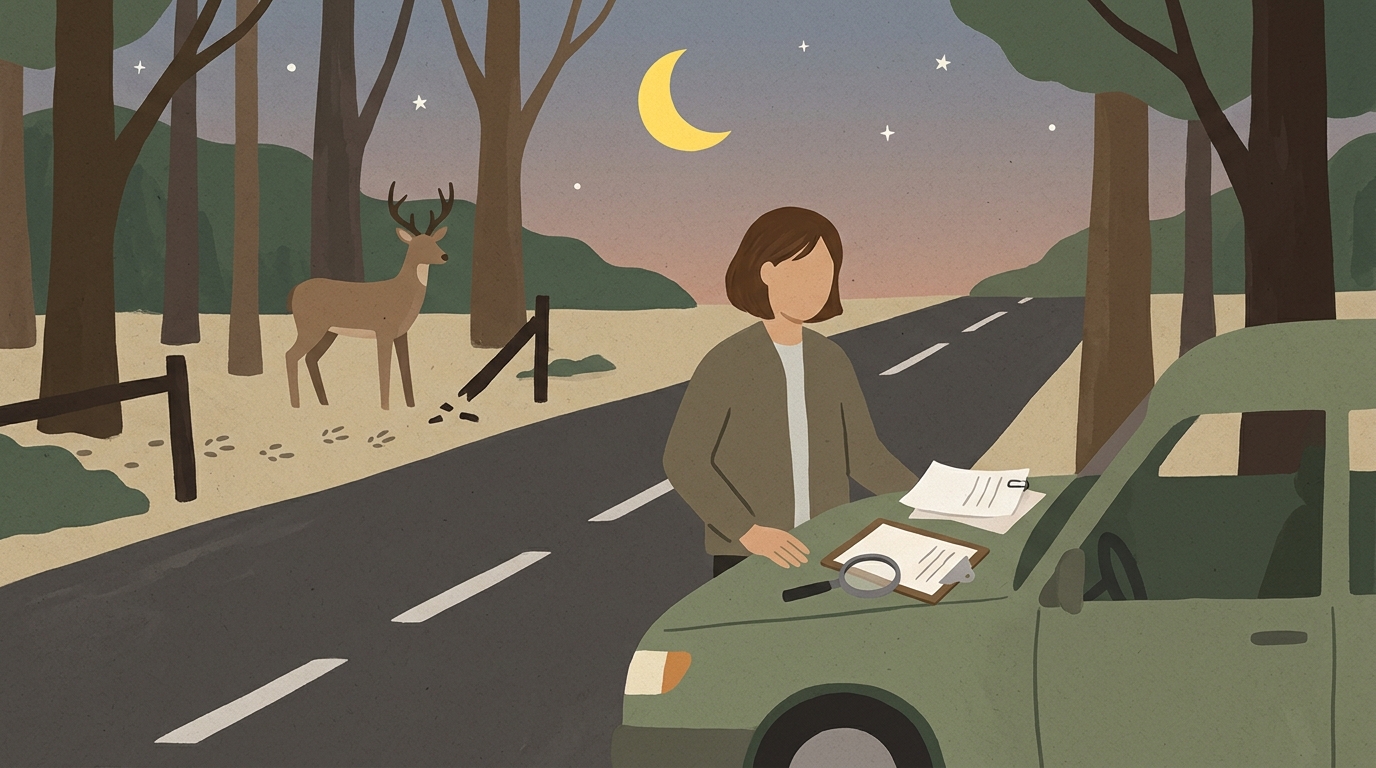
Yes — if you carry comprehensive coverage, hitting a deer is a comprehensive claim, and the insurer pays the cost to repair or replace your vehicle after your comprehensive deductible is subtracted (InsuranceHub, undated). Comprehensive is the only coverage on a personal auto policy that pays for your own vehicle's damage from striking an animal (Northwest Insurance Council, undated); liability pays only for damage and injuries you cause to others (The Zebra, undated).
The exception that catches people out: if you swerved, missed the deer and hit a tree, fence, guardrail or another car, that is a collision claim with your collision deductible (Policygenius, undated).
What Your Policy Actually Says
Comprehensive appears in most policy forms as coverage for loss to your auto "other than collision." The perils listed include theft, vandalism, severe weather, fire, falling objects and contact with a bird or animal (FNIC, undated). Striking a deer is the animal-contact peril; a deer running into your parked car is the same peril.
Collision is defined as impact with another vehicle or object, or upset of your auto. That is why the swerve matters: no animal contact means no animal peril, and the fence, tree or guardrail you hit is an object (Quote.com, undated). Adjusters look for hair, hide, blood or a carcass to tell the two apart.
The payout basis is identical on both coverages: the lesser of repair cost using parts of like kind and quality, or the vehicle's actual cash value immediately before the loss, minus the deductible. Past the insurer's total-loss threshold you receive actual cash value — depreciated market value, not purchase price and not the loan balance — less the deductible. Both coverages are optional under every state's financial-responsibility law, and both are routinely mandated by lienholders.
Comprehensive pays nothing toward injuries. Those run through personal injury protection in a no-fault state, or medical payments coverage and your health plan in an at-fault/tort state. There is no other driver to pursue, so fault is not contested either way.
The average wildlife-vehicle collision claim is $4,135 (Northwest Insurance Council, undated). Against a $500 deductible, a $3,000 repair pays out $2,500 (Brandon J. Broderick, undated).
How the Claim Process Works for This Scenario
- Move the car clear of the travel lane and stay away from the animal — an injured deer kicks. Call the non-emergency police or state highway patrol line from the scene. Several states require a report before a carcass may be removed or kept under a salvage tag, and the report number becomes your proof of animal contact.
- Photograph what decides which deductible applies: hair, hide or blood on the grille and bumper, the carcass and its position, skid marks and the roadway. If you swerved and never touched the deer, photograph the object you hit and say so plainly — an animal claim the adjuster later re-codes as collision only delays the repair.
- Report it as a comprehensive animal-contact claim, giving the date, time, mile marker or cross street and the police report number. Policies carry a prompt-notice condition, and late notice is a denial ground where the insurer can show the delay hurt its investigation.
- Get a written estimate before you authorize teardown, and ask the shop to list the radiator, condenser, airbag modules and any forward-facing camera or radar recalibration separately. Sensor work pushes front-end deer damage into total-loss territory on mid-value vehicles.
- Confirm your rental reimbursement daily and per-claim caps before you rent anything; comprehensive alone pays nothing for a rental. If you dispute the total-loss valuation, invoke the policy's appraisal clause before accepting payment and keep the comparable-vehicle list the insurer used.
What Gets Paid and What You're Still On the Hook For
| Paid by insurer under comprehensive | Paid by you |
|---|---|
| Parts and labor for grille, bumper cover, hood, radiator, condenser and front sheet metal, up to actual cash value | The comprehensive deductible, subtracted from every repair and total-loss payment |
| Airbag modules, pretensioners and forward-camera or radar recalibration when listed on the estimate | Betterment charged on wear items replaced in the repair, such as tires or a battery |
| Actual cash value less deductible and retained salvage on a total loss | Loan or lease balance above actual cash value, unless you carry gap coverage |
| Towing and storage only where the roadside or loss-settlement towing provision applies | Tow and storage fees above that provision's dollar cap |
| Rental car only with a rental reimbursement endorsement, capped at its daily rate and per-claim maximum | The gap above the capped daily rate, plus days past the cap while parts are backordered |
| Nothing toward injuries — PIP in a no-fault state, medical payments and health insurance in an at-fault state | Health plan deductible and coinsurance for occupant injuries, and resale value lost to front-end repair history |
Questions
Will a deer claim raise my premium?
A deer-vehicle collision alone may not affect future premiums, because insurers generally treat it as an unavoidable, no-fault loss (Insurancequotes.com, quoting the Ohio Insurance Institute, undated). Surcharge rules are filed per insurer per state, and some filings count any paid claim toward a claims-frequency tier or the loss of a claims-free discount. Ask which filed rule applies to a comprehensive animal claim in your state before filing a small one.
Is it worth filing if the damage is near my deductible?
Compare the written estimate to your deductible first. With a $500 deductible and $3,000 of damage, the payment is $2,500 (Brandon J. Broderick, undated); when the estimate sits just above the deductible, you net little and still carry a claim on your loss history. Teardown often finds hidden radiator and sensor damage, so get the estimate before deciding.
Does living where deer strikes are constant change my coverage?
Coverage terms do not change; pricing territory does. State Farm data cited by the Insurance Information Institute put West Virginia drivers at a 1 in 46 likelihood of an animal-involved collision claim for July 2025–June 2026 and Pennsylvania at 1 in 64, with Pennsylvania recording the highest raw count at 141,300 claims (Triple-I, undated). That frequency is already loaded into comprehensive rates there.
The adjuster denied it as a collision claim. Can I appeal?
Yes. Send the police report, scene photographs showing hair or hide on the vehicle, and the shop's written note of animal residue, then ask in writing for the specific policy language relied on. If the dispute is over the amount rather than the peril, the appraisal clause applies; if it is over the peril, your state department of insurance accepts complaints. Outcomes are decided claim by claim on the evidence.