By the Drivers Compass editors · Updated October 31, 2026
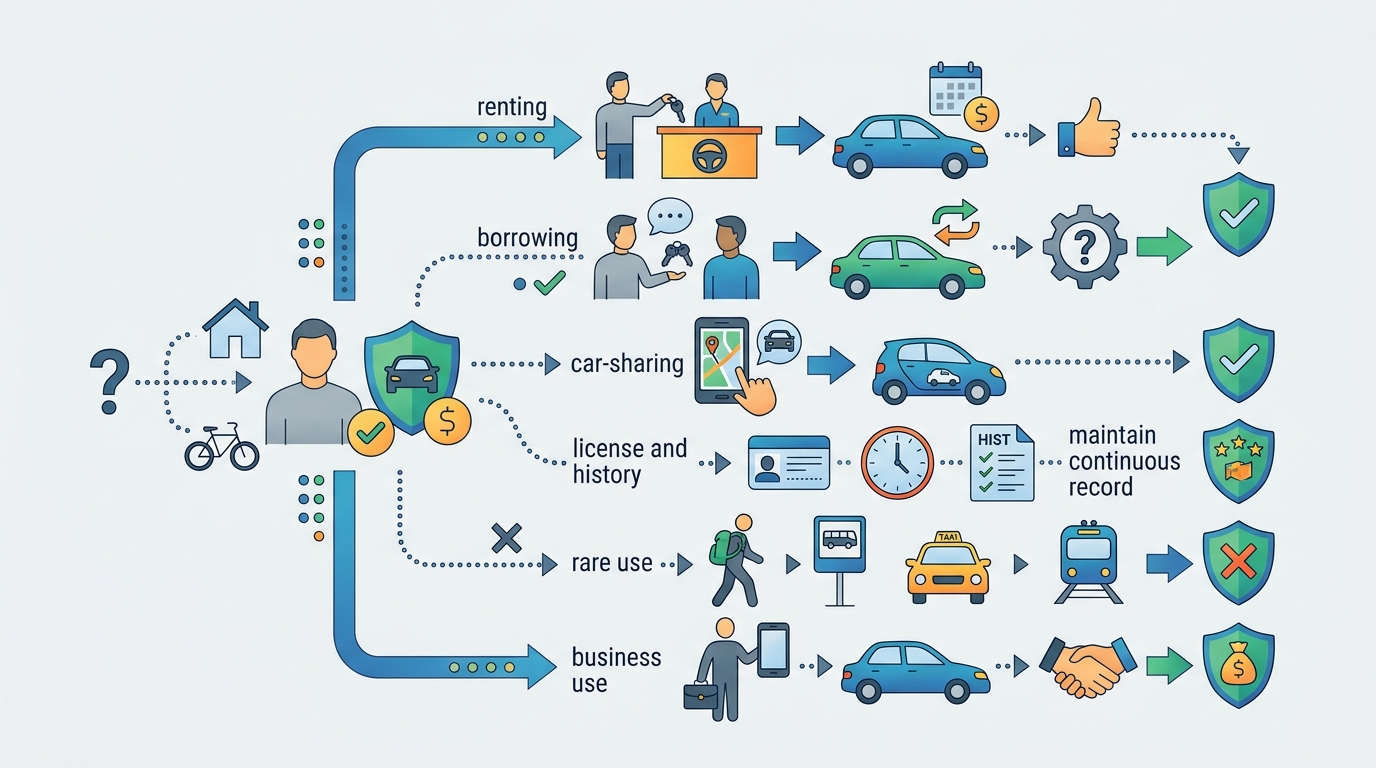
A non-owner policy is liability-only coverage for people who regularly drive vehicles they don't own, and it covers only the driver's liability in a crash (CarInsurance.com, undated). You generally need one if no car is titled to you but you still drive borrowed, rented, or car-share vehicles — or if a court or DMV has ordered you to keep proof of financial responsibility on file and you have no vehicle to insure (Progressive, 2026-04-09).
What it will not do is pay to repair the car you were driving, or your own injuries, unless you add optional coverage (MoneyGeek, undated). That limitation decides the question for most readers.
What This Situation Means for Your Coverage
When you sell or give up your car, two obligations come apart. The registration-based one — proof of insurance tied to a plate — ends with the vehicle. The driver-based one does not. If you still get behind the wheel of someone else's car, liability for injuries and property damage you cause travels with you, not with the registration.
A non-owner policy attaches to you as a driver. It is written at your state's minimum liability limits (CarInsurance.com, undated), and it is secondary: the vehicle owner's policy responds first, and the non-owner policy pays remaining damages above the owner's limits, up to the limits you bought (Insurance.com, undated). If you borrow a car insured at bare minimums and cause a serious injury crash, the owner's limits can exhaust quickly, and your policy is what stands between the remainder and your own assets.
Because it covers liability only, there is no deductible and no physical damage component — no collision, no comprehensive, and nothing toward your own medical bills unless you add an optional coverage (MoneyGeek, undated). In no-fault states, where medical costs normally run through personal injury protection rather than the at-fault driver's liability, whether a non-owner policy includes or offers PIP depends on that state's requirement and the insurer's filed form. Ask for the declarations page and form numbers before assuming injury coverage is in there.
The second mechanism is the filing. An SR-22 is a Certificate of Financial Responsibility — also called an SR-22 Bond or SR-22 Form — proving your insurance meets the minimum coverages required by law, and the document comes from your state's DMV (Progressive, 2026-04-09). If you are ordered to carry one but own no vehicle, the path is a non-owner policy, after which your insurer files the SR-22 with the state (Progressive, 2026-04-09). The period is typically at least three years, and some states require longer (Progressive, 2026-04-09) — durations and triggering offenses are set state by state, so read the court order or DMV reinstatement notice rather than a national summary.
Doing nothing has a defined consequence. If a policy carrying an active SR-22 cancels or lapses, the insurer notifies the DMV and your license is suspended (Progressive, 2026-04-09), and the required period restarts from zero (MoneyGeek, 2026-05-20). Reinstatement fees are set by each state's DMV and charged on top of premium.
Do You Need It? Quick Check
Check each against your own paperwork — title, registration, court notice, DMV reinstatement letter, or your household's current declarations page.
- No vehicle is titled or registered in your name, and none is registered at your address.
- Your court notice or DMV letter says you must file an SR-22, SR-22 Bond, or Certificate of Financial Responsibility (Progressive, 2026-04-09).
- You drive cars you don't own regularly — a relative's car, an employer's pool vehicle, a car-share or borrowed vehicle — not once or twice a year.
- You rent cars and decline the rental company's liability product at the counter.
- You expect to buy and insure a vehicle within 12 months and want continuous coverage history rather than a gap.
- There is a car in your household you have regular access to. If yes, most insurers require you to be listed as a driver on that vehicle's policy instead.
- You need liability only. If you also need the car you drive repaired after an at-fault crash, this policy will not do it (MoneyGeek, undated).
Your Next Steps
- This week: read the court order or DMV notice and write down whether an SR-22 is required, the start date, and the duration. Many states set at least three years, some longer (Progressive, 2026-04-09). Call the DMV if the notice is unclear — insurers cannot tell you what the state ordered.
- Before you quote: ask the insurer whether a household vehicle disqualifies you, and whether being added as a listed driver on that policy is the required route instead.
- Within a few days of quoting: bind the policy and ask the carrier's SR-22 or filings department to submit the form. Budget a one-time filing fee of roughly $15 to $25 on top of premium (MoneyGeek, 2026-05-20). A quote is an estimate; the bound premium can differ once your motor vehicle record is pulled.
- Two to three weeks after binding: confirm with the DMV — not just the insurer — that the filing was received and your record shows compliance.
- If you switch carriers: have the new insurer's SR-22 on file before the current policy cancels. A gap between filings is treated as a lapse and resets the timeline (MoneyGeek, 2026-05-20).
- Before each renewal date: make sure payment is scheduled. Non-payment cancellation triggers the same DMV notification and suspension as any other lapse (Progressive, 2026-04-09).
Coverage Options Compared
| Option | Published cost examples | Damage to the car you drive | SR-22 and lapse rules |
|---|---|---|---|
| Standard non-owner liability policy | Average $506/yr, GEICO lowest at $458/yr, USAA $207/yr for eligible military members (Insurance.com, 2026) | Not covered; no deductible, because there is no physical damage coverage (MoneyGeek, undated) | No filing unless ordered; ordinary cancellation rules |
| Non-owner policy with SR-22 filing | About $75/mo (roughly $900/yr), range $30–$85/mo by state; Travelers $40/mo, Progressive $59/mo, State Farm $33/mo in one comparison (MoneyGeek, 2026-05-20) | Not covered | Insurer files the form; a lapse means DMV notification, suspension, and a restart of the period (Progressive, 2026-04-09) |
| Listed driver on the owner's policy | Set by that vehicle, the owner's limits and your record | Covered only if the owner carries collision and comprehensive on that car | Some insurers will file an SR-22 for a listed driver; confirm before relying on it |
Published averages diverge because methodologies differ: $486/yr (Insure.com, undated), about $750/yr within a $200–$1,400 range (WalletHub, undated), $1,006/yr (MoneyGeek, undated), and about $46/mo (Insurify, 2026). State is the biggest swing — South Dakota averages $216/yr against New Jersey's $1,141/yr (Insure.com, undated) — then violation history, age, zip code territory, and, where permitted, credit-based insurance score; several states restrict or ban that scoring. Insurer choice moves it too: one comparison found $43/mo at Kemper versus $200/mo at Chubb for the same minimum liability policy (MoneyGeek, undated). Adding an SR-22 raises the figure again — one published average is $1,648/yr (AutoInsurance.com, undated) against about $900/yr elsewhere (MoneyGeek, 2026-05-20).
Questions
Can I switch insurers while my SR-22 is active?
Yes, but the sequence is strict: the new insurer must file a new SR-22 with the state before your current policy cancels. Any gap between the two filings counts as a lapse and resets your required period from scratch (MoneyGeek, 2026-05-20). Overlap the effective dates by a few days rather than matching them exactly, then confirm receipt with the DMV.
Will a non-owner policy cover a rental car I crash?
It can respond to injuries and property damage you cause to others, but it pays nothing toward the rental itself. If you cause an accident in a rental and carry only a non-owner policy, you are personally responsible for repairing or replacing that vehicle (Insurance.com, undated). The counter's damage waiver or a credit card benefit is the usual route for that exposure — read the written terms of either before declining.
The car owner has insurance. Why would my policy pay anything?
Non-owner coverage is secondary. The owner's policy applies first, and yours pays remaining damages above the owner's limits, up to your own limits (Insurance.com, undated). If the owner carries state minimums and the claim exceeds them, that gap is where your policy — and otherwise your assets — sits.