By the Drivers Compass editors · Updated October 31, 2026
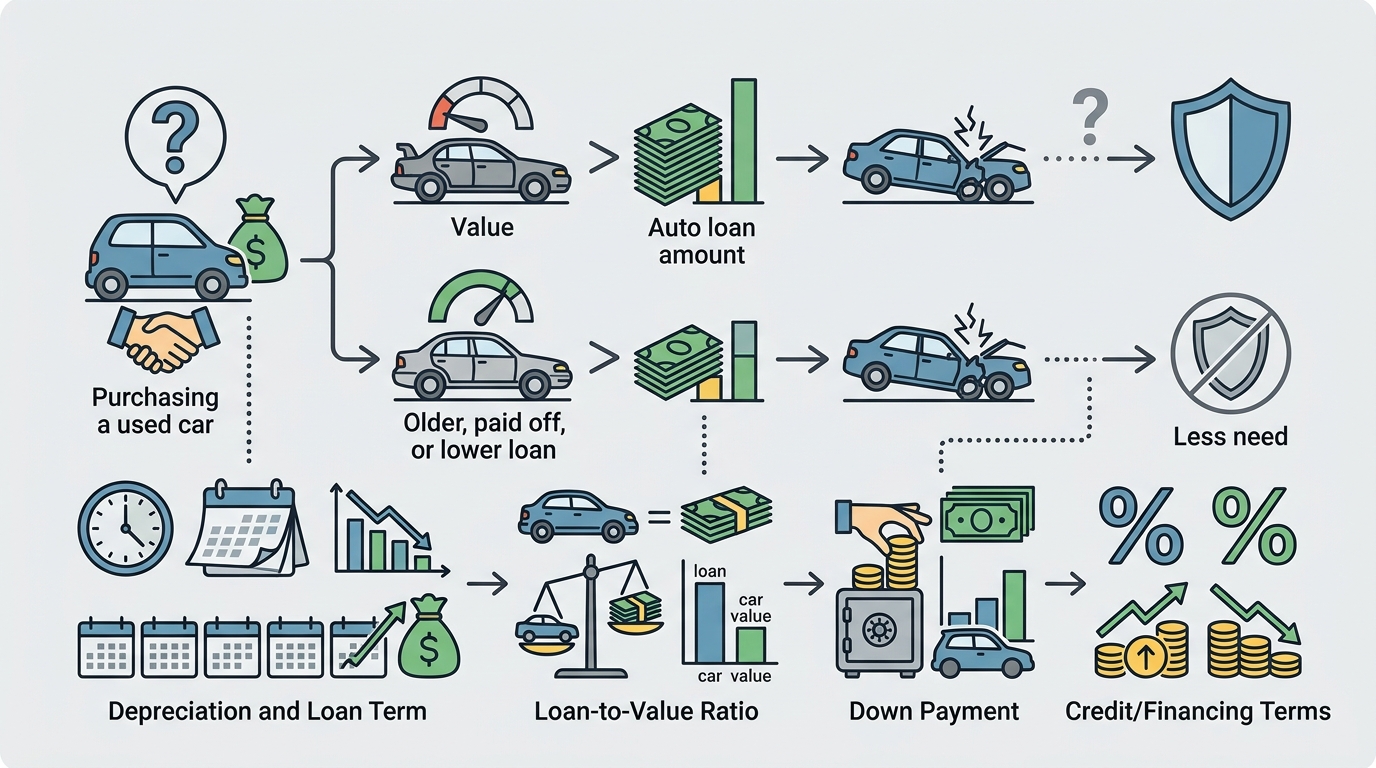
Gap insurance pays the difference between your car's actual cash value and what you still owe on the loan or lease if the car is totaled or stolen (Progressive, undated). On a used car, you need it only when your payoff balance is higher than the car's market value — which usually comes down to a long loan term, a small down payment, or negative equity rolled over from your last car.
You can check this yourself with two documents: a payoff quote from your lender and your policy's declarations page. If the payoff is lower than the car's value, gap coverage has nothing to pay.
What This Situation Means for Your Coverage
Gap insurance is not a standalone product. It sits on top of your comprehensive and collision coverage and only triggers when the car is stolen or declared a total loss and the outstanding loan balance exceeds what your primary auto insurer pays (empeople, undated). The insurer settles at actual cash value; gap covers the shortfall between that payout and the balance (Progressive, undated).
That is why you cannot buy gap coverage while carrying only state-minimum limits. Minimum liability is usually liability-only and does not cover your own vehicle, so there is no physical damage settlement for gap to supplement — comprehensive and collision have to be on the policy first (AIS Insurance, 2023-07-26).
The obligation can come from three different places, and they are not interchangeable:
- Your lender. Lenders may require gap insurance on long-term car loans, with the Insurance Information Institute citing terms of five years or longer (Insurify, undated). If it is required, the requirement is written into your retail installment contract, not into state law.
- Your lease. On a leased vehicle, gap coverage is usually rolled into the lease payments already, so buying a second gap product duplicates it (Triple-I, undated).
- Your state. Gap rules differ by state. Some states require it, and car dealers are sometimes required to offer it (eInsurance, undated). Whether that applies to you is a question for your state insurance department, not something you can assume from another state's rule.
Gap also has hard edges. It does not cover additional charges such as excessive lease mileage fees or finance charges on a loan (Insurify, undated). Read the endorsement or the dealer addendum before assuming a specific charge is included.
Do You Need It? Quick Check
Check each against your own paperwork — the retail installment contract, the lease agreement, a current payoff quote, and your declarations page. The more that are yes, the stronger the case for gap coverage.
- Your financing contract shows a term of 60 months or more (Triple-I, via eInsurance, undated).
- Your buyer's order shows a down payment of less than 20 percent of the purchase price (Triple-I, via AutoInsurance.com, undated).
- The amount financed on your contract includes negative equity carried over from a previous car loan (Triple-I, via eInsurance, undated).
- A payoff quote from your lender, requested today, is higher than the car's actual cash value or the insured value shown on your policy.
- Your declarations page already lists both comprehensive and collision coverage — without them, gap cannot be added (AIS Insurance, 2023-07-26).
- Your lease agreement does not already include a gap waiver rolled into the monthly payment (Triple-I, undated).
- You have been paying on the car for less than two to three years, the point at which most owners can drop the coverage (AutoInsurance.com, undated).
Your Next Steps
- This week: get a written payoff quote. Call your lienholder's loan servicing line and ask for a payoff amount with a good-through date. Compare it to the actual cash value or stated value on your declarations page. If the payoff is lower, stop here — gap has nothing to pay.
- Same week: read the financing or lease contract. Look for a clause requiring gap coverage, and for a gap waiver already bundled into a lease (Triple-I, undated). If the dealer sold you a gap product at signing, find the addendum and its cancellation clause before buying a second one.
- Before your next renewal date: call your insurer's policy service line. Ask whether gap is available as an endorsement on your policy and whether your car's model year is eligible — eligibility for gap added after purchase commonly depends on model year (Allstate, undated). Confirm comprehensive and collision are already on the policy.
- Before you accept a dealer gap contract: price both. Buying gap from an insurance company often costs less than buying it from a dealership (Triple-I, via Allstate, undated); added to an existing auto policy it can cost as little as $20 per year (Triple-I, via Insuranceopedia, undated).
- If a state requirement is unclear: contact your state insurance department. States differ on whether gap is required and whether dealers must offer it (eInsurance, undated); only your state's regulator can tell you which applies.
- At each renewal: re-run the comparison. Drop the endorsement once the payoff falls below actual cash value — generally after two to three years of ownership (AutoInsurance.com, undated).
Coverage Options Compared
| Option | What it costs | How you buy and cancel it | Limits to check |
|---|---|---|---|
| Gap endorsement on your auto policy (offered as part of a car insurance policy by insurers including Allstate, undated) | Can be as little as $20 per year added to an existing policy (Triple-I, via Insuranceopedia, undated) | Added by your insurer; eligibility can depend on the vehicle's model year (Allstate, undated). Removed at renewal or mid-term by calling the insurer | Requires comprehensive and collision already in force (AIS Insurance, 2023-07-26) |
| Dealer or lender gap contract | Buying from an insurance company often costs less than buying from a dealership (Triple-I, via Allstate, undated), and is typically financed into the loan | Sold at signing; cancellation and any refund follow the addendum's own terms, not your insurer's | Does not cover finance charges on the loan (Insurify, undated) |
| Gap built into a lease | Usually rolled into the lease payments rather than billed separately (Triple-I, undated) | Comes with the lease; not separately cancellable | Does not cover excessive lease mileage fees (Insurify, undated) |
No insurer is cheapest for every driver — gap pricing, like the rest of your premium, is underwritten individually and varies by state, vehicle, limits and the underwriting company your policy sits in. Get the endorsement price in writing from your own insurer before comparing it to a dealer quote.
Questions
I bought the car three months ago and skipped the dealer's gap offer. Can I still add it?
Often yes. You may be able to get gap insurance after buying a car, with eligibility depending on the vehicle's model year, and many insurers offer it as part of a car insurance policy (Allstate, undated). You will need comprehensive and collision already on the policy before gap can be attached (AIS Insurance, 2023-07-26). Call your insurer with the VIN and ask specifically whether your model year qualifies.
If I switch insurers mid-loan, does my gap coverage follow me?
No. A gap endorsement is part of the policy you cancel, so it ends with that policy. Ask the new insurer whether it offers gap at all and whether your car's model year is still eligible (Allstate, undated) before you cancel, and make sure comprehensive and collision are on the new policy too — without them, gap cannot be written (AIS Insurance, 2023-07-26). A dealer-sold gap contract is a separate agreement and follows its own cancellation terms.
My lease already includes gap. Should I buy the endorsement as well?
Check the lease first. For leased vehicles, gap coverage is usually rolled into the lease payments (Triple-I, undated), in which case an endorsement duplicates cover you are already paying for. Note that lease gap does not pay excessive mileage fees (Insurify, undated) — no gap product covers those, so buying a second one will not help.
When is it safe to drop gap on a used car?
When a current payoff quote from your lender comes in below the car's actual cash value. In practice that is generally after two to three years of ownership (AutoInsurance.com, undated), but a 72-month loan with negative equity rolled in can stay underwater longer. Re-check the payoff against your declarations page at each renewal rather than guessing from the calendar.