By the Drivers Compass editors · Updated October 31, 2026
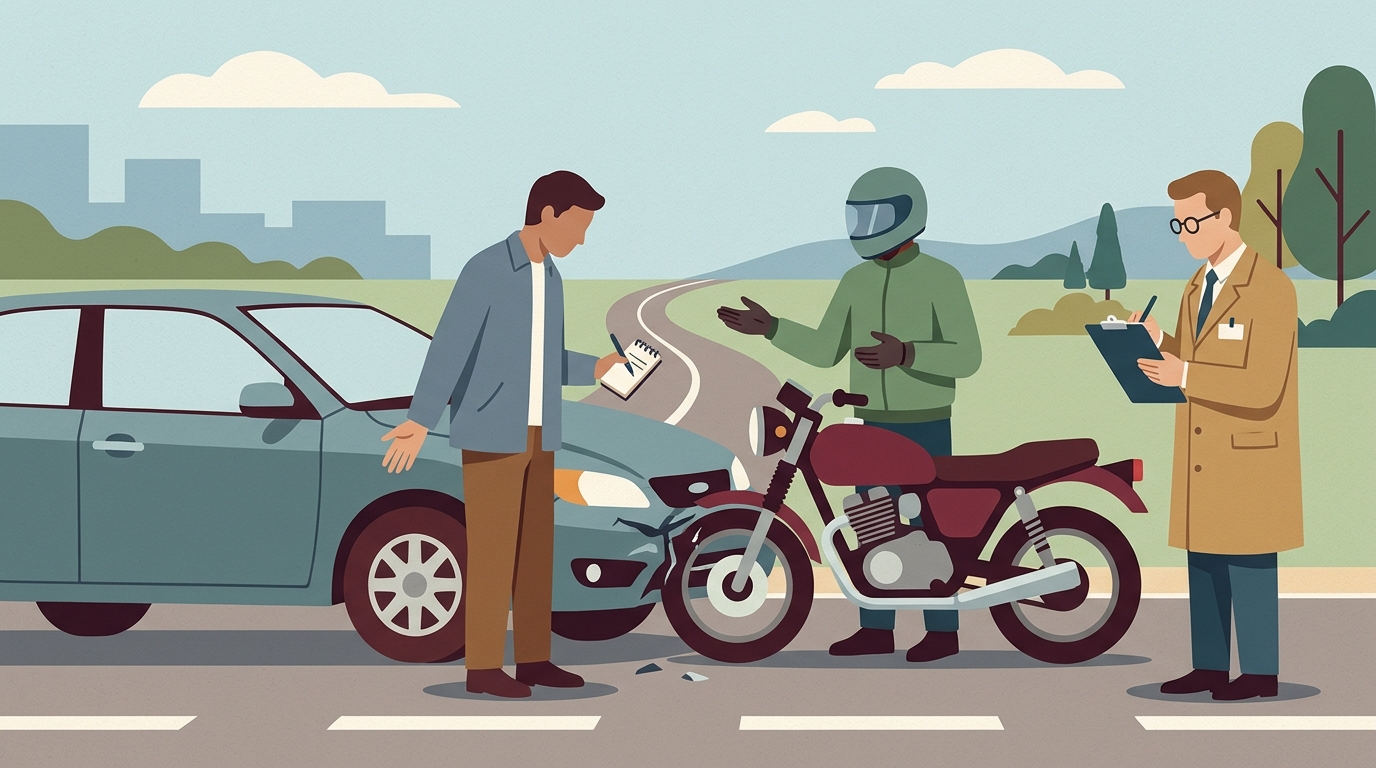
Uninsured motorist coverage pays you the damages you could have collected from an at-fault driver who carried no liability insurance or who illegally left the scene of the crash (Insurance Information Institute (Triple-I), undated). It is first-party coverage — your own insurer pays you — but it responds only when the other driver is legally at fault, so it stands in for the liability policy that driver should have bought.
Twenty states and the District of Columbia have mandatory requirements for uninsured or underinsured motorist coverage (Insurance Information Institute (Triple-I), undated). Everything else — your limits, your deductible, whether two cars' limits combine — turns on your state and your insurer's filed policy form.
What Uninsured Motorist Coverage Actually Pays For
The coverage splits into two parts on most declarations pages, and they pay on different bases.
Uninsured motorist bodily injury (UMBI) pays on a "legally entitled to recover" basis: your insurer pays the compensatory damages — medical bills, lost wages, pain and suffering — you could have won from the at-fault driver, up to your per-person and per-accident limit. It is triggered when that driver has no auto liability insurance or illegally leaves the scene of the crash (Insurance Information Institute (Triple-I), undated). Underinsured motorist bodily injury (UIMBI) covers the adjacent case: the at-fault driver is insured, but for an insufficient amount (Connecticut General Assembly, Office of Legislative Research, 2013).
Uninsured motorist property damage (UMPD), where a state allows it, pays for damage to your vehicle on an actual cash value (ACV) basis — pre-loss market value less depreciation — subject to a deductible.
A constructed illustration, not filed loss data. Illinois is an at-fault (tort) state, so the uninsured driver's fault has to be established. Your policy carries the state-mandated UMBI minimums of $25,000 per person and $50,000 per accident, and UMPD with the $250 maximum deductible Illinois insurers may apply (Illinois Department of Insurance, cited by NextCarReview, undated). An uninsured driver runs a light and is found at fault. Your medical bills and lost wages run past the $25,000 per-person cap: your insurer pays $25,000, and the balance is uncollected unless you pursue the driver personally — usually the reason they were uninsured. Your car is paid separately under UMPD, at actual cash value less the $250 deductible.
Limits from two vehicles can sometimes be combined. With $30,000 in uninsured motorist liability limits and a second vehicle carrying $20,000, in a state that does not prohibit stacking, $60,000 would be available for a claim with an uninsured driver (Insurance Information Institute (Triple-I), via Insurance Business Magazine, undated). Whether stacking is permitted or barred depends on your state and the filed form.
What It Doesn't Cover
- Crashes where you are the at-fault driver. The coverage responds only when the other driver is at fault and uninsured, or is a hit-and-run driver (Connecticut General Assembly, Office of Legislative Research, 2013). Your own injuries come from medical payments, personal injury protection, or health insurance.
- Collisions with an identified driver carrying adequate liability limits. Those are paid by that driver's liability insurer; underinsured motorist coverage responds only once those limits are insufficient (Connecticut General Assembly, Office of Legislative Research, 2013).
- Repairs to your own car under the bodily injury part. UMBI pays injury damages only. Vehicle damage needs UMPD — not sold in every state — or collision coverage.
- A hit-and-run you did not report to police in time. Most states require the accident to be reported to police within 24 to 72 hours for an uninsured motorist claim to qualify, and the statute of limitations for filing the claim is a separate deadline (MoneyGeek, undated).
- Mechanical breakdown unrelated to a collision, such as a failed transmission or a blown engine.
- Racing or competitive driving, and damage caused intentionally by you or a household member.
- Injuries in a vehicle you own but did not list on the policy. The owned-but-not-insured exclusion in most filed forms bars those claims.
- Punitive or exemplary awards, where the form limits recovery to compensatory damages. Read the "uninsured motor vehicle" definition in your own policy — including whether a no-contact "phantom vehicle" qualifies — before assuming a scenario is covered.
Typical Limits and Deductibles
| Limit or deductible option | What it means in a claim | Approximate premium effect |
|---|---|---|
| UMBI at $25,000 per person / $50,000 per accident (required in every New York policy, New York DFS cited by NextCarReview, undated; the same mandated minimums in Illinois, Illinois Department of Insurance via NextCarReview, undated) | Injury damages from an uninsured or hit-and-run driver are paid up to $25,000 for one person and $50,000 for all injured persons; the excess is uncollected unless you sue the driver | Illustrative example only, not a rate filing: the smallest line on the declarations page, a fraction of the bodily injury liability premium |
| UM and UIM built into a state minimum package — Vermont 25/50/10, Virginia 25/50/20, West Virginia 20/40/10 with UM required (Connecticut General Assembly, Office of Legislative Research, 2013) | The mandated UM limits track the state's liability minimums, so raising liability generally raises UM with it | Illustrative example only, not a rate filing: bundled into the mandated minimum premium rather than priced as an add-on |
| Stacked UM across two vehicles — $30,000 plus $20,000 giving $60,000 available where stacking is not prohibited (Insurance Information Institute (Triple-I), via Insurance Business Magazine, undated) | Each insured vehicle's limit combines for a single claim, where state law and the filed form permit it | Illustrative example only, not a rate filing: rated separately and priced above non-stacked UM where offered; barred outright in some states |
| UMPD with a $250 deductible (statutory in Texas, QuoteFii blog, undated; the maximum Illinois insurers may apply, Illinois Department of Insurance via NextCarReview, undated) | Vehicle damage caused by an uninsured at-fault driver is paid at actual cash value less $250 | Illustrative example only, not a rate filing: cheaper than collision for the same car, as it responds only to uninsured at-fault drivers |
| Collision coverage instead of UMPD | Pays actual cash value repair cost less your collision deductible regardless of fault or the other driver's insurance | Illustrative example only, not a rate filing: the larger of the two premiums, since it covers your own at-fault crashes too |
UM pricing is individually underwritten. The same limits are rated differently by state, zip code or territory, vehicle, driving record, insurer and underwriting company within that insurer, and — where the state permits it — credit-based insurance score.
Is It Required, and By Whom
State law. Twenty states and the District of Columbia have mandatory requirements for uninsured or underinsured motorist coverage (Insurance Information Institute (Triple-I), undated). A legislative review counted twenty-two jurisdictions requiring UM — Connecticut, the District of Columbia, Illinois, Kansas, Maine, Maryland, Massachusetts, Minnesota, Missouri, Nebraska, New Hampshire, New Jersey, New York, North Carolina, North Dakota, Oregon, South Carolina, South Dakota, Vermont, Virginia, West Virginia and Wisconsin — with fourteen also requiring UIM: Connecticut, Maine, Maryland, Massachusetts, Minnesota, Nebraska, New Jersey, North Carolina, North Dakota, Oregon, South Dakota, Vermont, Virginia and Wisconsin (Connecticut General Assembly, Office of Legislative Research, 2013). The mandate sits in each state's insurance code and financial responsibility law; confirm the current text with your state department of insurance, as these lists move by legislative session.
The form of the requirement differs. New York requires every policy to include UMBI at $25,000 per person and $50,000 per accident for two or more people (New York DFS, cited by NextCarReview, undated). Illinois mandates the same minimums, requires UIM if you buy higher UM limits, and requires insurers to offer UMPD (Illinois Department of Insurance, cited by NextCarReview, undated). Maryland and New Jersey each require uninsured motorist bodily injury, uninsured motorist property damage and underinsured motorist bodily injury (Allstate, undated).
Two states do not compel insurance at all but regulate what a purchased policy contains. In New Hampshire and Virginia, auto insurance is not mandatory, but a policy, once bought, must include uninsured motorist coverage (Insurance Business Magazine, citing Insurance Information Institute (Triple-I), undated); in New Hampshire that requirement includes underinsured motorist bodily injury as well (Allstate, undated). Virginia drivers who go without insurance pay an Uninsured Motorists Vehicle fee to the Department of Motor Vehicles instead (Connecticut General Assembly, Office of Legislative Research, 2013). Rhode Island does not require UM at the state minimum bodily injury limits, but requires UMBI if you buy higher liability limits (Allstate, undated). In Texas, a driver who does not want the coverage must turn it down in writing (QuoteFii blog, undated).
Lenders and lienholders. A loan or lease contract requires physical damage coverage — comprehensive and collision — to protect the lender's collateral regardless of fault. Uninsured motorist coverage is not a standard lender requirement, and a lender cannot create a state mandate. Read the insurance clause in your loan agreement for what it actually names.
Where it is optional, the U.S. Department of the Treasury's Federal Insurance Office estimates about 14% of U.S. drivers carry no insurance, roughly one in seven (cited by QuoteFii blog, undated). Whether a given limit fits your assets, health coverage and state rules is a decision to take with your agent or an attorney licensed in your state.
Questions
Does uninsured motorist coverage pay for a rental car while mine is repaired?
Not under uninsured motorist bodily injury, which pays injury damages only. Rental reimbursement is a separate coverage bought by daily limit and number of days, and some filed forms also allow loss of use to be claimed as an element of damages recoverable from the at-fault driver. Check your declarations page before you pick up a car, and get the adjuster's answer in writing.
I was hit by a driver who sped off. Can I still claim?
Potentially, because the coverage is designed to respond when the at-fault driver illegally leaves the scene of the crash (Insurance Information Institute (Triple-I), undated). The reporting deadline is the trap: most states require the hit-and-run to be reported to police within 24 to 72 hours for a UM claim to qualify, and the statute of limitations for filing the claim is a separate deadline (MoneyGeek, undated). File the police report first, then open the claim.
Should I claim under UMPD or collision for vehicle damage?
Where both are available, the deductible usually decides it. Texas sells uninsured/underinsured motorist property damage with a statutory $250 deductible, described as usually much lower than a collision deductible (QuoteFii blog, undated), and Illinois caps the UMPD deductible at $250 (Illinois Department of Insurance, cited by NextCarReview, undated). Both pay on an actual cash value basis, so your car's pre-loss market value is the ceiling either way.
If I own two cars, do my UM limits add together?
Only in states that do not prohibit stacking, and only if your insurer's filed form allows it. The Insurance Information Institute gives the example of $30,000 in uninsured motorist liability limits on one vehicle plus $20,000 on a second producing $60,000 available for a single claim in a state that does not prohibit stacking (via Insurance Business Magazine, undated). Ask whether your policy is written as stacked or non-stacked; the two are rated differently.
Can I drop uninsured motorist coverage to save money?
Not in the twenty-two jurisdictions a legislative survey identified as requiring UM, including New York, Illinois, Maryland, New Jersey and West Virginia (Connecticut General Assembly, Office of Legislative Research, 2013). Where it is optional the rejection is usually documented: Texas requires a driver who does not want the coverage to turn it down in writing (QuoteFii blog, undated). Whether dropping it suits your assets and health coverage is a question for your agent, not a general rule.