By the Drivers Compass editors · Updated October 31, 2026
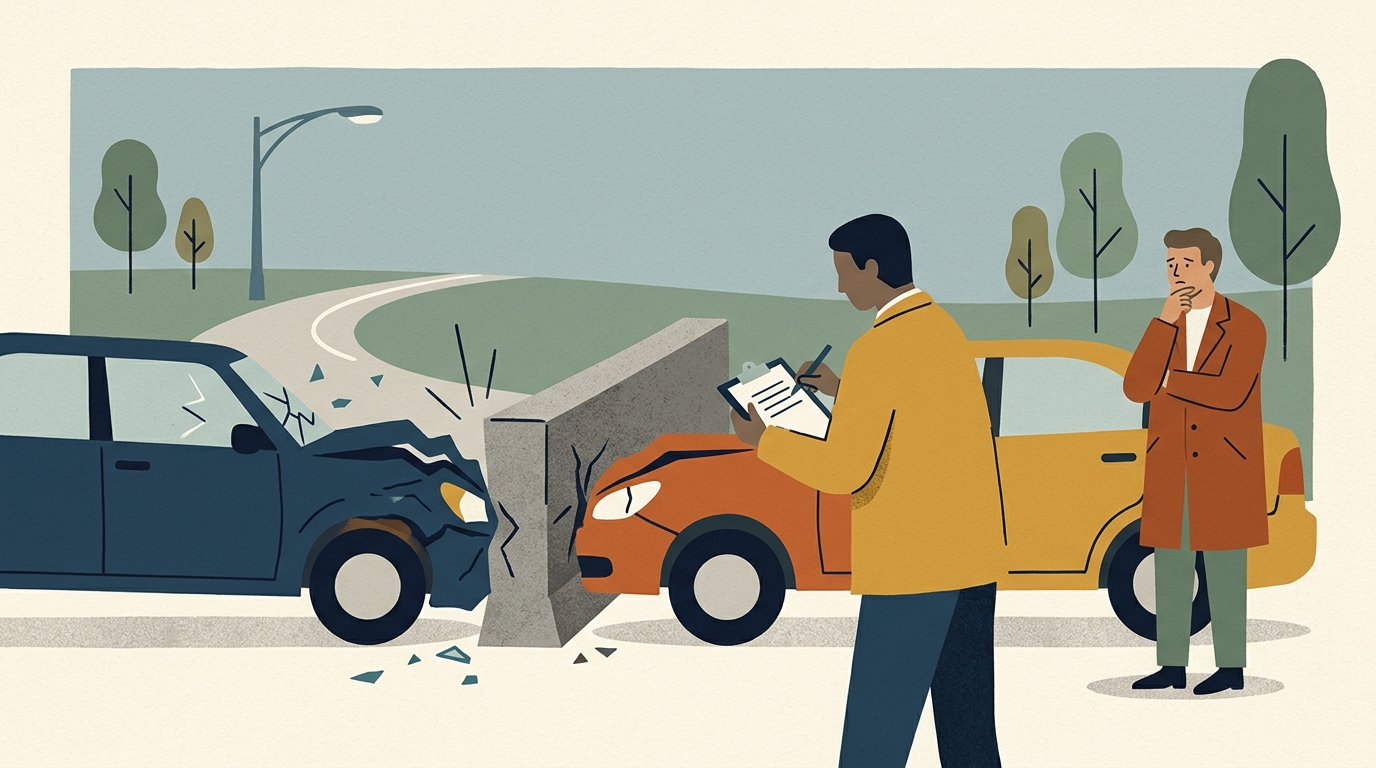
Collision coverage pays to repair or replace your own vehicle after it hits another car or object, or rolls over — up to the car's actual cash value (ACV), meaning its value minus depreciation, and minus the deductible you chose (Allstate, undated; WalletHub, undated). It applies whether or not you were at fault (Progressive, undated).
No state's financial responsibility law requires it (Nationwide, undated). If you have a loan or a lease, the lender requires it as a term of the contract, not as a matter of state law (Allstate, undated).
What Collision Coverage Actually Pays For
Collision coverage pays for physical damage to your own vehicle from impact: another vehicle, a guardrail, a tree, a curb, or a rollover. The payout basis is actual cash value (ACV) — the amount the car was worth immediately before the damage occurred, which is replacement cost reduced by depreciation (WalletHub, undated; Allstate, undated). It is not agreed value and not stated amount. ACV is the ceiling on the payout, and your deductible comes off every collision payment.
Fault does not change whether it responds. In an at-fault (tort) state, if you rear-end someone, your liability coverage pays their vehicle and collision pays yours, less the deductible. If the other driver is at fault, you can still claim on your own collision instead of waiting on their insurer. The deductible applies either way, and if the car is totaled the payout runs up to its actual cash value (Progressive, undated).
One published claim example shows the mechanics. An adjuster assessed a damaged vehicle's actual cash value at $26,500, and because the repair cost came in below that ACV, the insurer did not treat the loss as a total — it paid for the repairs minus the deductible instead (Lemonade, undated). Had the repair estimate exceeded the ACV, the settlement would instead have been the ACV minus the deductible. Whether any particular claim settles that way is decided case by case under your insurer's filed policy language.
What It Doesn't Cover
- Theft of the vehicle, hail, flood, falling objects and vandalism. Collision is listed as excluding theft, weather and vandalism (CarGurus, undated). Those are comprehensive (other-than-collision) perils, bought separately and carrying their own deductible.
- Mechanical breakdown and wear-and-tear failures. Collision, comprehensive and property damage liability all exclude mechanical breakdowns; only mechanical breakdown insurance (MBI) pays for mechanical failure repairs (AutoInsurance.com, undated). A transmission that dies on the highway is excluded; an engine destroyed because you struck a light pole is collision damage, because it stems from a covered impact (The Zebra, undated).
- Crashes during street racing, stunt driving or other illegal activity. A collision policy will not cover an accident resulting from street racing or stunt driving (Lemonade, undated), and racing or stunt work requires separate motorsport event insurance (The Zebra, undated).
- Rental car expenses while your car is being repaired. Collision generally does not pay rental costs during repairs (Omega Insurance Group, undated). That is rental reimbursement, a separate endorsement with its own daily and per-claim caps.
- Aftermarket customizations and upgrades. Collision typically covers only original equipment and factory-installed components, not aftermarket wheels, lift kits, audio systems or wraps, without additional custom-equipment coverage (Omega Insurance Group, undated).
- Injuries to you, your passengers or anyone else. Collision pays for property damage to your vehicle only. Medical costs run through medical payments, personal injury protection (mandatory in no-fault states, optional or unavailable elsewhere), or the at-fault driver's bodily injury liability.
- Loan balance above the car's ACV. Because the limit is ACV, a total loss on a financed car can settle for less than the payoff; gap coverage addresses that shortfall and is sometimes required by the loan contract (WalletHub, undated).
Typical Limits and Deductibles
The limit is not something you select. Collision's limit is the vehicle's actual cash value at the time of loss (Allstate, undated). The only real choice is the deductible.
| Option | What it means in a claim | Approximate premium effect |
|---|---|---|
| Limit = actual cash value (fixed, not selectable) | Maximum payout is what the car was worth immediately before the crash, after depreciation (WalletHub, undated) — not what you paid, and not what a replacement costs today | Not a rating choice; the vehicle's value, make, model and year are rated directly |
| Lowest deductible your insurer files in your state | You retain the smallest share of each repair, so smaller damage is still worth claiming | Illustrative, direction only: the highest collision premium of the options here |
| Mid-range deductible | You retain a moderate share of every collision repair before the insurer pays | Illustrative, direction only: priced below the lowest-deductible option |
| High deductible | Minor parking-lot damage can fall entirely beneath it, producing no payout at all | Illustrative, direction only: priced below the mid-range option |
| Highest deductible offered in that state filing | Coverage responds mainly to major damage and total losses | Illustrative, direction only: the lowest collision premium of the options here, where filings permit it |
The deductible amounts actually offered, and the price gap between them, vary by insurer, by the underwriting company within that insurer, by state filing, by zip code or territory, by vehicle make, model and year, by driver age and record, and — in states that permit it — by credit-based insurance score. Several states restrict or ban credit-based insurance scoring in rating. Ask for the same vehicle quoted at two deductibles side by side, and treat the result as an estimate: it is not the premium you will be charged once underwriting is complete and the policy is bound.
Is It Required, and By Whom
State law: not required, anywhere. Collision insurance is not required by state law (Nationwide, undated). State financial responsibility laws mandate liability coverage — and, in no-fault states, personal injury protection — because those pay other people. Collision pays for your own property, so no state mandates it.
California is a worked example. California law does not legally require collision coverage. Its mandated liability minimums were $15,000 for injury or death to one person, $30,000 for injury or death to multiple people, and $5,000 for property damage as of 2024, rising under California Senate Bill 1107 to $30,000 per person and $60,000 per accident, with a stated property damage figure, effective January 1, 2025 (Amicus Legal Group, undated). Every other state sets its own floor under its own statute, and those floors pay for damage you do to others — never your own car. Check your state's Department of Insurance for current figures rather than assuming the California numbers travel.
Lender and lienholder: required by contract. If you owe money on a car loan or lease a vehicle, collision coverage is required by the lender; otherwise it is optional (Allstate, undated). Per the NAIC, a lender requires what is commonly called 'full coverage' — liability plus comprehensive and collision — stacked on top of the state liability floor, and neither comprehensive nor collision is required by state law (Polly, undated). Nearly all lenders require a combination of comprehensive, collision and liability coverage, and in some cases uninsured motorist coverage or gap insurance where the loan contract specifies it, with proof of insurance usually required at loan application (WalletHub, undated).
Because insurance laws differ state to state, no blanket statement covers whether state law obliges you to protect a lienholder with collision and comprehensive (Car Insurance Comparison, undated). Treat the loan or lease agreement as the controlling document: it names the required coverages, any maximum deductible allowed, and the lienholder to be listed. Drop collision while financed and the lender can force-place its own coverage and bill you for it.
Questions
Does collision coverage pay for a rental car while my car is in the shop?
No. Collision generally does not pay rental expenses incurred while a vehicle is being repaired (Omega Insurance Group, undated). Rental reimbursement is a separate endorsement with its own daily limit and per-claim maximum, and it has to be on the policy before the loss. If another driver is at fault, their property damage liability coverage is the other route to a rental.
Do I have to be at fault for collision to pay?
No. Collision applies regardless of whether the policyholder is at fault, and the collision deductible applies either way (Progressive, undated). In an at-fault (tort) state you can claim on your own collision and let your insurer pursue the other carrier; if that subrogation succeeds, insurers commonly refund the deductible, though timing and outcome are decided case by case.
What happens if I owe more on the loan than the car is worth?
Collision's limit is the vehicle's actual cash value — its value minus depreciation (Allstate, undated) — so a total-loss settlement can land below your payoff and you still owe the difference. Gap coverage is the product that addresses that shortfall, and some loan contracts specifically require it (WalletHub, undated). Check your loan agreement for whether gap is already financed into the loan.
My transmission failed after a minor fender bender. Is that covered?
Only if the failure resulted from the impact. Collision, comprehensive and property damage liability all exclude mechanical breakdowns; mechanical breakdown insurance (MBI) is the coverage for mechanical failure repairs (AutoInsurance.com, undated). Damage traceable to a covered impact — an engine wrecked by hitting a light pole — falls under collision, while wear-and-tear failures do not (The Zebra, undated). The adjuster's causation finding decides it.
Can I drop collision on an older car?
If the car is financed or leased, no — collision is required by the lender for the life of the contract (Allstate, undated), and dropping it invites force-placed coverage. If you own it outright, collision is optional under every state's law (Nationwide, undated), and the question is whether the actual cash value you would collect justifies the premium plus the deductible. Get your current collision premium in writing and compare it against a realistic ACV for your year, make and mileage.