By the Drivers Compass editors · Updated October 31, 2026
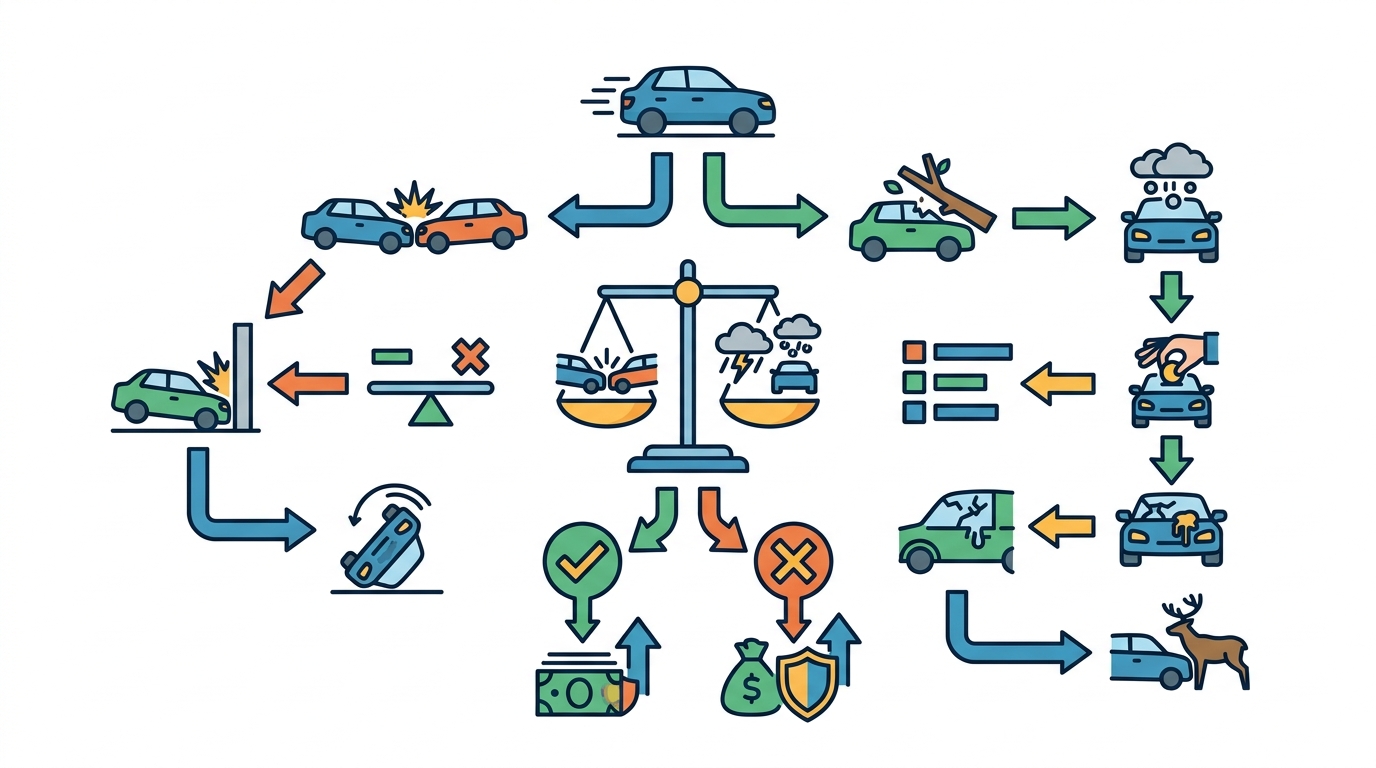
Collision pays when your car hits another vehicle or an object, or rolls over. Comprehensive pays when the damage comes from almost anything else: theft, fire, hail, flood, vandalism, falling branches, broken glass, or contact with an animal. Fault is not the test for either one — the cause of loss is, and each coverage carries its own deductible.
Both are optional under state law everywhere, though a lender or lessor can require them by contract. Nearly four out of five drivers buy them anyway (Insurance Information Institute (Triple-I), undated).
Side-by-Side Comparison
Five axes, both coverages, no blanks.
What triggers payment
- Collision: your car collides with another vehicle or an object — telephone pole, guard rail, mailbox, tree — or flips over. Pothole damage counts; mechanical failure and wear and tear to the car or its tires from bad roads do not (Insurance Information Institute (Triple-I), undated).
- Comprehensive: a cause other than a collision — contact with animals, fire, riot, vandalism, theft of the whole car or of parts such as an airbag, falling objects including trees, branches and ice, broken windshield, and natural disasters including earthquake, flood, hurricane, tornado and volcanic eruption (Insurance Information Institute (Triple-I), undated; NAIC, undated).
Payout basis
- Collision: repair cost minus your deductible (Insurance Information Institute (Triple-I), undated). On an older car, once the repair cost exceeds what the car is worth, the insurer totals it and pays what the car was worth rather than fixing it (NAIC, undated).
- Comprehensive: identical mechanics — repair cost minus the deductible, with a total-loss payment at the car's value when it is stolen or destroyed. Neither coverage pays above market value, which is why gap insurance exists: it covers the difference between a financed or leased car's worth and what is owed on it (Insurance Information Institute (Triple-I), undated).
Typical deductible range
- Collision: you pick it. Triple-I describes typical deductibles as $500 or $1,000 and notes that pothole damage often falls below that figure, making a claim impractical (Insurance Information Institute (Triple-I), undated). With a $500 collision deductible against $2,000 of damage, you pay $500 and the insurer pays the remaining $1,500 (Insurance Information Institute (Triple-I), undated).
- Comprehensive: also chosen by you, set separately from the collision figure on the same declarations page and commonly written lower. Glass and named-storm deductibles are handled differently by state and by insurer, so read the deductible lines on your declarations rather than assuming.
Whether at-fault status matters
- Collision: no. It reimburses damage to your car when you are at fault, when no other driver was involved, and when the other driver is never identified (Insurance Information Institute (Triple-I), undated). In an at-fault (tort) state you may instead claim against the other driver's property damage liability, which carries no deductible for you; liability coverage has no deductible at all (Insurance Information Institute (Triple-I), undated).
- Comprehensive: fault is not an element of the claim in any state. A storm, a thief or a deer has no liability policy to pursue.
Required or optional
- Collision: optional under state law; a lending institution or lessor may require it by contract (NAIC, undated).
- Comprehensive: also not required by law (NAIC, undated), and also commonly required by a lender on a financed car (Insurance Information Institute (Triple-I), undated). Liability is the coverage states compel — every state except New Hampshire requires drivers to buy it (Insurance Information Institute (Triple-I), undated).
On price, Triple-I puts the average cost of collision at about $290 a year and comprehensive at a little over $134 a year, and notes comprehensive costs significantly less than collision (undated). Those averages carry no state, limit, deductible or year, so treat them as relative cost only. What you are charged turns on your state, deductible, vehicle year and model, record, territory, credit-based insurance score where permitted, and the underwriting company inside the insurer.
Which One Pays in Common Scenarios
Each row is a constructed illustration, not filed loss data, and assumes a policy carrying both coverages.
| Scenario | Which coverage pays | Why | Fault and deductible note |
|---|---|---|---|
| Hit a deer on a rural road | Comprehensive | Contact with animals sits on the comprehensive list, not collision (Insurance Information Institute (Triple-I), undated; NAIC, undated) | Fault is not an element in any state; comprehensive deductible subtracted |
| Swerve to avoid a deer and hit a tree | Collision | The car struck an object, so the cause of loss is a collision (Insurance Information Institute (Triple-I), undated) | No other driver to claim against; collision pays regardless of fault |
| Rear-ended at a stoplight | Other driver's property damage liability, or your collision | Collision pays repairs minus your deductible whoever caused it; liability carries no deductible for you (Insurance Information Institute (Triple-I), undated) | Which route depends on whether the other driver is identified and insured, and whether your state routes vehicle damage through tort liability |
| Car stolen from your driveway | Comprehensive | Theft of the entire car is a comprehensive cause of loss (Insurance Information Institute (Triple-I), undated) | Payment is the car's value minus the comprehensive deductible, not what you paid or owe |
| Hail dents the roof and cracks the windshield | Comprehensive | Severe weather and broken glass both fall under comprehensive (NAIC, undated) | Fault irrelevant; a separate glass or wind/hail deductible may be written into your declarations |
| Pothole bends a wheel and control arm | Collision | Pothole damage is collision; tire and suspension wear from bad roads is excluded (Insurance Information Institute (Triple-I), undated) | If the bill is under a typical $500 or $1,000 deductible, filing is impractical (Insurance Information Institute (Triple-I), undated) |
| Tree branch falls on the parked car | Comprehensive | Falling objects including trees, branches and ice are comprehensive causes (Insurance Information Institute (Triple-I), undated) | Fault is not tested; a property owner's liability is separate from your auto policy |
Do You Need Both, One, or Neither
Work through these against your own car, loan balance and state.
- You financed or leased the car. Keep both. The lender or lessor can require collision and comprehensive by contract (Insurance Information Institute (Triple-I), undated; NAIC, undated) — a loan condition, not a state law. Letting either lapse typically triggers force-placed coverage billed to you.
- You owe more than the car is worth. Keep both and price gap insurance, which covers the difference between the car's worth and the balance owed, because collision and comprehensive pay only market value (Insurance Information Institute (Triple-I), undated).
- The car's market value is close to your deductible. Do the arithmetic before renewing: on an older car the insurer totals rather than repairs once repair cost exceeds value (NAIC, undated), so your ceiling is the car's value minus the deductible, against the roughly $290 a year for collision and a little over $134 for comprehensive Triple-I cites as averages (undated).
- You own a recent car outright with real resale value. Keep both. Collision is the only coverage that pays for your own car after a single-vehicle crash, a rollover or a hit-and-run where the other driver is never identified.
- You park outdoors in a hail, flood, wildfire or theft-exposed zip code. Keep comprehensive even if you drop collision: it is what responds to theft, fire, hail, flood and vandalism (NAIC, undated), and it costs significantly less than collision (Insurance Information Institute (Triple-I), undated).
- You carry state-minimum liability only. None of your own car's damage is covered — liability pays other people's property and injuries and carries no deductible (Insurance Information Institute (Triple-I), undated). Dropping both does not relieve the liability requirement, which applies in every state except New Hampshire (Insurance Information Institute (Triple-I), undated).
- You rent cars several times a year. Carrying both coverages on your own car means you likely will not need the rental company's collision damage waiver or loss damage waiver (NAIC, undated) — confirm with your insurer first, because extension to rentals depends on your policy's filed language.
- You are deciding which one to drop. Drop collision before comprehensive: comprehensive is the cheaper of the two (Insurance Information Institute (Triple-I), undated) and covers theft and destruction of the whole car, the loss hardest to self-fund.
Questions
Can one event be paid under both collision and comprehensive?
No. A single loss is classified under one cause and settled under one coverage with one deductible. Where events chain together — you hit a deer, then slide into a pole — the insurer assigns the loss to one cause, and that choice determines which deductible is subtracted. Separate incidents on different dates are adjudicated separately, each with its own deductible.
If the other driver caused the crash, should I use my collision coverage or their liability?
In an at-fault (tort) state you can claim against the at-fault driver's property damage liability, which carries no deductible for you, or use your own collision, which pays repair cost minus your deductible (Insurance Information Institute (Triple-I), undated). Using your own collision is often quicker where fault is disputed, and your insurer then pursues recovery. No-fault statutes generally govern injury claims rather than vehicle damage, so check your state's rules before assuming.
I have comprehensive but not collision. What happens if I hit a guard rail?
Nothing is paid for your car. Striking an object or rolling over is collision, while comprehensive responds only to non-collision causes such as theft, fire, weather, vandalism, falling objects and animal contact (Insurance Information Institute (Triple-I), undated; NAIC, undated). Your liability coverage still pays for damage you caused to other people's property, with no deductible.
Why was my deer claim paid under comprehensive when my car clearly hit something?
Because contact with animals is written into the comprehensive cause-of-loss list rather than the collision one (Insurance Information Institute (Triple-I), undated; NAIC, undated). That classification often works in your favour, since comprehensive deductibles are frequently set lower than collision deductibles on the same policy. Had you swerved and hit a tree instead, the loss would be a collision and the collision deductible would apply.