By the Drivers Compass editors · Updated October 31, 2026
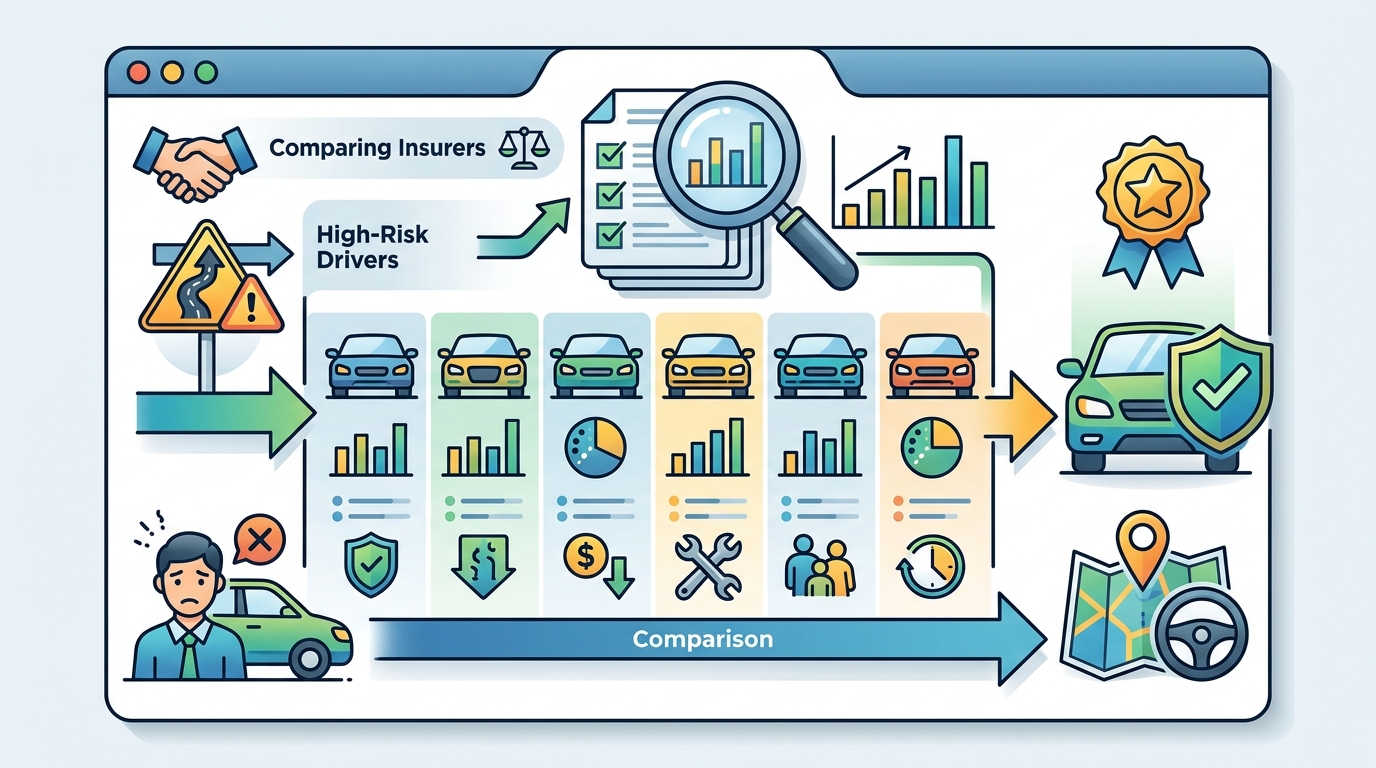
"High-risk" is not one thing. A DUI, three speeding tickets, an at-fault accident with injuries, a long coverage lapse and a brand-new SR-22 filing are five different underwriting problems, and the carrier that prices one of them well often prices the others badly. The seven companies below are the ones most likely to still quote you after a surcharge-triggering event — ranked by how broadly they write high-risk business and file SR-22s, not by price, because no insurer is cheapest for every profile in every zip code.
Use this as a shortlist to quote, not a price list. What you actually pay depends on your state, your limits and deductible, the date of the violation, your vehicle, whether your state is no-fault or at-fault, and — in most but not all states — your credit-based insurance score.
Top Picks at a Glance
No national dollar average appears in this table on purpose. A premium figure is only meaningful attached to a named state, a named set of limits, a deductible, a vehicle and a violation date — and a quote is never the same thing as a bound premium, because underwriting can re-rate you once your motor vehicle report and CLUE loss-history report come back. The last column of each row tells you where to get a number that applies to you.
| # | Insurer | Premium for a surcharged driver — where it comes from | Minimum-limits premium | Named qualifying discount |
|---|---|---|---|---|
| 1 | Progressive | Often rated in a nonstandard underwriting company rather than the preferred book; quote both | Quoted at your state's statutory minimum; pull the comparison figure from your state DOI tool | Snapshot (telematics) |
| 2 | State Farm | Agent-quoted off the filed surcharge schedule for your state; SR-22 filed in most states | Quoted at state minimum; ask the same agent to price higher limits on the same application | Drive Safe & Save |
| 3 | GEICO | Direct quote; some DUI and multi-violation profiles are declined and referred out | Quoted at state minimum; declines are more common on the harder profiles | DriveEasy |
| 4 | USAA | Military, veterans and eligible family only — an eligibility gate, not a price gate | Quoted at state minimum | SafePilot |
| 5 | Dairyland | Nonstandard specialist built around SR-22 and FR-44 filings, including non-owner policies | Minimum-limits and monthly-pay policies are the core product | Multi-car discount |
| 6 | The General | Nonstandard; accepts lapses and multiple violations other carriers decline | Minimum-limits focus, low down-payment options | Good Student discount |
| 7 | Bristol West | Nonstandard Farmers subsidiary, sold through independent agents; common SR-22 market | Minimum-limits focus | Paid in Full discount |
Order reflects breadth of high-risk acceptance and filing support, in the same order the write-ups below appear. It is not a price ranking, and the state table further down shows why a single ranking cannot be one.
Why Each Insurer Made the List
- Progressive. It supports SR-22 filings in most states that use them and quotes drivers with DUIs and multiple violations directly online, which matters when you have days to get a filing in before a suspension starts. Snapshot gives you a route to a lower renewal rate. The trade-off: Progressive frequently rates high-risk applicants through a nonstandard company inside the group, so the number you see is not the preferred-book number, and in some states Snapshot data can raise the rate as well as lower it.
- State Farm. Drive Safe & Save and the Steer Clear program for younger drivers both give a surcharged driver something to actively earn back, and the agent can show you the filed surcharge schedule for your state instead of a black-box figure. Limitation: State Farm writes through captive agents, and acceptance after a DUI or a recent at-fault injury claim is underwritten case by case. Some offices take little new high-risk business, which is a distribution limit rather than a pricing one.
- GEICO. Direct quoting lets you test the profile in minutes, and DriveEasy is available in a growing but still incomplete list of states. The caveat is acceptance rather than price: GEICO declines a share of DUI and multi-violation applicants outright and may refer them to an unaffiliated nonstandard carrier. A referral is not a GEICO policy, and the referred premium is set by whoever actually writes it, under that company's own filed rates.
- USAA. If you are eligible, quote it after any surcharge event; SafePilot is its telematics program. The hard limit is eligibility — active duty, veterans and certain family members only — so nothing about a good quote here transfers to a reader who cannot join. Eligibility also does not exempt you from the SR-22 filing requirement, from your state's look-back period, or from re-underwriting at renewal once a new violation lands on your motor vehicle report.
- Dairyland. A nonstandard carrier that treats SR-22 and FR-44 filings as a routine product rather than an exception, including non-owner filings for drivers with no vehicle, and it writes monthly-pay policies with low down payments. The trade-off is coverage depth: these policies are usually sold at state-minimum limits with a thin menu of optional coverages, and the cost per dollar of liability protection is higher than a standard carrier charges a clean driver.
- The General. It accepts coverage lapses, multiple violations and prior cancellations that standard carriers decline, and quotes without requiring prior continuous insurance. That acceptance is the product. The cost side: policies are commonly written at minimum limits on frequent installment billing, and once your violation ages past the look-back window in your state's filed schedules, requoting standard carriers is usually what lowers the price rather than staying put.
- Bristol West. As Farmers' nonstandard brand it is a common landing spot for SR-22 business, and because it is distributed through independent agents, one agent can quote it against several other nonstandard carriers in a single sitting on identical limits. The limitation: sitting inside the Farmers group does not mean you can move into a Farmers preferred policy automatically. That is a separate underwriting decision made when your record improves.
How Rates Differ by State
Statutory minimums, filing rules and whether credit may be used in rating at all are set state by state, and they reorder this list more than any brand preference does. Progressive, listed first above, is routinely undercut by Dairyland, The General or Bristol West in Texas and Florida for drivers with an active SR-22 — and in California it cannot use the credit-based insurance score that helps it price some surcharged drivers elsewhere. Treat the last column as the place to get the cheapest-carrier answer for your own profile, because the state regulator publishes those comparisons for exactly this purpose.
| State | Fault system | What moves a high-risk price here | Carriers that typically compete hardest | Where the state publishes comparison figures |
|---|---|---|---|---|
| California | At-fault | Credit-based insurance scoring is banned in auto rating; driving record and years licensed carry more weight; a low-cost state program exists for income-eligible drivers | Standard carriers stay competitive; nonstandard brands have less room to undercut | California Department of Insurance premium comparison tool; California Low Cost Auto program |
| Texas | At-fault | Credit permitted in rating; a deep nonstandard market competes on SR-22 filings | Dairyland, The General, Bristol West | HelpInsure.com, run by the Texas Department of Insurance |
| Florida | No-fault | PIP is required and bodily injury liability is not, so the minimum policy is structurally different; a DUI triggers an FR-44 that forces higher liability limits than the ordinary minimum | Nonstandard specialists dominate FR-44 business | Florida Office of Insurance Regulation premium comparison |
| New York | No-fault | Drivers declined in the voluntary market can be placed through the New York Automobile Insurance Plan, where the plan sets the rate rather than competition | Standard carriers, then the assigned-risk plan | Department of Financial Services annual premium comparison |
| Michigan | No-fault with PIP choice | Since the 2019 reform you select a PIP level, which changes the premium independently of your record | Varies by territory; quote both standard and nonstandard | DIFS consumer rate comparison |
The cheapest insurer in a given state is decidable only against a fixed profile — same limits, same deductible, same zip code, same violation date — which is what the state tools above are built to let you run.
What This Situation Does to Your Premium
A surcharge is not a penalty an adjuster decides on. It is a multiplier filed in advance with your state's insurance department, generally through the SERFF filing system, and applied to the base rate for your territory and vehicle. That is why the same ticket adds a very different dollar amount in two zip codes: the multiplier is the same, the base it multiplies is not.
The multipliers themselves come from loss experience. Insurers build them from their own claim data plus industry aggregates — the NAIC Auto Insurance Database Report for countrywide premium and loss patterns, and Highway Loss Data Institute reports for collision and injury loss results by vehicle make, model and year. HLDI's work is why two drivers with identical records and identical limits can be surcharged differently: the vehicle's own claim history is a separate rating variable from your record.
Three mechanics decide what a violation costs you:
- The look-back period. Filed surcharge schedules rate a violation for a set number of years from the conviction or accident date, then drop the multiplier at renewal. The length is set in each carrier's filing for each state, so ask for it rather than assuming. It is also separate from how long the violation stays on your driving record, which is set by your state's motor vehicle agency and is usually longer.
- The filing, which is not the surcharge. An SR-22 is a certificate your insurer files with the state proving you carry at least the statutory minimum. The filing charge itself is a flat administrative fee; the expense is that filing identifies you as a surcharge-class risk. Florida's FR-44 goes further and requires liability limits above the ordinary minimum for the filing term.
- Tier placement. Many groups move a surcharged driver from a preferred underwriting company into a nonstandard one. That is a change of rate manual, not a change of discount, and it usually outweighs any single discount you can add back.
A coverage lapse works differently from a violation. It removes the prior-insurance or continuous-coverage credit that standard carriers apply, which is why a clean-record driver with a gap can be quoted above a driver with a ticket and no gap.
How to Qualify for the Best Rate
- Pull your own motor vehicle report from your state's licensing agency and request your CLUE loss-history report before you shop, so you know which violations and claims a carrier will see and when each one falls outside the look-back window.
- Ask each quoting carrier, in writing, which underwriting company the policy would be issued in — preferred or nonstandard — and what would have to change for you to move back into the preferred company.
- Ask whether accident forgiveness is available to you at all, and whether it carries a waiting period or a clean-record requirement. In many filings it cannot be added after the accident that triggered the surcharge.
- Have the SR-22 or FR-44 filed by the carrier you expect to keep for the full filing term. A mid-term cancellation triggers an SR-26 notice to the state and can restart a suspension.
- Quote at least one nonstandard specialist against at least one standard carrier on identical limits and the same deductible, so the comparison is decidable instead of a guess.
- Price higher liability limits, such as 100/300/100, next to your state's statutory minimum on the same quote, and get the minimum from your state insurance department rather than from a carrier's sales page.
- Enroll in a telematics program by its actual name — Snapshot, Drive Safe & Save, DriveEasy or SafePilot — and confirm in the program terms whether your state permits the rate to increase as well as decrease on the data.
- Diary the date your violation ages out of the look-back period your carrier quoted you, and requote standard carriers the month before the renewal that follows it.
Questions
How long will a DUI keep my rate elevated?
Three clocks run at once, and they end at different times. The state sets how long the SR-22 or FR-44 filing must stay in force; your carrier's filed surcharge schedule sets how long the multiplier applies from the conviction date; and your motor vehicle agency sets how long the conviction remains visible on your record, which is typically the longest of the three. Ask a State Farm agent to show you the filed schedule for your state, and ask Progressive or GEICO which underwriting company you are being quoted in — a tier move can keep the price up after the surcharge itself drops off.
Can my current insurer drop me once I file an SR-22?
It can non-renew you at the end of the term in most states, and the required advance notice is set by state law rather than by the insurer, so check your state insurance department's rules rather than the carrier's call-center answer. That is the market Dairyland, The General and Bristol West serve — they write the business standard carriers shed. If no voluntary carrier will take you, several states run a residual market, such as the New York Automobile Insurance Plan, which issues at minimum limits at a rate the plan sets.
Does a coverage lapse hurt as much as a ticket?
It can, and it works through a different lever. A ticket adds a filed surcharge multiplier; a lapse removes the prior-insurance or continuous-coverage credit a standard carrier would otherwise apply, and some standard carriers will not quote a new-business applicant with no prior insurance at all. The General quotes without requiring prior continuous coverage, which is why it appears here. If your lapse came with a registration suspension, resolve that with your motor vehicle agency first — a carrier can file the SR-22 but cannot clear the suspension for you.
How do I check a high-risk carrier's complaint record before I buy?
Use the NAIC Consumer Information Source, which publishes a complaint index scaled to each company's premium volume, so a result above the baseline median means more complaints than its market share would predict. Look up the specific underwriting company named on your quote rather than the brand, because a group's nonstandard subsidiary — Bristol West inside Farmers, for example — files separately from the preferred company. Pair that with your state insurance department's own complaint statistics, which reflect claim handling under that state's rules rather than countrywide totals.