By the Drivers Compass editors · Updated October 31, 2026
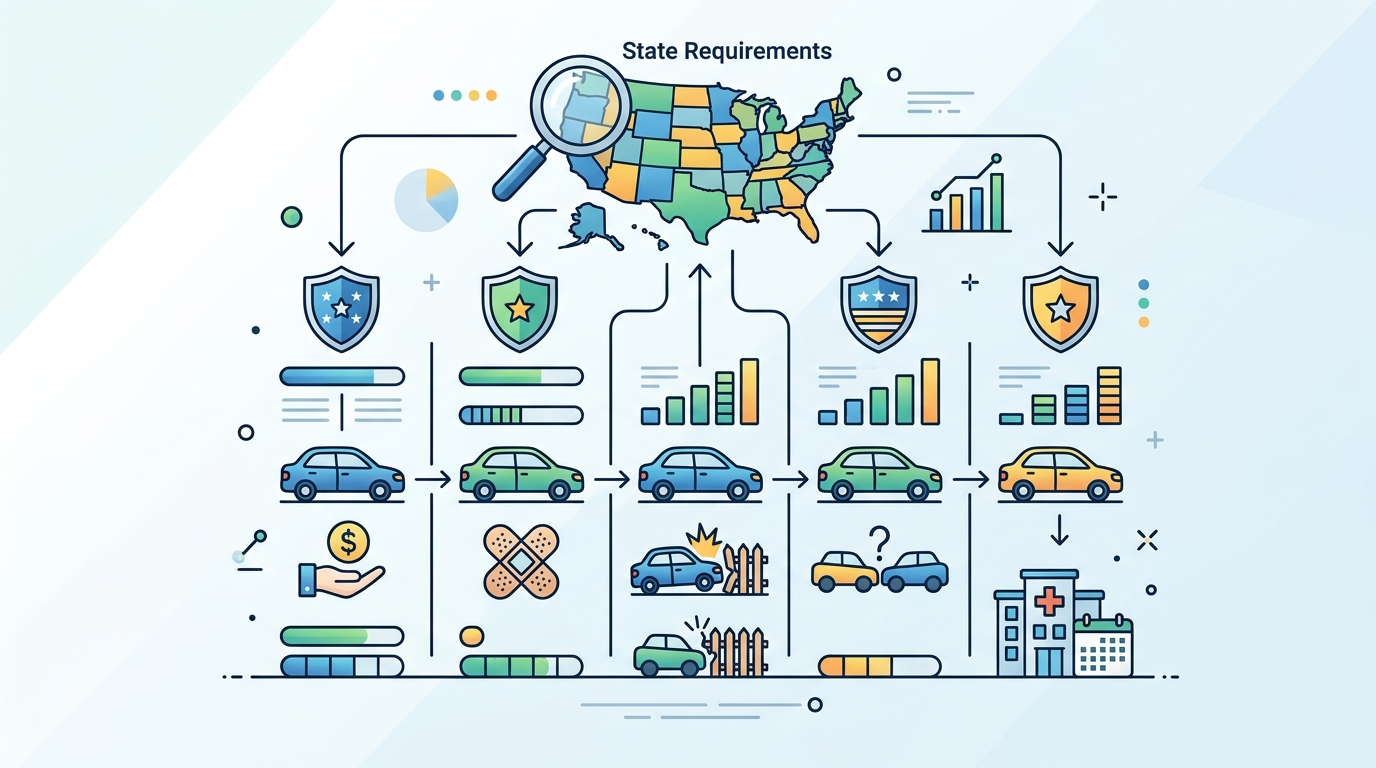
Every state except New Hampshire requires drivers to carry liability car insurance, though some let you post another form of financial responsibility instead (MoneyGeek, 2026). What that liability requirement looks like varies enormously: Florida requires $10,000 of personal injury protection and $10,000 of property damage liability with no bodily injury coverage at all, while Alaska, Maine, Michigan, North Carolina and Virginia require $50,000 per person and $100,000 per accident (MoneyGeek, 2026).
On top of the split limit, your state may also require personal injury protection, uninsured motorist coverage, or medical payments — and whether you sue the other driver or claim on your own policy depends on whether you live in a no-fault or an at-fault state. This guide compares those rules side by side.
Minimum Liability Limits, All 50 States
Splits are written the way your state writes them — bodily injury per person / bodily injury per accident / property damage, in thousands. Where a split is shown, it comes from the Insurance Information Institute's state minimum liability table (rev. 7/2024), reproduced via the Independent Insurance Agents & Brokers of America risk education page, or from the later statutory change noted in that row. Where a row says "see state guide," the figure is not reproduced here; check the state's own statute or DMV financial-responsibility schedule before you buy, because several legislatures have revised their minimums since 2023.
The PIP column follows the twelve PIP-mandate states identified by WalletHub (2026) and AAA. "Add-on" marks the states where PIP sits alongside an at-fault system and may be required or optional depending on the statute — Arkansas, Delaware, Maryland, New Hampshire, Oregon, South Dakota, Texas, Virginia, Washington and Wisconsin (Jerry).
| State | Bodily Injury/Property Damage Split | PIP Required (Y/N) | UM/UIM Required (Y/N) |
|---|---|---|---|
| Alabama | 25/50/25 (Insurance Information Institute, 2024-07) | N | N |
| Alaska | 50/100/25 (Insurance Information Institute, 2024-07) | N | N |
| Arizona | See state guide | N | See state guide |
| Arkansas | See state guide | Add-on | See state guide |
| California | 30/60/15, up from 15/30/5 effective January 2025 (Bankrate, 2025) | N | See state guide |
| Colorado | See state guide | N | See state guide |
| Connecticut | See state guide | N | See state guide |
| Delaware | 25/50/10 (Insurance Information Institute, 2024-07) | Y — $15,000/$30,000 PIP (Insurance Information Institute, 2024-07) | N |
| District of Columbia | 25/50/10 (Insurance Information Institute, 2024-07) | N | Y (UM) |
| Florida | 10/20/10 — PD liability and PIP, no BI required (Insurance Information Institute, 2024-07) | Y — $10,000 (MoneyGeek, 2026) | N |
| Georgia | See state guide | N | See state guide |
| Hawaii | See state guide | Y | See state guide |
| Idaho | See state guide | N | See state guide |
| Illinois | See state guide | N | See state guide |
| Indiana | See state guide | N | See state guide |
| Iowa | See state guide | N | See state guide |
| Kansas | 25/50/25 (Insurance Information Institute, 2024-07) | Y | Y (UM and UIM) |
| Kentucky | See state guide | Y (choice) | See state guide |
| Louisiana | See state guide | N | See state guide |
| Maine | 50/100/25 plus medical payments (Insurance Information Institute, 2024-07) | N | Y (UM and UIM) |
| Maryland | See state guide | Add-on | See state guide |
| Massachusetts | See state guide | Y | See state guide |
| Michigan | $50,000 per person/$100,000 per accident BI (MoneyGeek, 2026); PD see state guide | Y | See state guide |
| Minnesota | See state guide | Y | See state guide |
| Mississippi | See state guide | N | See state guide |
| Missouri | See state guide | N | See state guide |
| Montana | See state guide | N | See state guide |
| Nebraska | See state guide | N | See state guide |
| Nevada | See state guide | N | See state guide |
| New Hampshire | 25/50/25 if you satisfy the Motor Vehicle Financial Responsibility Law by buying insurance (Nolo, 2024-02-07) | Add-on | See state guide |
| New Jersey | See state guide | Y (choice) | See state guide |
| New Mexico | See state guide | N | See state guide |
| New York | See state guide | Y — $50,000 per person (Coverage Criteria, 2026) | See state guide |
| North Carolina | 50/100/50 effective July 1, 2025 (Insurance Journal, 2025-01-15) | N | See state guide |
| North Dakota | See state guide | Y | See state guide |
| Ohio | See state guide | N | See state guide |
| Oklahoma | See state guide | N | See state guide |
| Oregon | See state guide | Add-on | See state guide |
| Pennsylvania | See state guide | Y (choice) | See state guide |
| Rhode Island | See state guide | N | See state guide |
| South Carolina | See state guide | N | See state guide |
| South Dakota | See state guide | Add-on | See state guide |
| Tennessee | See state guide | N | See state guide |
| Texas | See state guide | Add-on | See state guide |
| Utah | 50/100/25, up from 30/60/20 under House Bill 113, passed 2023 (Bankrate, 2025) | Y — $3,000 under Utah Code 31A-22-307 (LegalClarity) | See state guide |
| Vermont | See state guide | N | See state guide |
| Virginia | 50/100/25, up from 30/60/20 as phase two; insurance was not a legal requirement before July 2024 (Bankrate, 2025) | Add-on | See state guide |
| Washington | See state guide | Add-on | See state guide |
| West Virginia | See state guide | N | See state guide |
| Wisconsin | See state guide | Add-on | See state guide |
| Wyoming | See state guide | N | See state guide |
These are legal minimums only. A lender or lessor will normally require comprehensive and collision coverage with a stated maximum deductible for as long as there is a loan on the car — that is a contract term, not a state law, and it is enforced by force-placing coverage rather than by the DMV. Keep the two lists separate when you are deciding what to buy.
No-Fault vs. Tort States
Which system your state uses decides who you file the injury claim with first, and whether you can sue for pain and suffering at all.
- Pure (mandatory) no-fault — Florida, Hawaii, Kansas, Massachusetts, Michigan, Minnesota, New York, North Dakota and Utah. You file your own injury bills with your own PIP coverage regardless of who caused the crash, and you can only step outside that system and sue the other driver once your injuries or costs clear the state's threshold.
- Choice no-fault — New Jersey, Pennsylvania and Kentucky. These three are among the twelve PIP states but let drivers choose between a no-fault policy and a traditional liability policy (WalletHub, 2026), so where your injury claim goes depends on which option you selected when you bought the policy, not just on where you live.
- At-fault/tort — the remaining states and the District of Columbia: Alabama, Alaska, Arizona, Arkansas, California, Colorado, Connecticut, Delaware, Georgia, Idaho, Illinois, Indiana, Iowa, Louisiana, Maine, Maryland, Mississippi, Missouri, Montana, Nebraska, Nevada, New Hampshire, New Mexico, North Carolina, Ohio, Oklahoma, Oregon, Rhode Island, South Carolina, South Dakota, Tennessee, Texas, Vermont, Virginia, Washington, West Virginia, Wisconsin and Wyoming. You claim against the at-fault driver's bodily injury liability coverage and retain the right to sue, which is why the per-person BI limit in the table matters more here than anywhere else.
Some of those tort states run PIP as an "add-on": Arkansas, Delaware, Maryland, New Hampshire, Oregon, South Dakota, Texas, Virginia, Washington and Wisconsin (Jerry). Delaware, for example, requires $15,000/$30,000 of PIP alongside 25/50/10 liability (Insurance Information Institute, 2024-07) — you get first-party medical coverage without losing the right to sue.
Regional Patterns in Coverage Requirements
The clearest pattern in the table is not geographic — it is chronological. A cluster of states has moved to a 50/100 bodily injury floor in the space of three years: Utah, up from 30/60/20 under House Bill 113, passed in 2023; Virginia, up from 30/60/20 to 50/100/25 as phase two of its overhaul, in a state where insurance was not even a legal requirement before July 2024 (Bankrate, 2025); and North Carolina's jump to 50/100/50 effective July 1, 2025 (Insurance Journal, 2025-01-15). California made a smaller move in the same direction, from 15/30/5 to 30/60/15 effective January 2025 (Bankrate, 2025). They join Alaska and Maine, which already sat at 50/100/25 (Insurance Information Institute, 2024-07).
The plausible driver is that a fixed dollar limit erodes. A per-person bodily injury limit written into statute decades ago buys progressively less emergency treatment, surgery and lost-wage reimbursement each year, and property damage limits in single digits of thousands no longer total a late-model vehicle. Legislatures do not index these numbers, so they sit still until a bill moves them in one step — which is why the increases arrive as single jumps rather than annual drift. North Carolina is a useful check on the assumption that higher minimums simply mean higher prices: the state still ranks in the middle of the pack for full-coverage insurance rates despite having among the highest minimums in the country (Insurance Journal, 2025-01-15).
The second pattern is that the lowest liability floors sit in states that handle injuries elsewhere. Florida requires no bodily injury liability at all, just $10,000 of PIP and $10,000 of property damage liability (MoneyGeek, 2026), because the no-fault system is meant to absorb the first layer of injury cost. The District of Columbia pairs a 25/50/10 split with mandatory uninsured motorist coverage (Insurance Information Institute, 2024-07), and Kansas requires UM, UIM and PIP on top of 25/50/25 (Insurance Information Institute, 2024-07) — in both, the protection is built into your own policy rather than the other driver's. Read the liability split and the first-party requirements together; neither column tells you much alone.
None of this makes a state minimum adequate for your situation. Whether 25/50/25 or 50/100/50 leaves you exposed depends on your assets, your medical coverage, the cars you share the road with and what your own policy says.
Look Up Your State's Full Requirements
Each state guide sets out the statutory split, any PIP or uninsured motorist mandate, proof-of-insurance rules and penalties, and notes any change still phasing in.
Northeast
- Connecticut requirements
- Maine requirements
- Massachusetts requirements
- New Hampshire requirements
- New Jersey requirements
- New York requirements
- Pennsylvania requirements
- Rhode Island requirements
- Vermont requirements
South and Mid-Atlantic
- Alabama requirements
- Arkansas requirements
- Delaware requirements
- District of Columbia requirements
- Florida requirements
- Georgia requirements
- Kentucky requirements
- Louisiana requirements
- Maryland requirements
- Mississippi requirements
- North Carolina requirements
- Oklahoma requirements
- South Carolina requirements
- Tennessee requirements
- Texas requirements
- Virginia requirements
- West Virginia requirements
Midwest
- Illinois requirements
- Indiana requirements
- Iowa requirements
- Kansas requirements
- Michigan requirements
- Minnesota requirements
- Missouri requirements
- Nebraska requirements
- North Dakota requirements
- Ohio requirements
- South Dakota requirements
- Wisconsin requirements
West
- Alaska requirements
- Arizona requirements
- California requirements
- Colorado requirements
- Hawaii requirements
- Idaho requirements
- Montana requirements
- Nevada requirements
- New Mexico requirements
- Oregon requirements
- Utah requirements
- Washington requirements
- Wyoming requirements
Questions
Does buying my state's minimum mean I'm properly covered?
It means you are legal, which is a different question. A driver in Florida carrying the state minimum has $10,000 of property damage liability and no bodily injury liability at all (MoneyGeek, 2026), so a serious injury claim against them lands outside the policy almost immediately; a driver in North Carolina carrying 50/100/50 since July 1, 2025 (Insurance Journal, 2025-01-15) has $50,000 of property damage liability and bodily injury coverage besides. Neither figure was set with your assets in mind. Compare the limits you are offered against what a hospital stay and a totaled late-model vehicle actually cost where you drive, and look at uninsured motorist limits too — required in Kansas and the District of Columbia (Insurance Information Institute, 2024-07) but not everywhere.
I'm moving to another state. What actually has to change on my policy?
Both the split and the first-party coverages. Moving from Alabama's 25/50/25 to Alaska's 50/100/25 (Insurance Information Institute, 2024-07) doubles the bodily injury floor you must carry. Moving between no-fault states changes more than that: New York requires $50,000 of PIP per person, the highest fixed PIP minimum of any no-fault state (Coverage Criteria, 2026), while Utah's PIP minimum is $3,000 under Utah Code 31A-22-307 (LegalClarity) — the same label, very different coverage. Tell your insurer your new garaging address before you move; your premium is rated on the new territory and the policy may have to be rewritten on a different form entirely.
How often do these minimums change?
Often enough that a figure you looked up two years ago may be wrong. California moved from 15/30/5 to 30/60/15 effective January 2025 and Virginia from 30/60/20 to 50/100/25 after insurance became a legal requirement there in July 2024 (Bankrate, 2025); Utah's increase to 50/100/25 came through House Bill 113 in 2023 (Bankrate, 2025) and North Carolina's 50/100/50 took effect July 1, 2025 (Insurance Journal, 2025-01-15). Meanwhile Alabama's 25/50/25 and Delaware's 25/50/10 (Insurance Information Institute, 2024-07) have not moved in the same window. Check the statute or DMV schedule for your state at renewal rather than assuming last year's limits still satisfy it.
My lender says I need full coverage — is that a state requirement?
No. State law sets liability, and in some places PIP or uninsured motorist: Kansas requires bodily injury and property damage liability plus PIP, UM and UIM at 25/50/25 (Insurance Information Institute, 2024-07), while New Hampshire does not require insurance at all, only that owners satisfy the Motor Vehicle Financial Responsibility Law — and those who choose insurance to do so must carry at least 25/50/25 (Nolo, 2024-02-07). Comprehensive and collision appear in neither state's statute; they appear in your loan or lease contract, and the lender enforces them by force-placing coverage, not by suspending your registration. Drop them and you have a contract problem, not a licensing one.