By the Drivers Compass editors · Updated October 31, 2026
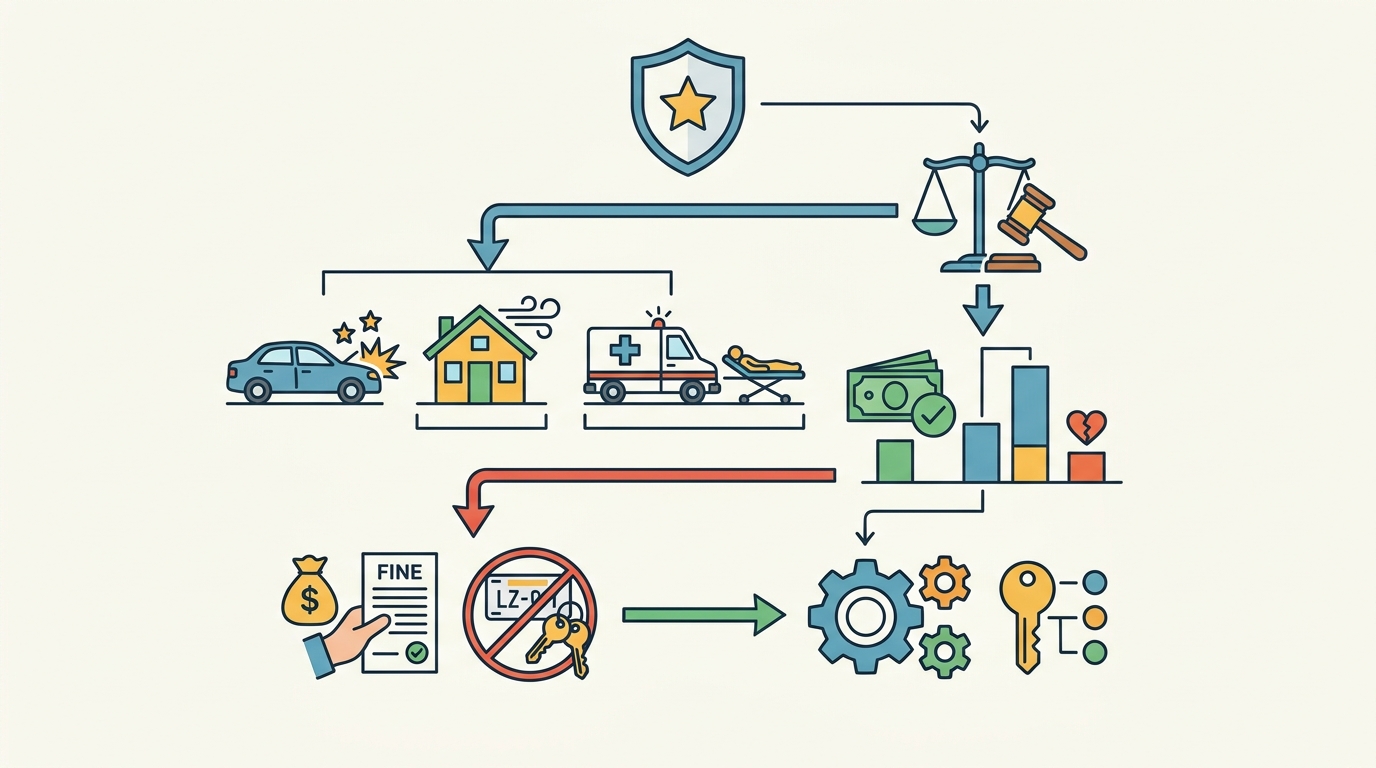
California requires every registered vehicle to carry bodily injury liability and property damage liability coverage, set out in the split-limit format of per-person bodily injury / per-accident bodily injury / property damage (Cal. Veh. Code § 16056; Cal. Ins. Code § 11580.1b). The legislature has amended those limits, so confirm the figures that apply to your policy's issue or renewal date with the California DMV or the California Department of Insurance before you buy.
California is an at-fault (tort) state. There is no Personal Injury Protection mandate, and liability coverage pays third parties only — your own injuries and your own vehicle are paid from medical payments, uninsured motorist, collision and comprehensive coverage, each optional, each with its own limit, and collision and comprehensive each with a deductible.
Minimum Coverage Limits by Type
Each row names the source of the requirement. Ask the DMV or your insurer for the current numeric limit tied to your policy date; the statute has been amended on a phased schedule.
| Coverage | Required in California? | Source of the requirement | What it pays and to whom |
|---|---|---|---|
| Bodily injury liability, per person | Yes | Cal. Veh. Code § 16056; Cal. Ins. Code § 11580.1b | Pays medical costs, lost wages and general damages owed to one injured third party, capped at the per-person limit for that person. No deductible. Damages above the cap are your personal liability. |
| Bodily injury liability, per accident | Yes | Same statutes | Caps the total paid to all injured third parties in one accident, no matter how many people are hurt, while any single person is still capped at the per-person limit. |
| Property damage liability | Yes | Same statutes | Pays to repair or replace the other party's vehicle, fence or structure, capped per accident. Repair cost above the cap is yours to pay. |
| Personal Injury Protection (PIP) | No | No California statute imposes a PIP mandate; California has no no-fault statute | Your injuries are recovered from the at-fault driver's bodily injury liability coverage, or from your own optional medical payments or uninsured motorist bodily injury coverage. |
| Uninsured/underinsured motorist (UM/UIM) | Not mandatory; must be offered, rejection must be in writing | Cal. Ins. Code § 11580.2(a) | UM bodily injury pays your injury damages, capped at the UM limit you bought, when the at-fault driver is uninsured, underinsured or a hit-and-run. |
| Medical payments (MedPay) | No | No California statute requires it | Pays medical bills for you and your passengers up to the limit you buy, without a fault determination and without a deductible on most filed forms. |
A financial responsibility deposit or self-insurance certificate filed with the DMV can substitute for a policy under Cal. Veh. Code § 16021, but that route is uncommon for individual drivers.
If you have a loan or lease, collision and comprehensive are normally required by the lienholder's contract, not by California law. Those are two separate obligations. Dropping lender-required coverage can trigger force-placed insurance under your loan agreement even though the Vehicle Code would let you register and drive without it.
What Happens If You Don't Carry the Minimum
These consequences are set by statute. Court fines in California also carry mandatory penalty assessments added under Cal. Penal Code § 1464 and Cal. Gov. Code § 76000, which raise the amount owed above the base fine by a multiplier that varies by county — ask the court clerk for the total rather than assuming the base figure is what you pay.
- Fine for failing to show evidence of insurance. Cal. Veh. Code § 16028(a) requires you to carry evidence of financial responsibility and present it to a peace officer on demand. Cal. Veh. Code § 16029 sets a fine range for a first offense and a higher range for a later offense within the period that statute defines, before penalty assessments.
- Vehicle impoundment. Cal. Veh. Code § 16029(c) allows the court to order the vehicle impounded, with towing and storage charges billed to you.
- License suspension after an uninsured accident. If you are in a crash reportable to the DMV under Cal. Veh. Code § 16000 — any injury, any death, or property damage above the dollar threshold in that section — and you had no liability coverage in force, the DMV suspends your driving privilege under Cal. Veh. Code § 16070 for the period that section sets.
- SR-22 filing to reinstate. Reinstatement after a § 16070 suspension requires your insurer to file an SR-22 certificate with the DMV under Cal. Veh. Code §§ 16430–16431 and keep it in force for the statutory period. If the policy lapses, the insurer notifies the DMV under § 16431 and the suspension resumes.
- Registration suspension. Cal. Veh. Code § 4000.37 ties registration to electronic insurance reporting by your insurer. If no coverage is reported, the DMV can suspend the registration, and a vehicle with suspended registration can be towed under Cal. Veh. Code § 22651.
- Loss of non-economic damages. Proposition 213, codified at Cal. Civ. Code § 3333.4, bars an uninsured driver from recovering pain-and-suffering damages from an at-fault driver, even when the other driver is entirely at fault.
Coverage That's Common but Not Required
None of the following is mandated by California law. A California-specific percentage of drivers carrying each one is not available to cite here from NAIC or California Department of Insurance data, so no take-up share is given for any of them rather than estimated for some.
- Collision. Pays to repair your vehicle after impact with another vehicle or object, or a rollover, regardless of fault, capped at the vehicle's actual cash value and reduced by your deductible. Actual cash value is depreciated value, not replacement cost.
- Comprehensive (other than collision). Pays for theft, fire, hail, falling objects, glass breakage, flood and animal strikes, capped at actual cash value and reduced by your deductible. Wildfire damage to a vehicle falls under comprehensive, not collision.
- Uninsured motorist bodily injury. Must be offered at limits up to your liability limits and can be rejected only in writing (Cal. Ins. Code § 11580.2(a)). Pays your injury damages up to the UM limit you bought when the at-fault driver is uninsured, underinsured or a hit-and-run.
- Uninsured motorist property damage. Pays for damage to your car caused by an identified uninsured driver, capped at the limit set in Cal. Ins. Code § 11580.2(p)(4). It cannot be used when the striking vehicle is unidentified.
- Medical payments. Pays medical bills for you and your passengers up to the limit purchased, with no fault determination and no deductible on most filed forms.
- Rental reimbursement and towing/labor. Pay a stated daily and per-claim maximum for a rental, and a stated per-tow maximum, and only when the underlying loss is itself covered.
- Gap coverage. Pays the difference between the actual cash value settlement on a total loss and the loan or lease balance. It is a lender-driven purchase, never a state requirement.
- Rideshare or delivery endorsement. A standard personal auto policy excludes driving while logged into a transportation network company app once a passenger is matched or on board. Whether an endorsement closes that gap depends on the filed form your insurer uses — read it.
One California-specific rating note: Proposition 103 (Cal. Ins. Code § 1861.02) prohibits credit-based insurance scoring in private passenger auto rating and makes driving safety record, annual miles driven and years of driving experience the mandatory primary rating factors. Most states permit credit-based insurance scores, so quotes you compare from other states will not be built the same way.
placeholder
placeholder
Questions
I just moved to California. How long do I have to get a California policy?
New residents must register the vehicle in California within the period set by Cal. Veh. Code §§ 4152.5 and 6700, and proof of California-compliant liability coverage is part of registration under Cal. Veh. Code § 4000.37. There is no separate grace period allowing you to drive uninsured — the § 16028 duty to carry evidence of financial responsibility applies the moment you drive on a California highway. Tell your insurer the date you became a resident, because an out-of-state policy's limits and forms may not satisfy § 16056.
Does my California policy cover me if I crash in Nevada or Arizona?
Standard California liability forms contain an out-of-state coverage clause that raises your liability limits to the minimum required by the state where the accident happened when that state's minimum is higher. That clause lives in the insurer's filed policy form, not in the Vehicle Code, so read your own form before relying on it. Fault rules change at the state line too — the other state's negligence rules govern the claim, not California's.
Does a photo of my insurance card on my phone count as proof?
Yes. Cal. Veh. Code § 16028(b) permits display of evidence of financial responsibility on a mobile electronic device to a peace officer, and the officer may view only the insurance information on the device. Note that the DMV separately verifies coverage through electronic reporting under § 4000.37, so a card in your phone does not help if your insurer has already reported a lapse.
My insurer cancelled my policy. Does the state find out?
Yes. Insurers report policy terminations electronically to the DMV under Cal. Veh. Code § 4000.37, which can lead to registration suspension and a DMV notice. If you are under an SR-22 filing from an earlier Cal. Veh. Code § 16070 suspension, § 16431 requires the insurer to notify the DMV of the lapse and the suspension can resume. Replace the coverage before the termination date, not after.